Bloomberg reporter: INLIS cost and design make non-caveated GCB deals impractical for public search
Bloomberg reporter Low De Wei testified that non-caveated GCB deals are functionally "secret" due to the cost and design of Singapore's INLIS database. Unlike the browsable REALIS system, INLIS requires specific addresses and per-search fees, which Low called "prohibitively expensive". He admitted searches are "possible" but require significant effort.


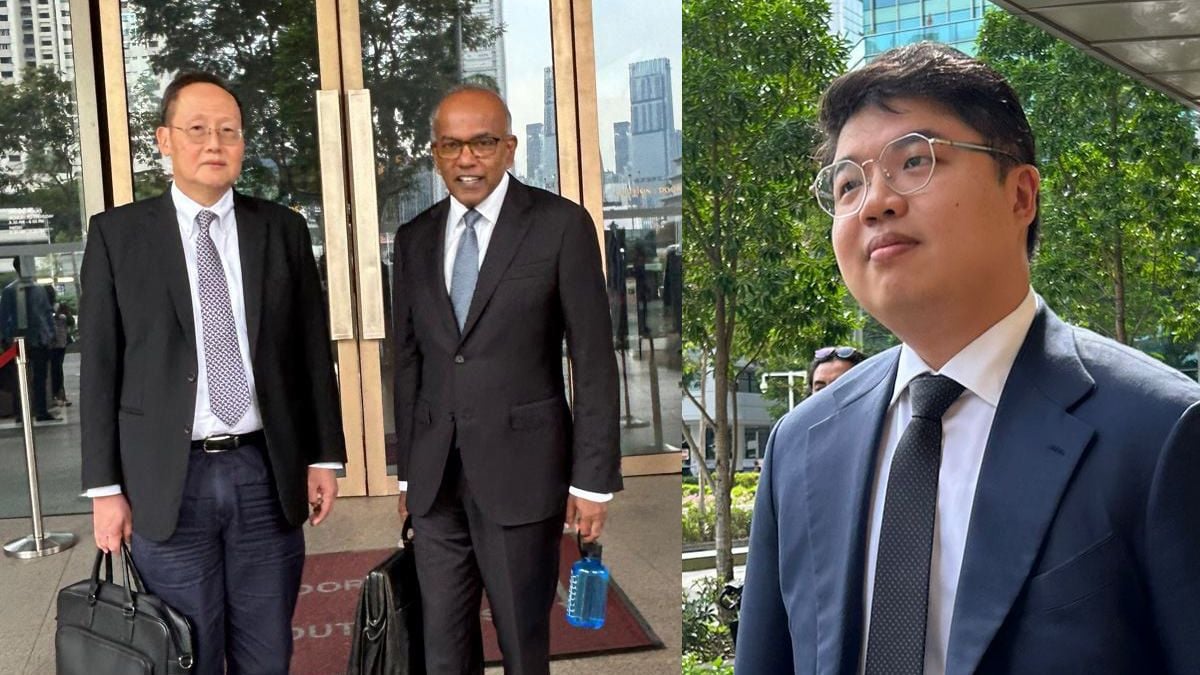
The fifth day of the defamation trial brought by ministers K. Shanmugam and Tan See Leng against Bloomberg L.P. and reporter Low De Wei, also known as Dexter, opened on Monday, 13 April 2026, before Justice Audrey Lim at the Singapore High Court, with over 30 members of the public and media present.
The suit arises from an article published by Bloomberg on 12 December 2024, headlined "Singapore Mansion Deals Are Increasingly Shrouded in Secrecy." Shanmugam, who serves as Minister for Home Affairs and Law, and Tan See Leng, the Minister for Manpower, allege the article falsely implied they had conducted their respective Good Class Bungalow transactions non-transparently by exploiting gaps in Singapore's property disclosure framework. The article referenced Shanmugam's sale of his former home in the Queen Astrid Park area to UBS Trustees for S$88 million, and Tan See Leng's non-caveated purchase of a bungalow in Brizay Park for approximately S$27.3 million, both transacted in 2023. Both ministers deny any impropriety.
Both Shanmugam and Tan See Leng had already completed their testimony during the first four days of the trial and were released as witnesses. Monday marked the first occasion on which Low, the reporter who wrote the article and the second defendant in the proceedings, took the witness stand.
Madeleine Lim released after brief re-examination
Proceedings commenced with a brief re-examination of Madeleine Lim, a senior executive editor at Bloomberg News and the company's first witness.
Senior Counsel Sreenivasan Narayanan, appearing for Bloomberg, clarified the circumstances under which the article's paywall had been removed. Lim confirmed the paywall was lifted only for the specific article and not for Bloomberg's website as a whole.
The removal arose from a technical issue with the article's mobile version: because the mobile and desktop versions shared a single paywall configuration, removing access restrictions for mobile required removing them for the article across all platforms.
Lim also confirmed that a link to the government's Factually rebuttal had been placed prominently above the article following the issuance of a correction direction. This banner remained in place until 20 January 2026, when Bloomberg was permitted to remove it from the website, though not from the article itself.
Sreenivasan took Lim to an internal Bloomberg email dated 24 September 2024, which had featured in the ministers' case. The email involved Chanya, a reporter from Bloomberg's finance team, and Low, who was in the real estate team. Lim described the document as part of a brainstorming exercise in which different people contributed different ideas and angles, with no single definitive position taken.
Asked directly whether Bloomberg had targeted Shanmugam in its coverage, Lim said it had not. Lim was released from the witness stand.
Procedural matter on calling Low as a witness
Before Low took the stand, a brief procedural exchange arose over which counsel should conduct his examination-in-chief.
Sreenivasan observed that Low was both a defendant in his own right and a witness whose evidence Bloomberg sought to rely upon. He indicated he could not close Bloomberg's case until Low gave evidence, and proposed to call him as his own witness while avoiding duplication.
Senior Counsel Chelva Retnam Rajah, appearing for Low personally, submitted that the examination-in-chief was properly his to conduct, since Low was primarily a defendant in his own right.
Justice Lim resolved the matter by directing that Rajah should conduct the examination-in-chief for good order. She confirmed she was treating both Sreenivasan and Rajah as having no cross-examination of Low to conduct.
Low's examination-in-chief: a statement of good faith
Rajah took Low through his affidavit of evidence-in-chief within approximately ten minutes. Low confirmed his formal identity as the second defendant in both Originating Claims 11 and 12 of 2025, and verified his affidavit and its exhibits.
In the concluding paragraph of his affidavit, Low had stated that the article did not allege or imply any wrongdoing, illegality or impropriety on the part of either minister, and that he had at all times acted in good faith, motivated by the public interest in transparency and reporting on trends in the Singapore Good Class Bungalow market.
Singh then began his cross-examination. He established at the outset that Low had graduated from the London School of Economics and Political Science, was familiar with the English language, and would have understood the words he chose to use in the article.
INLIS versus REALIS: the cost and discovery distinction
Singh questioned Low on the meaning of words deployed throughout the article, including "cloaking," "opacity," and "shrouded in secrecy." Low confirmed that when he used those terms, he was referring to information not known to the public, not to information withheld from the government.
Singh then walked Low through the operational mechanics of two property databases: the Urban Redevelopment Authority's Real Estate Information System, known as REALIS, and the Singapore Land Authority's Integrated Land Information Service, known as INLIS.
Low explained that by January 2024 — eleven months before the article's publication — he had been aware of three search tools: REALIS, a simplified free version of REALIS accessible at the National Library Board known as PRPT, and INLIS. He confirmed he had himself conducted searches on INLIS before writing the article.
Low drew a clear distinction between the two main systems. REALIS allowed users to search by street name, project name, or postal district, and to browse and narrow results by area and property size. A free access option exists through the National Library Board. Caveated transactions would surface through this browsable process without the user needing to know the specific property address in advance.
INLIS operated differently. A user was required to know the specific property address before beginning a search. The system would then return a property ownership or title information report, from which an instrument reference number could be identified. Only by then conducting a separate search on that specific instrument number could the user retrieve the names of the transferor, the transferee, and the purchase price.
Low confirmed that any member of the public could follow this process, but emphasised it required multiple steps and a per-search payment.
Low stated that a property ownership information search on INLIS cost S$5.25, while a property title information search cost S$16. He described the cumulative cost of searching non-caveated transactions across the market as prohibitively expensive for routine public monitoring.
Singh asked whether the distinction between REALIS and INLIS came down simply to INLIS requiring a larger payment. Low replied: "In practice, yes." But he immediately qualified this, adding that cost alone was not his full argument.
The more fundamental issue, he said, was that a person would need to know what they were looking for before a search on INLIS could begin. Without prior knowledge of a specific property address, a member of the public had no practical entry point into the non-caveated transaction record at all.
Singh sought to collapse this distinction. He put it to Low that the only difference between REALIS and INLIS, for the purposes of the article's secrecy framing, was the payment requirement. He asked: "You are saying because it entails a cost, the information is secret to the public?" Low replied: "Because it entails a significant cost, it is."
The judge intervenes on the secrecy question
Justice Lim intervened to seek a clearer formulation of Low's position. She asked whether what Low was saying was that it was not impossible to conduct a search, but that doing so required effort and money. Low confirmed this, saying: "It is possible, yes."
Justice Lim also pressed Low on whether the court's understanding was accurate: that the difficulty of conducting a search on INLIS was precisely what made non-caveated transactions shrouded in secrecy in the context of the article. Low agreed that this was correct.
Singh noted that searches on both REALIS and INLIS required the user to search by property address rather than by name, meaning neither system allowed a member of the public to search by entering a person's name. Low confirmed this.
Tan See Leng's inclusion in the article
Singh questioned why Tan See Leng's property purchase was included in an article framed around deals shrouded in secrecy, given that Tan had not used a trust structure and his transaction details would have been accessible via the process Low had described.
Low maintained that Tan's purchase was cited as an example of a non-caveated or "off-radar" transaction, not as an example of secrecy in the sense of a deal conducted through a trust.
Singh referred Low to paragraph 6 of the article, which stated that buyers typically paid premiums for "off-radar" transactions in Singapore. He asked whether the reference to off-radar deals in that context was a reference to deals which were shrouded in secrecy. Low agreed.
Justice Lim directed Low to an answer he had given earlier in proceedings, in which he had accepted that the difficulty of conducting a search on INLIS was what made non-caveated transactions shrouded in secrecy in the article's framing. She then asked why Tan See Leng was mentioned.
Low replied that it was as an example of a non-caveated transaction. Justice Lim noted that the article described those ultra-rich individuals named within it as people whose purchases were cloaked in secrecy, and asked whether a reader would not assume that all those named fell within that characterisation. Low accepted that a reader might assume so.
Under continued questioning from Singh and in response to the judge's directions, Low accepted that Tan's non-caveated transaction was included in the article in the context of the article's secrecy framing.
The parliamentary reply and the 'disingenuous' accusation
After a break, Singh turned to two consecutive paragraphs of the published article.
He first established the background. In mid-October 2024, Bloomberg's Singapore bureau chief Andrea had drawn Low's attention to a parliamentary question submitted by then Non-Constituency Member of Parliament Leong Mun Wai, asking about Good Class Bungalow sales to trust companies with foreign beneficiaries.
On 14 October 2024, Low sent six questions to the Singapore Land Authority. He subsequently received the written answer to the parliamentary question provided by then Second Minister for Law Edwin Tong.
That answer, spanning four pages, set out the regulatory framework for landed property acquired through trust companies. It stated that Singapore citizens were not required to seek approval under the Residential Property Act to acquire landed residential property. Where a property was held through a licensed trust company, approval was not required if the beneficiaries were Singaporean.
The SLA tracked all cases where approval was required — specifically where the purchaser was foreign or where beneficiaries of a licensed trust company were foreign. Beyond those cases, the SLA did not collect general data on landed residential properties acquired through trust companies.
Singh established that Low had read and understood this reply at the time. Low confirmed that as of 15 October 2024, he understood from the reply that the government would know whether the beneficiaries of trust companies purchasing property were Singaporean or foreign.
Singh then showed Low a draft of the article dated 15 October 2024, in which the parliamentary reply had been paraphrased to state that the SLA "does not collect general data on landed residential properties acquired through trust companies if the beneficiaries are Singapore citizens."
Singh noted that this framing inserted the words "if the beneficiaries are Singapore citizens" — language that did not appear in paragraph three of the actual parliamentary reply, which addressed foreign beneficiaries and foreign purchasers.
Low said he was not certain whether he or a colleague named Serena had written that paraphrase, and noted the draft had not yet been fact-checked at that stage. Singh pressed Low on whether, given his stated understanding that paragraph three referred to foreign beneficiaries, the insertion of "if beneficiaries are citizens" could have been an accurate paraphrase of that paragraph. Low's answers shifted under questioning.
Singh told Low: "I suggest to you that you are making up your evidence as we go." Justice Lim directed Singh to move on.
Singh proceeded to the two consecutive paragraphs as published. The first, which the article attributed to the Second Minister for Law's parliamentary reply, stated that the SLA did not collect general data on landed residential properties acquired through trust companies if the beneficiaries were Singapore citizens. The second stated: "In essence, that means that property agents and other service providers involved in the transactions are primarily responsible for verifying the identities and source of wealth of Singaporean mansion buyers."
Singh argued that this construction gave readers the false impression that the government did not know the identities of trust beneficiaries who were Singapore citizens, and that responsibility for verifying those identities had been left to private-sector intermediaries. He told Low: "What you did was disingenuous."
Low disagreed. He said what he had written reflected the feedback he had received from the SLA, which he described as having been "very keen" to emphasise the role of property agents and other service providers as the primary gatekeepers for verifying buyers' identities and sources of wealth. He added that his use of "primarily" indicated that these intermediaries were the main parties responsible, not the exclusive ones.
Justice Lim intervened. She stated that she would read the article as an ordinary person, and that the phrase "in essence, that means" in the second paragraph would be understood as drawing a conclusion from the preceding statement.
A reader would link the two paragraphs: because the SLA did not collect such data, it followed that private intermediaries bore primary responsibility. She was not, she said, interested in what Low had understood the SLA's reply to mean, but in what the article communicated to its readers.
Low maintained that "primarily responsible" did not imply that the government lacked knowledge of the beneficiaries' identities. He said that if he had intended to exclude the government entirely, he would have written that private intermediaries were the "only" parties responsible rather than the primary ones.
Singh then asked why Low had selectively conveyed to readers that the government did not know who the beneficiaries were, when the government's own written reply had made clear it tracked all cases where approval was required.
He put to Low: "It becomes quite clear that you have written this piece to convey falsehoods." Low said he completely disagreed.
The hearing was adjourned at 1:00 pm. Cross-examination of Low De Wei is scheduled to continue on Tuesday, 14 April 2026, at 10:00 am.
This report is based on correspondent notes from open court proceedings, supplemented by reports filed by The Straits Times, CNA, Lianhe Zaobao and Mothership. Paraphrased exchanges reflect the order in which proceedings occurred in open court.