Shanmugam, Tan See Leng awarded S$230,000 each in Bloomberg defamation suit
The High Court has ordered Bloomberg L.P. and reporter Low De Wei to pay Minister K Shanmugam and Minister Tan See Leng S$230,000 each in damages, ruling that a December 2024 article on Good Class Bungalow deals defamed both ministers by linking their property transactions to money laundering.
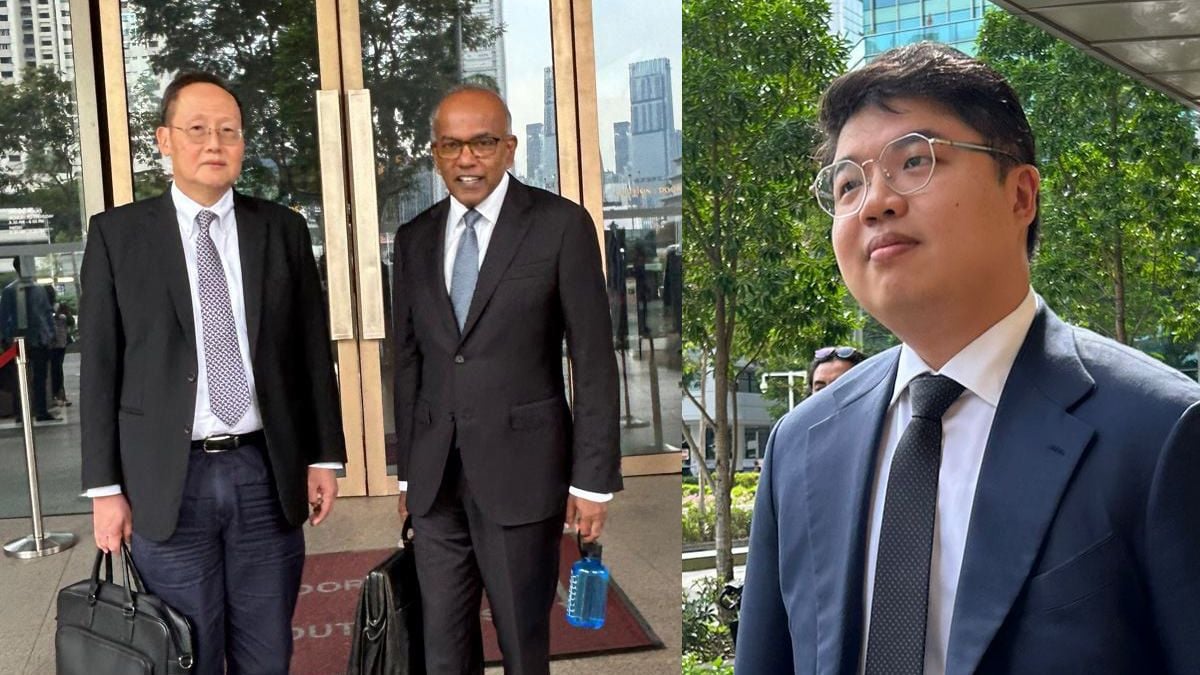
- Court finds Bloomberg article defamed Shanmugam and Tan by implying money laundering links.
- Reynolds privilege defence rejected; not recognised under Singapore law.
- Bloomberg, reporter Low De Wei ordered to pay S$230,000 each to ministers.

The General Division of the High Court has ordered Bloomberg L.P. and its reporter, Low De Wei, to pay Minister for Home Affairs and Coordinating Minister for National Security K Shanmugam and Minister for Manpower Tan See Leng S$230,000 each in damages for defamation.
In a judgment delivered on 14 July 2026, Justice Audrey Lim found that a Bloomberg article published on 12 December 2024, titled "Singapore Mansion Deals Are Increasingly Shrouded in Secrecy," defamed both ministers over their respective Good Class Bungalow (GCB) transactions.
The court held Bloomberg and Low jointly and severally liable for the full damages awarded to each claimant, meaning either defendant could be pursued for the complete sum of S$460,000.
Background to the dispute
The article, authored by Low, examined the market for GCBs, Singapore's most exclusive landed housing category, and reported that close to half of bungalow purchases by value lacked property caveats, filings that make transactions publicly traceable through the Urban Redevelopment Authority (URA) database.
The article named Shanmugam as the seller of a GCB in the Queen Astrid Park area for S$88 million, purchased by an entity called the Jasmine Villa Settlement whose ultimate beneficiary could not be established. It separately named Tan as the buyer of a GCB in Brizay Park for nearly S$27.3 million in a non-caveated transaction.
Both ministers sued Bloomberg and Low, arguing the article falsely implied they had exploited an absence of checks and disclosure requirements to conduct their property deals in a non-transparent manner, and had done so to avoid scrutiny extending to the possibility of money laundering.
Bloomberg and Low contested the claims, maintaining the article addressed broader trends in the GCB market rather than any wrongdoing by the ministers.
Findings on defamatory meaning
Justice Lim found that an ordinary reasonable reader would understand the article to convey that Singapore's system for non-caveated GCB transactions lacked adequate checks, balances or disclosure requirements, allowing such deals to be kept secret.
She noted that the article's headline, its opening bullet point stating "More people buy homes with trusts, hiding owners' identities," and its first paragraph describing "Singapore's ultra-rich" as "cloaking their purchases... in secrecy" collectively created this impression.
The judge rejected Bloomberg's argument that any inference of opacity applied only to public scrutiny and not to the Singapore government. She found the article conveyed that even government authorities were unaware of non-caveated transactions, an impression she later found to be factually false.
Justice Lim held that Tan's transaction, placed under the article's "Non-Caveated Deals" heading, would lead readers to infer he had taken advantage of the absence of a caveat to avoid transparency.
She found readers would similarly understand Shanmugam's transaction, involving a trust with an unidentifiable beneficiary, as an example of using a trust structure to evade scrutiny, regardless of his position as seller rather than buyer.
On the question of money laundering, the judge found the article's references to a S$3 billion money laundering scandal, alongside comparisons to anti-money laundering measures in the United Kingdom and New York, would lead an ordinary reader to conclude that buyers preferring secrecy did so to avoid scrutiny that might extend to money laundering. She found this impression attached to both ministers' transactions.
Reynolds privilege rejected
Bloomberg and Low argued that, if the article was found defamatory, they were entitled to rely on the Reynolds privilege, a public interest defence developed in English law through Reynolds v Times Newspapers Ltd.
Justice Lim rejected this argument, citing the Court of Appeal's earlier ruling in Review Publishing Co Ltd v Lee Hsien Loong that the Reynolds privilege has never formed part of Singapore's common law, having developed instead from the European Convention for the Protection of Human Rights and Fundamental Freedoms and the UK's Human Rights Act, neither of which applies in Singapore.
The judge found Bloomberg, as a non-citizen corporate entity, could not invoke the defence in any event, since constitutional free speech under Article 14(1)(a) of the Constitution is confined to Singapore citizens. She further found that Bloomberg and Low had not provided sufficient evidence of a shift in Singapore's political, social or cultural values to justify adopting the privilege.
Justice Lim added that, even if the privilege were available, the defendants would not have satisfied the "responsible journalism" test. She noted the allegations were serious, there was no urgency to publish given the transactions dated back to 2023, and the ministers were not given an adequate opportunity to respond to the specific allegations ultimately published. She also found the timing, ahead of Singapore's 2025 general election, weighed against the defendants, noting that Low had conceded in court that the decision to frame Shanmugam's transaction as "political fodder" was an editorial one.
Findings on malice and falsehoods
The judgment identified several claims in the article that Justice Lim found to be false, including the assertion that the government was unaware of non-caveated transactions. She noted that Low had accepted a member of the public could retrieve details of any transaction, caveated or not, through the Singapore Land Authority's Integrated Land Information Service (INLIS).
She further found no evidence supported the article's claim that non-caveated transactions typically commanded a price premium, noting that Low had been told directly by List Sotheby's International Realty that there was no pricing difference between caveated and non-caveated deals.
Justice Lim found that internal Bloomberg correspondence demonstrated the dominant purpose behind the article was to report on the ministers individually, rather than on broader market trends.
She cited an internal email in which a Bloomberg colleague referred to Shanmugam as "our favourite minister" and later exchanges discussing how to "wrap" the ministers' transactions into a broader story.
The judge also found that Bloomberg's removal of a paywall on the article on 25 December 2024, days after a correction direction was issued under the Protection from Online Falsehoods and Manipulation Act (POFMA), demonstrated malice.
She rejected Bloomberg's explanation that the removal was necessary for compliance, noting the direction concerning the article's correction notice had already been satisfied before the paywall was lifted.
Damages awarded
In assessing damages, Justice Lim considered the gravity of the allegations, the standing of the ministers as Cabinet members, the extensive reach of the article, and the defendants' conduct, including the finding of malice.
She noted that as of 27 August 2025, the article had recorded 73,580 views from Singapore on Bloomberg's website, with a further 1,400 unique views recorded between August 2025 and March 2026, in addition to substantial engagement across Bloomberg's social media platforms.
The court awarded each claimant S$170,000 in general damages and S$60,000 in aggravated damages, totalling S$230,000 each, exceeding the S$160,000 general and S$50,000 aggravated damages previously awarded to the same ministers in Shanmugam Kasiviswanathan v Xu Yuanchen [2026] SGHC 69. Justice Lim also granted the injunctions sought by the claimants and will hear parties separately on costs.
The Bloomberg article was also cited in a related December 2024 article published by The Online Citizen. In March 2026, the outlet's chief editor, Terry Xu, was ordered to pay Shanmugam and Tan a combined S$420,000 in damages over that article.
Bloomberg's response
Bloomberg's website showed the article had been retracted as of 5.44pm on the day the judgment was delivered.
A note on the page stated: "Bloomberg News retracted a story about property transactions in Singapore originally published on Dec 12, 2024 to comply with an order from the country's High Court."
Responding to queries from CNA, Bloomberg's editor-in-chief John Micklethwait said the company was "very disappointed" by the ruling but would "of course respect it."
"Our newsroom – and our reporter – conducted themselves with integrity, and met all our editorial standards in preparing the story at the centre of this trial. We continue to stand by them," Micklethwait added.
Closing submissions revisited
The written judgment briefly summarises the parties' submissions before turning to its analysis. A more detailed account of the hearing, reported separately by The Online Citizen, records several submissions by Bloomberg's counsel that are not expressly discussed in the written judgment.
These submissions are drawn from The Online Citizen's contemporaneous report of the hearing and should not be taken as findings of the court. None of these submissions altered the outcome of the case, with Justice Lim ultimately finding the article defamatory and awarding damages to both claimants.
Sreenivasan Narayanan SC, for Bloomberg, submitted that the ordinary reasonable reader test should be applied strictly as at the date of publication, without importing sensitivities that emerged later in the proceedings. He argued the article was carefully qualified, describing non-caveated deals as "harder to track, not impossible to track," and that it did not state the government lacked relevant information.
Sreenivasan further submitted that the claimants had accepted in cross-examination the factual accuracy of the specific factual statements concerning their respective transactions. He argued that Shanmugam, as seller, could not have controlled whether his buyer used a trust structure or filed a caveat. He submitted the only conceivable defamatory element in Tan's case concerned a possible link to money laundering, which the article presented as a possibility rather than an assertion.
Sreenivasan also disputed Davinder Singh SC's submission that a paragraph in Bloomberg's written submissions addressing the timing of the POFMA correction direction relative to the claimants' letters of demand could be read as implying coordination between the claimants, the POFMA Office and the Cabinet. Sreenivasan said the paragraph merely set out a sequence of events and did not allege any improper coordination.
Singh replied that Bloomberg's written submissions contained no section addressing how an ordinary reasonable reader would understand the article, and that the defendants' submissions selectively reproduced or altered the article's wording.
He argued the description of Shanmugam's sale as "political fodder" showed the article was not limited to purchasers, and that Low had accepted at trial that the article's central proposition concerned anti-money laundering, a characterisation Singh said the defendants later departed from in writing.
The judgment focuses its analysis of the responsible journalism defence on the issues of urgency, the seriousness of the allegations and the opportunity afforded to the claimants to respond. It does not expressly discuss Bloomberg's submissions on the timing of the ordinary reasonable reader assessment, the significance of the claimants' cross-examination evidence on factual accuracy, or the exchange between counsel concerning Bloomberg's written submissions and the alleged implication of coordination between the claimants, the POFMA Office and the Cabinet.