Geylang restaurant faces backlash as Google reviews drop after S$2 charge for children’s outside drinks
A Geylang restaurant has faced online backlash after a customer disputed a S$2 charge for children drinking their own water. The incident sparked a sharp fall in Google ratings, with mixed reactions online over whether the outside-drinks policy was fairly enforced or overly rigid.

- A family was charged S$2 for children drinking their own water at a Geylang restaurant.
- The restaurant’s Google rating dropped sharply following widespread online backlash.
- Opinions are divided between supporting business rules and calling for flexibility for children.

A Geylang restaurant has come under scrutiny after charging a family S$2 for children consuming water brought from outside, prompting a wave of online criticism and a sharp drop in its Google rating.
The incident, which occurred on 7 February 2026, resurfaced after local media Mothership reported the case, triggering widespread public reaction.
Within 24 hours of the report’s publication, the restaurant’s rating fell from 4.2 to 2.4.
The charge was applied under a policy prohibiting outside food and drinks, which the restaurant said had been clearly communicated to customers.
Customer disputes charge
The customer, identified by the surname Ng, said the charge arose during a family meal involving five people, including two children aged five and 10.
According to the receipt, the family was billed S$2 for two servings labelled as “outside drinks”.
Ng said he had ordered beer from the restaurant while the children drank plain water from their own bottles.
When the bill arrived, he questioned the charge, explaining that the drinks were simply water consumed by children.
However, he said staff insisted the charge was mandatory and declined to waive it.
“We understand that restaurants may have policies on outside food and drinks, but applying such a charge to children drinking plain water felt unreasonable and lacking in goodwill,” Ng said.
He described the charges as “both surprising and disappointing”, adding that such fees are typically not enforced when customers are already purchasing drinks.
Ng noted that his family had been patronising the establishment for over 20 years, dating back to its earlier incarnation.
He said his family had frequented the original Sik Wai Sin Eating House before it split into separate businesses.
He added that he had not encountered such a charge in previous visits and had assumed the policy applied primarily to adults.
Google rating dropped to 2.4
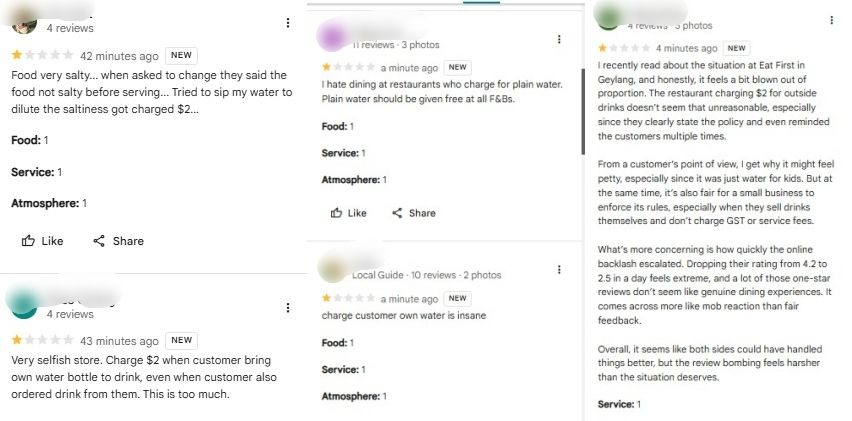
Following the report, the restaurant’s Google rating fell from 4.2 to 2.4 as of 14 April, driven by a surge of one-star reviews.
Critics said the S$2 charge for children drinking plain water was overly rigid, while others argued it reflected standard business policy and customer responsibility.
Some commenters took a more balanced view, suggesting both parties could have handled the situation better, while others warned that the volume of negative reviews appeared disproportionate and risked unfairly harming a small business.
Restaurant defends policy enforcement; closed-circuit footage cited
In response, the restaurant maintained that its no-outside-food-and-drinks policy had been clearly displayed at the entrance and communicated to diners.
The owner’s wife, Julia Hsieh, shared closed-circuit television footage of the incident with state media The Straits Times.
The footage showed the family arriving at approximately 8.15pm, accompanied by a domestic helper who placed a 1.5-litre bottle of mineral water on the table.
Staff reportedly reminded the group multiple times that outside drinks were not permitted.
Despite the reminders, the helper opened the bottle and poured water into a bowl for the children.
The footage showed the children drinking from the bowl, with their mother passing it between them.
Hsieh said staff had repeatedly informed the group that doing so would incur a charge.
Owner raises concerns over backlash
Restaurant owner Steve Chia described the incident as a matter of principle rather than profit.
He questioned why the issue was raised publicly two months after the dining experience.
Chia said the business had been unfairly targeted by what he described as “online vigilantes”.
Calling the backlash his first experience of cyberbullying, he expressed concern about the impact on his livelihood.
“With a small action like this, you may feel you are standing up for justice. But you are killing someone’s livelihood without finding out the facts first,” he said.
Chia added that the restaurant is a standalone business that does not impose service charges or Goods and Services Tax (GST), and aims to keep prices affordable.
Policy rooted in business concerns
Chia said the policy on outside food and drinks has been in place since he first opened the business in 2016.
He continued enforcing the rule after relocating to Geylang in 2023.
He explained that the policy was necessary due to rising operational costs and past experiences with customers bringing in outside meals.
In recent years, he said diners had brought fast food, cooked rice, and takeaway meals into the restaurant and used its utensils.
“We are running a small business. We are selling bottled water too,” he said.
“Just as we respect and appreciate our customers, we would also like customers to understand that we have our own policy.”
Hsieh added that such policies are common in the industry and not unreasonable.
Online reaction split
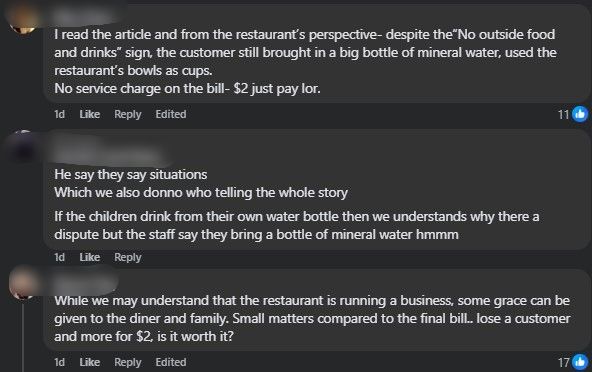
The case has drawn mixed reactions online, with some supporting the restaurant’s right to enforce its rules.
Supporters argued that a no-outside-drinks policy is standard practice and necessary for business sustainability.
Others, however, felt the policy was applied too rigidly, particularly given that the drinks involved were plain water consumed by children.
Some commenters suggested that greater flexibility or discretion could have been exercised in this instance.
A number of users also questioned the timing of the complaint and whether the issue could have been resolved directly at the restaurant.
Despite differing views, several commenters said the scale of the backlash, including negative reviews, appeared disproportionate.


Impact on business visibility
Chia expressed concern that the drop in online ratings could affect the restaurant’s reputation, particularly among tourists.
He noted that up to 30 per cent of customers are foreign visitors who rely on online reviews when choosing where to dine.
He claimed that some of the negative reviews may not reflect genuine customer experiences.
Nevertheless, he said there are no plans to revise the current policy.