Netizens challenge Sim Ann's Sunset Way housing defence, urge rethink of 1980 Master Plan over biodiversity concerns
Public opposition has intensified after Sim Ann defended plans for new public housing at Sunset Way, with many urging the Government to review its reliance on the 1980 URA Master Plan. Commenters called for Maju Forest to be preserved and alternative housing sites to be prioritised.
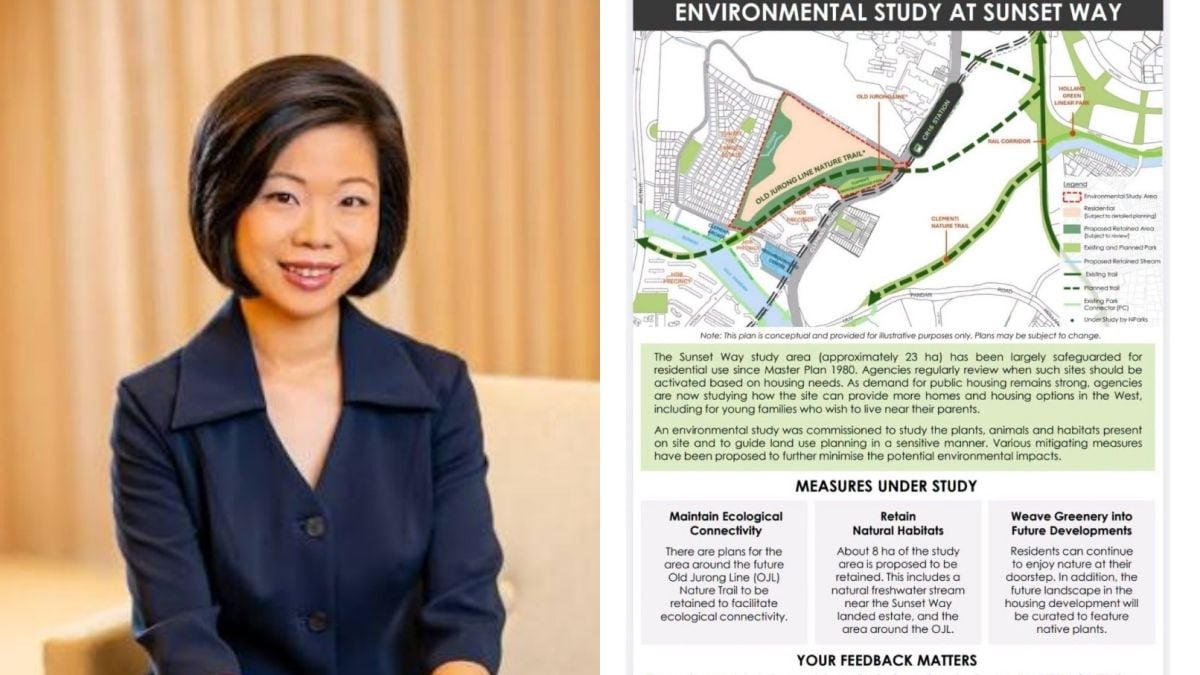
- Netizens rejected the Government's reliance on the 1980 Master Plan to justify developing the Sunset Way site.
- Many urged the Government to preserve Maju Forest and prioritise redevelopment of existing urban land instead.
- Two petitions opposing the Sunset Way and Gillman Barracks housing plans have attracted nearly 22,000 supporters.

SINGAPORE: Public opposition has intensified following Senior Minister of State Sim Ann's defence of the proposed public housing development at Sunset Way, with many Singaporeans arguing that decades-old planning decisions should be reassessed in light of today's environmental challenges and changing housing needs.
The debate emerged after the Government announced on 10 July 2026 plans to develop new public housing projects at Gillman Barracks and a site bounded by Brookvale Drive, Clementi Road and Sunset Way in Clementi.
In a Facebook post published on the same day, Sim, who serves as Senior Minister of State in the Ministry of Foreign Affairs and the Ministry of Home Affairs and is also a Member of Parliament for Holland-Bukit Timah GRC, addressed concerns surrounding the Sunset Way proposal.
She acknowledged that the development would be significant for residents, particularly those living within the Sunset Neighbourhood Committee, and recognised that the site has remained a green space for many years.
However, Sim noted that the land "has also been zoned for residential use since URA's Master Plan 1980."
She said the site could help address future housing demand in western Singapore.
"As housing needs continue to evolve, this site can help provide homes for Singaporeans in the West region, including for young families who wish to live near their parents for mutual care and support," she wrote.
Sim also acknowledged that residents may have questions about the proposal and sought to assure the public that environmental considerations were being assessed.
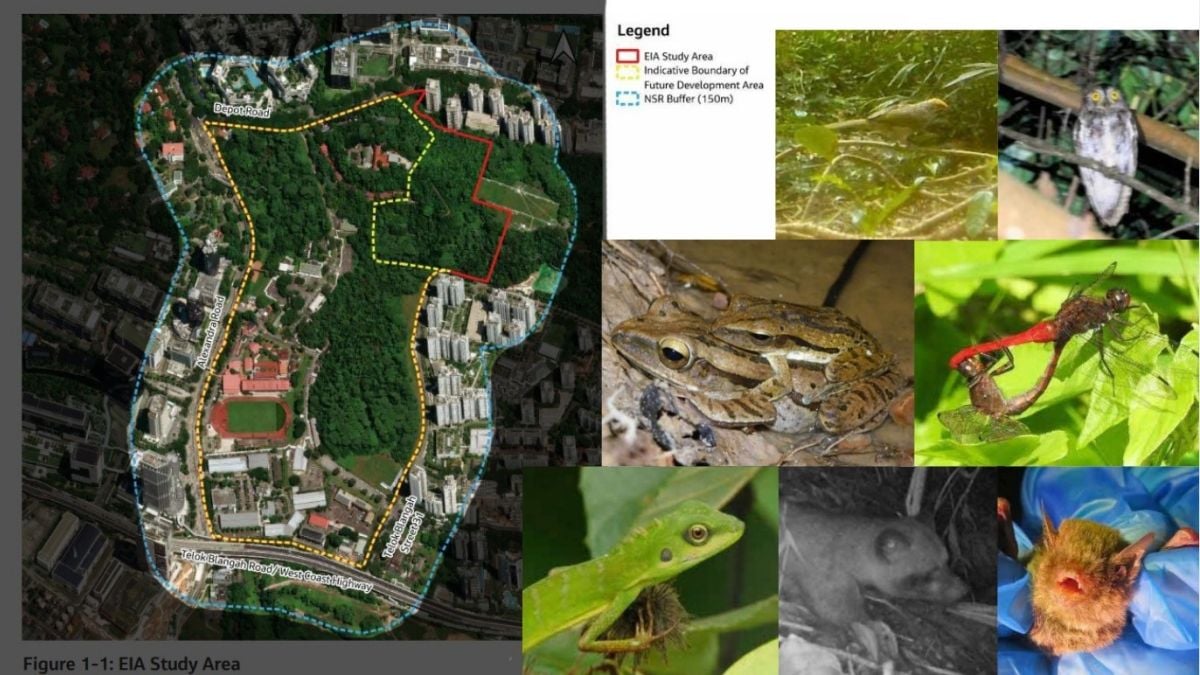
"Please be assured that Government agencies have commissioned an environmental study to assess the site's flora and fauna, and better understand its ecological value," she said.
She added that the study had recommended measures to minimise potential environmental impacts.
Sim directed residents to the Housing & Development Board's environmental impact assessments for both Gillman Barracks and Sunset Way and encouraged members of the public to submit feedback through HDB's public consultation exercise, which runs from 10 July to 6 August 2026.
Calls to preserve one of Singapore's remaining forests
Despite those assurances, many responses on Sim's Facebook page expressed strong opposition to the proposal, with commenters arguing that Maju Forest should remain protected.
Many said Singapore had already lost substantial natural habitats to development over recent decades and warned against further shrinking the country's remaining forested areas.
Several referenced previous developments involving Dover Forest and described Maju Forest as one of Singapore's remaining "green lungs".
One commenter wrote: "Please stop destroying our green spaces!!!"

Another added: "We do not need to clear forest for public housing... NO to turning Singapore into a concrete jungle."
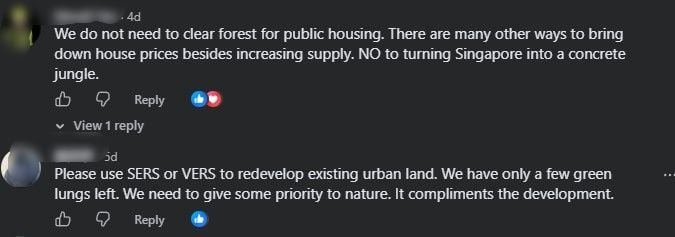
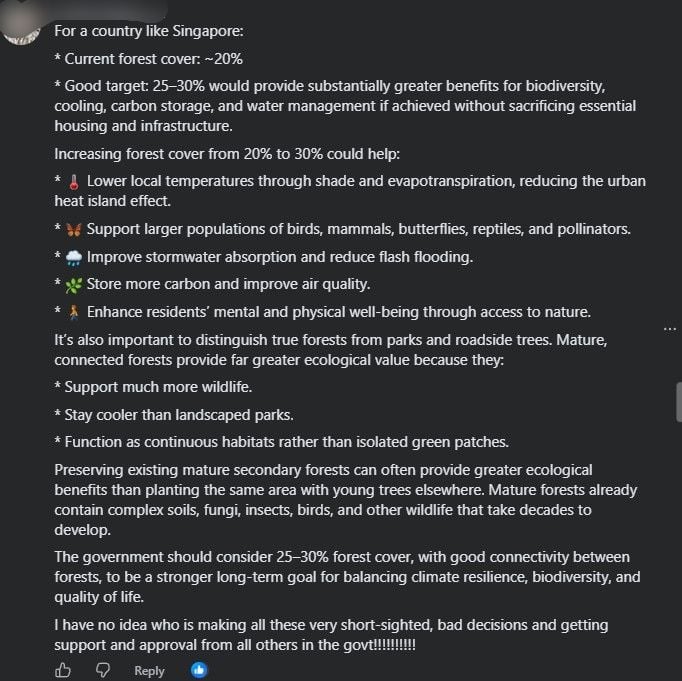
Others argued that mature forests provide ecological functions that cannot be replicated simply by planting replacement trees elsewhere.
Commenters highlighted the forest's role in supporting biodiversity, moderating local temperatures and providing habitats for wildlife, saying those environmental benefits would be permanently diminished if the development proceeds.
Some also encouraged members of the public to support the ongoing petition calling for Maju Forest to be preserved.
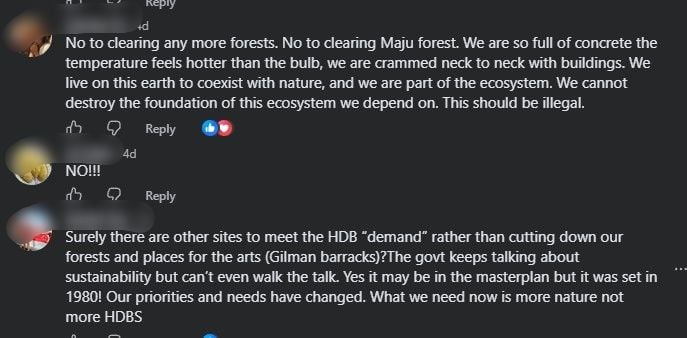
'It's 2026, stop referencing the 1980 Master Plan'
A recurring criticism centred on the Government's repeated reference to the Urban Redevelopment Authority's 1980 Master Plan.
Many argued that land-use decisions made more than four decades ago should not automatically justify development today without reconsideration of present-day environmental priorities.

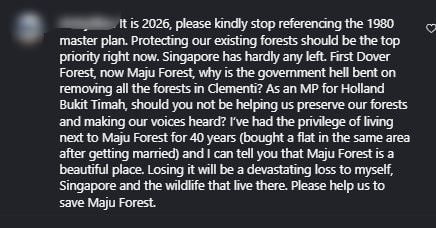
One commenter wrote: "It is 2026, please kindly stop referencing the 1980 Master Plan. Protecting our existing forests should be the top priority right now."
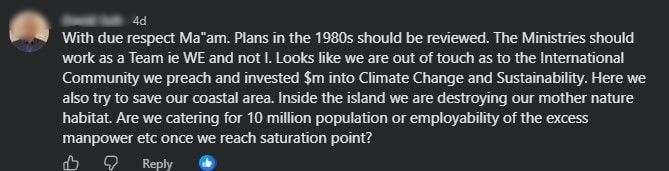
Another said planning assumptions from the 1980s should be reviewed because climate change, biodiversity conservation and sustainability have become significantly more important since the plan was first adopted.
Others argued that historical zoning alone should not determine whether development proceeds.
"Being zoned decades ago does not absolve current responsibility and due diligence now," one commenter wrote.
Several also questioned whether Singapore's lower birth rate and changing demographic profile should prompt a broader reassessment of future housing demand before additional forests are earmarked for development.
Redevelop existing estates instead of forests
Many commenters suggested that alternative sites should be prioritised before clearing natural forests.
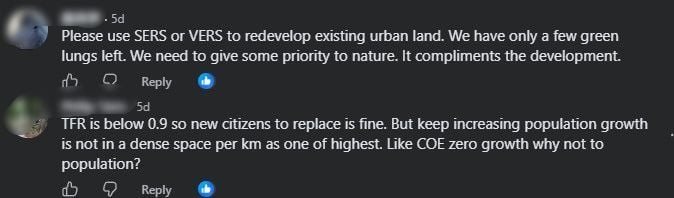
Some proposed expanding the Selective En bloc Redevelopment Scheme (SERS) or the Voluntary Early Redevelopment Scheme (VERS) to redevelop older low-rise Housing & Development Board estates.
Others suggested making greater use of brownfield land, vacant schools, industrial sites and golf courses instead of developing Maju Forest.
One commenter wrote: "STOP THE BUILD PLEASE. So many low-rise HDBs that can be developed instead of Maju Forest."

Another added: "We have only a few green lungs left. We need to give some priority to nature."
Many argued that redevelopment within already urbanised areas would better balance housing needs with environmental conservation.
Residents fear irreversible environmental loss
Some residents living near the forest said the proposal would fundamentally alter the character of the neighbourhood.
One resident, who said they had lived beside Maju Forest for 40 years, described the prospect of losing the forest as deeply personal.
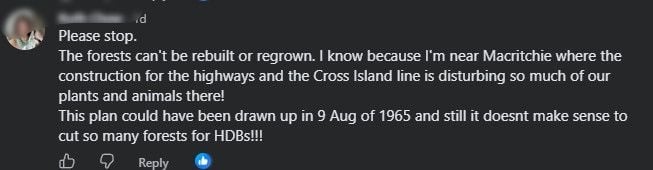
"Losing it will be a devastating loss to myself, Singapore and the wildlife that live there. Please help us to save Maju Forest," the resident wrote.
Others said the area's cooler environment, birdsong and tranquil surroundings are closely connected to the mature forest ecosystem.
Several argued that while trees can be replanted elsewhere, mature forests that have developed over decades cannot simply be recreated once cleared.
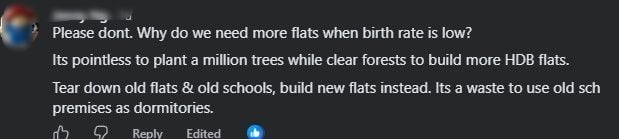
Some also questioned whether additional housing supply was necessary given Singapore's declining birth rate, arguing that irreplaceable natural habitats should not be sacrificed when alternative development sites remain available.
Petitions continue gaining support
The growing public concern has also been reflected in two online petitions opposing the proposed developments.
The "Save Gillman Barracks/Forest" petition and the "Save Maju Forest" petition have collectively attracted nearly 22,000 supporters.
Both petitions argue that increasing Singapore's housing supply should not come at the expense of remaining forests, biodiversity or historically significant community spaces.
Supporters have instead called on the Government to pursue alternative development strategies that can meet future housing demand while preserving environmentally and culturally important sites for future generations.
HDB outlines environmental safeguards
HDB has said the proposed developments at Gillman Barracks and Sunset Way were informed by detailed environmental and heritage studies.
The agency said findings from those studies, together with public feedback submitted by 6 August, would help shape the final development plans, including housing yield, flat mix, project classification and development timelines.
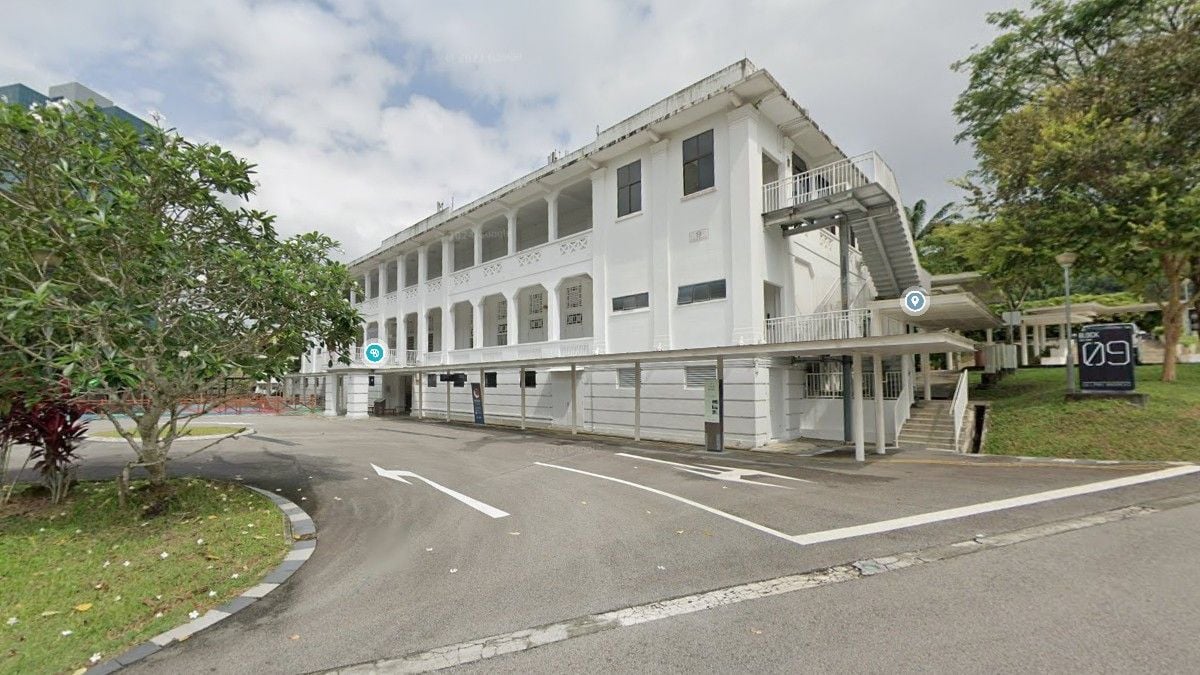
At Gillman Barracks, HDB plans to build public and private homes near the Greater Southern Waterfront while retaining more than 20 of the site's 86 heritage buildings.
The agency also intends to preserve most of the existing secondary forest, a natural forest stream and ecological corridors.
Environmental surveys identified 293 plant species and 178 fauna species at the site, including 33 species of conservation significance.
HDB said the proposal includes ecological corridors of at least 30 metres in width, around eight hectares of connected green space and phased vegetation clearance to minimise impacts on wildlife.
Four heritage clusters are also planned for retention and could be adapted for commercial and community uses.
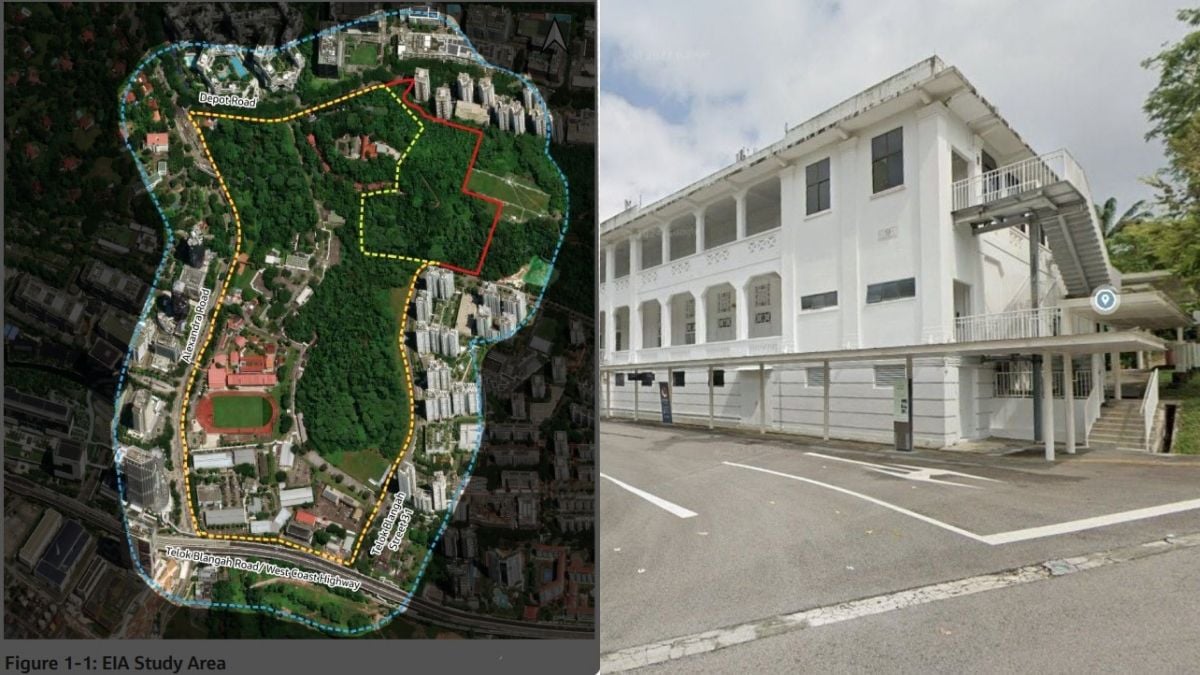
For the 23-hectare Sunset Way site, HDB said the proposed estate would provide additional housing options in western Singapore while incorporating biophilic landscape design featuring native plant species.
Approximately eight hectares of land, including a natural freshwater stream and areas along the former Old Jurong Line, would be retained as wildlife habitat and connected to a proposed nature trail.