Bloomberg reporter denies agenda to link ministers' GCB deals to money laundering
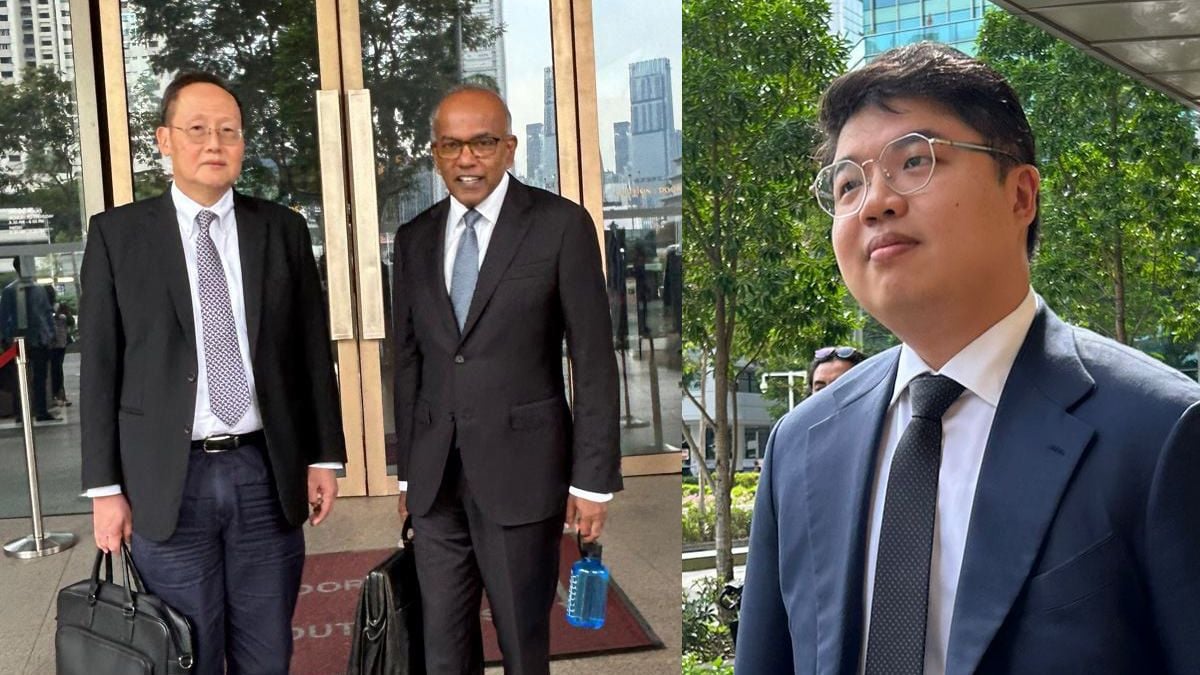
Cross-examination of Bloomberg reporter Low De Wei entered its second day on 14 April 2026 as counsel for two Cabinet ministers alleged that paragraphs on money laundering measures were deliberately repositioned in the final article to implicate both men.


The sixth day of the defamation trial brought by ministers K. Shanmugam and Dr Tan See Leng against Bloomberg LP and reporter Low De Wei resumed on Tuesday, 14 April 2026, before Justice Audrey Lim of the High Court of Singapore.
Senior Counsel Davinder Singh, representing both ministers, continued his cross-examination of Low for a second consecutive day.
The central allegation advanced by Singh was that Low and his colleagues had pursued what Singh described as an "agenda" to target both ministers. Singh put it to Low that the agenda was pursued by positioning paragraphs in the final article such that both ministers' property transactions were framed in the context of money laundering concerns.
Low denied this throughout the hearing. He maintained that his article, titled "Singapore mansion deals are increasingly shrouded in secrecy" and published on 12 December 2024, was not about money laundering but had made reference to it.
Singh alleges money laundering paragraphs were moved to bracket both ministers in final article
Singh drew the court's attention to a comparison between a draft of the article dated 23 October 2024 and the version ultimately published.
In the October draft, two paragraphs describing anti-money laundering measures introduced in the United Kingdom and New York appeared before any mention of either minister's property transaction.
In the published article, those paragraphs were placed immediately after the reference to Dr Tan's purchase of a bungalow in Brizay Park for approximately S$27.3 million. They appeared just before the first reference to Shanmugam's sale of his Queen Astrid Park property to UBS Trustees for S$88 million.
Singh also noted that the two paragraphs contained no reference to caveats or non-caveated property deals, yet were placed under a section sub-headed "non-caveated deals."
He put it to Low that the effect was to remind readers that both ministers were involved in transactions that took advantage of the secrecy and opacity described in the article, in the context of money laundering concerns.
Singh then put the allegation formally: "I suggest to you, sir, that it was intended by you and your colleagues — pursuant to their agenda — to target Shanmugam as well as Dr Tan, and to link their conduct with the concern over money laundering. That is the reason these two paragraphs were moved to their location in the final article."
Low replied: "I completely disagree with that. We have no agenda."
Low acknowledged that the paragraphs had been moved, but said he was not certain whether he or an editor had made the change. He also confirmed, in answer to an earlier question, that the final form of the published article was satisfactory to him — in terms of what was said, how it was said, and where it was said.
Singh puts that paraphrase claim is false; Bloomberg's own counsel unable to produce source
A substantial portion of the hearing concerned paragraph 8 of the article, in which Low described market trends following Singapore's S$3 billion money laundering case.
Low had maintained that paragraph 8 paraphrased William Wong, the founder of a bungalow-specialist property agency, who was quoted by name in the preceding paragraph as saying more buyers prefer to be low-profile.
The passage in paragraph 8 carried no quotation marks and did not name Wong as its source. It stated that the money laundering scandal had drawn attention to China-born Singapore residents staying in mansions rented for as much as S$150,000 a month, and that ten money launderers had since been convicted, jailed, and deported.
Justice Lim asked Low to produce the correspondence in which Wong had provided the specific details contained in the passage. She then called on Senior Counsel Sreenivasan Narayanan, Bloomberg's own counsel, to assist Low in locating the relevant correspondence.
Sreenivasan was unable to produce it. The only reference to money laundering in Wong's communications with Low was the phrase "money laundering saga."
Low then acknowledged that Wong had not stated the details about China-born Singapore residents, the rental figures cited, or the number convicted and deported.
Singh responded: "Your evidence that you paraphrased him is a lie and you got called out by it because the court asked you to show the reference — and not even your lawyer could do it."
Sreenivasan immediately stood to object to the characterisation and asked Singh not to get "personal."
Singh continued: "In other words, you were seeking to mislead the court." Low disagreed.
Singh puts that "privacy" was dropped while money laundering reference was deliberately kept
Singh produced a draft dated 8 October 2024 in which the William Wong passage still contained the word "privacy" alongside a reference to the money laundering saga — reflecting both reasons Wong had given for buyers preferring discretion.
The word "privacy" did not appear in the corresponding passage of the published article.
Low accepted that the word had been removed, and that this had occurred with his knowledge and consent.
Singh put it to Low that by retaining the money laundering reference while dropping "privacy," the passage directed readers towards money laundering as the primary motivation behind buyers' preference for low-profile transactions. Low said he did not know whether that had been his decision alone, noting that editors had also been involved in the final text.
Singh puts that senior editors raised money laundering questions across eight weeks
Singh examined Low at length over internal Bloomberg email exchanges from August to October 2024, in which senior editors raised questions about government access to the identities of trust beneficiaries and the article's treatment of anti-money laundering standards.
On 22 August 2024, Lulu Chen — identified in the proceedings as Low's supervisor — responded to what Low described as an early draft. Chen's email listed a number of questions she described as necessary for the story, including whether secretive property deals still required government vetting and whether anti-money laundering standards were being maintained.
Low accepted that Chen's email used the phrase "so what of the story" in the context of the government and anti-money laundering. He also accepted the phrase referred to the core of the story and why it would matter to readers.
On 2 October 2024, Emily Cadman, a senior editor based in Sydney, asked in a further email whether the agencies responsible for tracking money laundering and illicit financial flows were able to identify the owners of shell company purchases, and whether there were disclosure rules requiring such identification.
Low acknowledged he did not respond to Cadman by telling her money laundering was not the focus of the article.
In his reply to Cadman, Low wrote that in theory the government should still be able to see the relevant transactions, but that it was "not clear how much AML checks they do." He added that he would ask the government about it in a query.
Singh put to Low that in this reply he had placed Shanmugam squarely in the context of money laundering. Low disagreed.
Singh also pointed out that Low had already corresponded with a London-based Bloomberg colleague about UK anti-money laundering rules as early as 30 August 2024, predating Cadman's 2 October email. Low accepted this.
Low confirmed that he had himself written the words "to combat money laundering" when capturing material from his London colleague for the article, and that he had done so because he considered it relevant to what he wished to include.
Singh alleges article told readers the government does not verify trust buyers' identities
In the morning session, Singh examined Low at length on paragraphs 28 to 31 of the published article. Those paragraphs concern the government's data collection on trust-based property purchases, the role of property agents and service providers in verifying buyers' identities and source of wealth, and the absence of mandatory disclosure rules.
Low accepted that in paragraph 29 he had used the words "in essence, that means" to explain to readers the import of the preceding paragraph. Paragraph 28 stated that the government does not collect general data on landed properties acquired through trust companies where the beneficiaries are Singapore citizens.
Singh put it to Low that paragraph 29 therefore told readers that what this meant in practice was that the verification of buyers' identities and source of wealth was left primarily to property agents and other service providers — not to the government.
Low accepted the logical connection between paragraphs 28 and 29, but maintained throughout that neither was intended to convey that the government was unaware of the identities of trust beneficiaries.
Low also accepted that checks and balances and mandatory disclosure rules — the subject of paragraph 31 — are matters legislated by the government, not the public.
Justice Lim intervened to ask Low what he had meant when he said the passage "sums up the article." She then asked him to define what he meant by "mandatory disclosure rules," pressing him by component — whether it referred to disclosure of price, disclosure of buyer and seller names, and what other matters it covered.
Through a series of answers, Low progressively narrowed his characterisation. He said mandatory disclosure referred to the pricing of deals and the identity of the ultimate beneficial owner of trusts, but not to source of wealth.
Singh put it to Low that on this basis paragraph 31 conveyed a falsehood, because Singapore's existing framework already provided for disclosure of pricing and for the government's knowledge of trust beneficiaries. Low disagreed.
Justice Lim also confirmed with Low directly, in open court, that his role as a reporter is to report accurately. Singh followed immediately by putting to Low that — on the basis of what Singh described as a false premise in paragraph 29 and a fiction in paragraph 31 — Low had conveyed to readers that Singapore has no checks and balances on property transactions of the kind described. Low disagreed.
Singh puts that article's closing passage is about money laundering
After the lunch break, Singh returned to the final paragraphs of the article by way of a separate line of argument centred on source of wealth and the risk of illegitimate overseas funds.
He put to Low that overseas funds entering property transactions require scrutiny to determine whether they are legitimate, and that the reason such scrutiny is necessary is to prevent money laundering. Low replied that this was "one possibility."
Singh then put to Low that the article's closing passage — opacity, things going "out of control" without checks and balances, and all private property deals being subject to mandatory disclosure rules — was therefore about money laundering.
Low said he completely disagreed.
Singh pressed the point: "And the references to things going out of control — you could not have meant that Singaporeans would take to the streets because they did not know the identity of the trust beneficiary, correct?"
Low disagreed and asked for the question to be put again.
He then replied: I’m not saying Singaporeans would take to the streets. They can vote for their representatives and raise this issue. This is democracy.
Cross-examination to conclude Wednesday
Singh indicated he expected to complete his cross-examination by noon on Wednesday, 15 April 2026. He asked Justice Lim for some allowance, citing the nature of certain answers given during cross-examination.
Senior Counsel Sreenivasan Narayanan indicated his re-examination of Low was expected to take between one hour and one and a half hours.
The trial resumed at 10.00 AM on Wednesday.
This report is based on correspondent notes from open court proceedings, supplemented by reports filed by The Straits Times, CNA and Lianhe Zaobao. Paraphrased exchanges reflect the order in which proceedings occurred in open court.