“Sad to see it gone”: Netizens nostalgic as iconic Bukit Timah satellite dishes dismantled along BKE
Two landmark satellite dishes at Bukit Timah Satellite Earth Station have been removed after nearly four decades, sparking nostalgia and debate over heritage preservation and future land use.

- Two Bukit Timah satellite dishes were dismantled in early 2026 after decades of operation.
- Their removal sparked nostalgia and debate over heritage preservation.
- The site will support future connectivity infrastructure developments.

SINGAPORE: Two iconic satellite dishes at the Bukit Timah Satellite Earth Station have been dismantled, marking the end of a familiar sight along the Bukit Timah Expressway (BKE). The removal was confirmed by Singtel on 15 April 2026.
A Singtel spokesperson told The Straits Times that the antennas were no longer at the site, with removal works having begun in the first quarter of 2026.
The structures were taken down to make way for future infrastructure developments.
“They have been removed to make way for future infrastructure that will support the evolving connectivity needs of enterprises and customers,” the spokesperson said.
End of an era for legacy infrastructure
The two satellite dishes had stood near Rifle Range Road for almost four decades. Built in the 1980s, they were originally designed to support international telecommunications traffic on legacy satellite systems.
By the time of their removal, the antennas were no longer in active use. Singtel confirmed that no services or customers were affected by the dismantling.
The Bukit Timah Satellite Earth Station itself was officially opened in 1987 to expand Singapore’s international telecommunications capacity. It supplemented the earlier earth station on Sentosa, which began operations in 1971 but lacked space for additional antennas.
Technical specifications and development
Of the two dishes removed, one measured 32 metres in diameter and was present when the station first opened. The second, measuring 21 metres, was added in 1988 to increase capacity.
Both were among the oldest structures at the facility. Only one dish — the larger 32m antenna — remains part of the station’s historical record, having been integral to its initial operations.
Satellite dishes function by receiving signals transmitted from orbiting satellites, which relay communications sent from ground stations. This system enabled services such as live telecasts and long-distance data transmission.
The Rifle Range Road site was selected due to its relative distance from the airport and minimal radio-frequency interference, factors critical for stable satellite communications.
Role in technological milestones
Over the years, the Bukit Timah Satellite Earth Station contributed to several technological developments.
In 2010, it supported the 3D broadcast of Singapore’s National Day Parade.
The station processed, formatted and transmitted the broadcast via satellite to Singtel’s former mio TV platform.
Beyond broadcasting, the facility enabled a range of high-speed communication services.
These included remote newspaper printing, banking and financial data transfers, and the transmission of images across international networks.
Public reaction and nostalgia
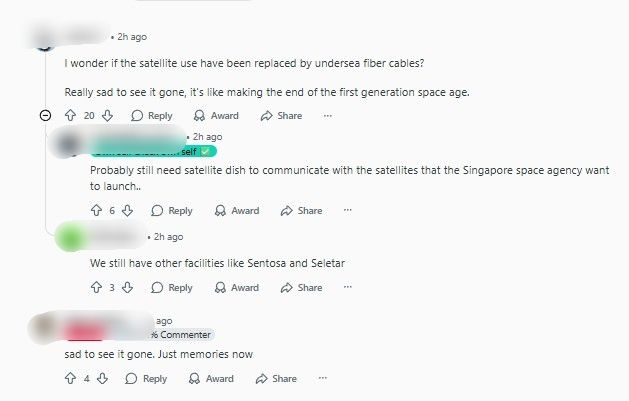
The dismantling prompted widespread reaction online, particularly among users commenting on The ST’s Facebook page and in a Reddit Thread. Many expressed nostalgia for what they described as a distinctive and enduring landmark.
Several recalled childhood memories of spotting the dishes while travelling along the BKE. Families had even given them nicknames such as “two kwalis on a hill” and “alien communications”.


Others questioned why the structures were not preserved as part of Singapore’s national heritage. Some commenters argued that the dishes held greater cultural significance than sites already officially recognised.

A significant number of responses reflected concern about the future of the site.
Some expressed scepticism, suggesting the land could be redeveloped for housing, including Build-To-Order flats, amid ongoing population growth.
At the same time, more technically inclined commenters acknowledged that the satellite dishes had become obsolete.
Advances in fibre-optic networks and newer satellite technologies, including low-Earth orbit systems, have largely replaced the functions once served by such infrastructure.