Local tenants forced to withdraw from Chinatown as rents rise, offers reportedly reach as high as S$18,000
Tenants and business owners told Lianhe Zaobao that steep rent hikes in Chinatown are forcing closures, with some units reportedly drawing offers up to S$18,000. Concerns are mounting over the displacement of local heritage businesses and the district’s shifting cultural identity.

- Business owners report rent hikes far exceeding official averages, forcing closures and relocations.
- Tenants say foreign operators are offering significantly higher rents, intensifying competition for shophouse units.
- Authorities maintain rent increases are moderate and continue to support heritage businesses through existing schemes.

Rising rents in Singapore’s Chinatown have prompted renewed concern among tenants and observers, following accounts from business owners who say they have been priced out of the historic district amid intensified competition for shophouse spaces.
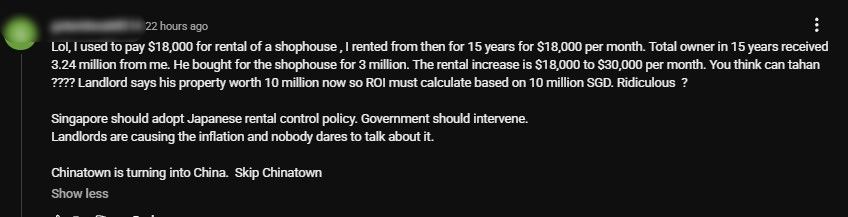
Online sentiments reflect deep dismay over Chinatown's cultural erosion, as mainland Chinese businesses willing to pay inflated rents steadily displace local heritage and food.
Many netizens expressed frustration at the government's perceived inaction, with calls for urgent policy intervention to preserve Singapore's traditional identity before it is irreversibly lost.
A report by Chinese-language newspaper Lianhe Zabao published on 16 April 2026 highlighted growing unease over whether higher-paying foreign operators are displacing local businesses, particularly in heritage areas known for traditional trades and long-standing food culture.
Several tenants described being unable to sustain operations after lease renewals brought steep increases, with some citing offers from prospective tenants reportedly reaching as high as S$18,000 per month.
Local business closures amid rent pressures
One such case involved Leslie Chua, who opened Madam Liew’s Bistro & Bar in Chinatown in 2022 after relocating from a Bedok coffeeshop stall.
The establishment specialised in Peranakan dishes based on family recipes, positioning itself as a small bar offering traditional cuisine.
However, the business closed at the end of 2023 after a year of operation, following a sharp increase in rent upon lease renewal.
“At the time, getting S$8,000 in rent was already quite good,” Chua told Zaobao.
He described how multiple agents approached him with competing offers as his lease neared expiry, many linked to prospective tenants from China.
“From the agents I learned that someone offered S$15,000 and the highest was even S$18,000,” he said.
Chua added that there was “absolutely no room for negotiation”, leaving tenants with limited options.
Disparity between official data and tenant experience
Zaobao reported that according to Urban Redevelopment Authority (URA) data, shophouse rents in historic districts have risen by an average of about 1 to 2.5 per cent over the past two years.
However, several business owners interviewed described increases far exceeding these averages when renegotiating leases.
Dessert shop owner Feng Junhao said he would cease operations at the end of the week after being unable to meet revised rental demands.
“Really no choice,” Feng said. “When I started negotiations for the sixth year this year, I just couldn’t afford that price.”
He noted that rent had risen to S$8,800 in the past year and could potentially reach between S$10,000 and S$12,000.
“It seems the neighbouring unit can rent for S$16,000. Why would he rent it for less?” Feng said, referring to landlord considerations.
Despite the pressure, Feng said he had resisted raising prices, citing the demographic profile of customers in the area.
“Over in Chinatown there are many rental flats with many elderly people. So if I raise prices I feel it’s meaningless,” he said.
Long-standing businesses adopt ownership strategy
While some businesses have exited, others have sought to secure long-term stability by purchasing property rather than renting.
Teck Soon Medical Hall, which has operated in Chinatown for more than 60 years, represents one such case.
Traditional Chinese medicine practitioner Chow Khai Shui said the business acquired its premises in 1998 for S$980,000 and later invested over S$700,000 in renovations.
He noted that property prices have since risen significantly, with some units now selling for over S$10 million to S$20 million.
“Because now there are many outsiders here, some operators from China, they really like Chinatown,” he said.
Shifting footfall and changing consumer patterns
Feng also pointed to declining footfall in Chinatown, including during peak festive periods.
“Honestly I feel that the overall crowds in Chinatown have already gone downhill,” he said.
“Especially during this year’s Lunar New Year, it was bad, really very bad.”
He contrasted current conditions with earlier years when wet markets in the area were more vibrant.
“In the past the market downstairs was very bustling. But now the whole wet market has become much quieter,” he said.
Feng added that his business relied primarily on local customers rather than tourists, noting that traditional desserts had limited appeal to foreign visitors.
“Foreigners won’t appreciate these things,” he said.
Residents note changing cultural landscape
Residents interviewed by Zaobao have also observed shifts in the character of Chinatown, with some expressing difficulty identifying with the evolving mix of businesses.
A resident identified as Melvin said there are about four or five Hunan cuisine restaurants just around Smith Street.
“Many shops already don’t really have a local flavour anymore.”
He added that the prevalence of foreign-run establishments made it harder to connect with the area’s food culture.
Leslie Chua similarly expressed concern over the erosion of traditional food heritage.
“A lot of Chinatown’s food culture has actually been lost,” he said.
“Now wherever you go, almost every corner is mala.”
He noted that the linguistic environment had also shifted over time.
“The original environment used to be mainly Cantonese, but now it has become mainly Mandarin,” he said.
Public sentiment and calls for intervention
Online reactions have reflected widespread concern over the transformation of Chinatown and other historic districts.
Many commentators described a sense of loss, citing the displacement of traditional Singaporean and Nanyang food culture.
Some said they had stopped visiting Chinatown altogether, stating that it no longer felt familiar.
Calls for government intervention have included proposals for rent controls, stricter oversight of foreign-owned businesses and limits on the concentration of operators from a single nationality.
A comment wrote: "Chinese F&B operators can offer double the price, so of course landlords will rent to whoever pays more. If the government still does not step in to intervene, Singapore will inevitably lose its colour over time. I wonder what they are waiting for."
"If this goes unregulated, the food that Singaporeans eat — or what passes as Singaporean food — will all be foreign. What will Singaporean food even mean then: Vietnamese pho, northern Chinese cuisine, Hunanese food, north Indian food, Burmese food, Filipino food..."

Others expressed scepticism about whether such measures would be implemented, with some attributing the situation to market forces and economic priorities.



In February, Syed Harun defends heritage restaurant Warong Nasi Pariaman closure was not due to high rents
The issue of rising rents and foreign investment has also been raised in Parliament.
On 3 February 2026, Senior Parliamentary Secretary for National Development Dr Syed Harun Alhabsyi stated that the closure of Warong Nasi Pariaman was not caused by high rents.
He cautioned against attributing closures solely to rental costs and cited URA data showing that median rents in heritage districts had risen moderately, broadly in line with other central retail areas.
Dr Syed Harun said the Government would continue supporting heritage businesses through inter-agency initiatives, including assistance under the SG Heritage Business Scheme.
He also stated that there were no plans to introduce new taxes on commercial heritage properties.
During the Committee of Supply debate on 2 March 2026, MP for Marine Parade–Braddell Heights GRC Tin Pei Ling also raised concerns about whether foreign capital inflows could be contributing to rising rents and displacing local operators.
URA defends Kampong Glam shophouse sales slump as locals dominate buyers amid foreign ownership concerns
Similar trends have been observed in other historic districts, including Kampong Gelam.
On 6 April, URA addressed claims that rents in Haji Lane had nearly doubled, stating that median rents in the area had increased by about 2 per cent annually, comparable to other heritage districts.
The authority also noted that shophouse transactions in Kampong Gelam had declined significantly, with annual transactions falling by about 60 per cent between 2020–2022 and 2023–2025.
According to official data, local buyers accounted for approximately three-quarters of transactions between 2020 and 2025.
Only one shophouse was sold to a foreign buyer in 2024, with none recorded in 2025.
URA also outlined regulatory measures aimed at maintaining a balanced business mix, including restrictions on certain types of outlets such as souvenir shops, bars and Western fast-food establishments.