Desmond Lee says AI use in schools balanced, age-appropriate with safeguards, supervision and integrity rules
Desmond Lee says AI use in schools is balanced and age-appropriate, with safeguards, supervision, and academic integrity rules guiding student learning and development across all levels.

- Desmond Lee says AI use in schools follows a tiered, age-appropriate framework with safeguards.
- Students must not use AI as a shortcut and face penalties for academic dishonesty.
- MPs raised concerns on inequality, parental consent, and cognitive offloading risks.

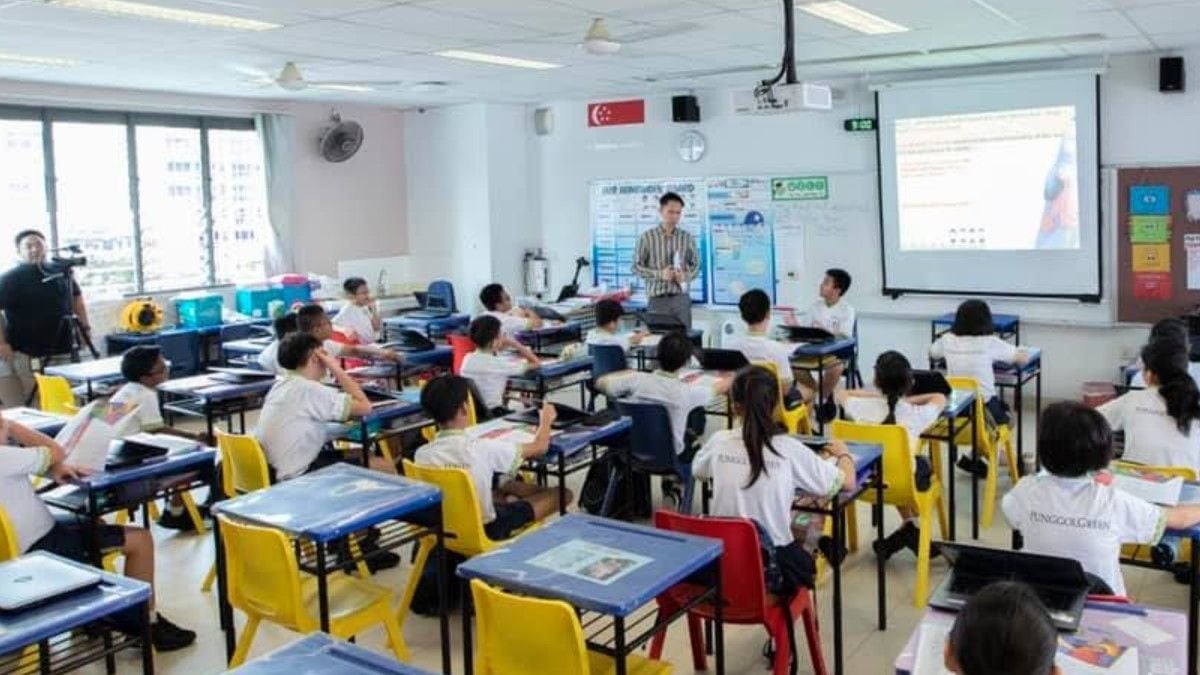
SINGAPORE: The use of artificial intelligence in schools is being carefully calibrated to remain balanced and age-appropriate, with structured safeguards to support students’ learning and development, Minister for Education Desmond Lee said.
Responding to parliamentary questions on 6 May, Lee emphasised that theoretical knowledge alone is insufficient.
Students must also engage in supervised, hands-on experiences using educational AI tools designed specifically for learning environments.
“This spiral approach as students progress through different levels in school prepares them to harness AI to benefit their learning, critically evaluate AI output and guard against risks such as cognitive offloading,” Lee said.
Lee outlined that the Ministry of Education’s approach is grounded in research on how children learn and develop at different stages.
This has resulted in a tiered framework that introduces AI progressively across levels.
The framework ensures that students build foundational knowledge before engaging more deeply with AI tools. Schools are also required to reinforce that AI must not replace genuine learning.
“We want to provide our students with a school environment where they can develop good learning habits and understand the importance of upholding academic integrity,” Lee said.
At the secondary level, some schools may design assignments that permit the use of AI.
In such cases, students must disclose and properly cite any AI-assisted work.
Lee said this prepares students for post-secondary education and future workplaces, where AI usage is expected to be more prevalent.
Academic integrity and examination safeguards
Students who present AI-generated content as their own work without disclosure will face consequences for academic dishonesty, Lee said.
National examinations remain strictly invigilated, and the use of AI is prohibited in these settings. For coursework where AI is allowed, teacher supervision is required to ensure usage aligns with assessment objectives.
Lee added that educational AI tools deployed in schools include built-in safety guardrails designed to protect students’ interests, privacy, and well-being.
The ministry has also implemented strict data governance measures.
Data generated from MOE-built AI tools is anonymised and not used to train external models.
For schools using commercial off-the-shelf AI tools, strict guidelines apply. Input data must not include personal or personally identifiable information.
These measures are intended to ensure compliance with data management standards while safeguarding student privacy.
Parental concerns and engagement
Lee acknowledged that parents have raised concerns about exposing young children to AI, particularly in relation to excessive screen time.
In response, the ministry provides guidance to parents on supporting their children’s use of AI. Schools also share information on how AI tools are used in teaching and offer avenues for parental feedback.
“AI has been developing rapidly and is increasingly embedded into everyday systems around us,” Lee said.
“If we’re not mindful, we may lose the consciousness in detecting the presence of, and influence that AI has in our decision making and ways of thinking, simply because it works so seamlessly.”
“So development of AI literacy is critical and must be timely,” he added.
Debate over opt-out provisions and classroom use
During the session, Aljunied GRC MP Kenneth Tiong raised questions about whether parents should be allowed to opt their children out of specific AI-related classroom activities.
Tiong cited concerns about cognitive offloading, referring to research suggesting students may rely on AI instead of developing metacognitive skills through sustained effort.
He also questioned how the ministry ensures students continue to experience “productive struggle” in learning, and referenced Sweden’s reversal of early digitalisation policies after studies suggested digital tools could impair learning.
In response, Lee said the use of AI depends on whether tools are integrated into the Student Learning Space (SLS) and form part of classroom instruction.
“It’s part of teaching and learning. It’s part of teachers’ blended approach, and I think that will enable our teachers to be able to help our children learn the cognitive aspects, foundational knowledge, more deeply,” he said.
Lee added that where external tools are introduced, parental consent is required. If consent is not obtained, students will not be allowed to use those tools.
He likened restricting AI in classrooms to rejecting basic teaching tools, stating, “I don’t want my children to have a whiteboard, I want a blackboard.”
“We must enable our teachers to be able to perform their role, and this is of course subject to MOE guidance and good Singapore teaching practice,” he said.
Equity concerns and support measures
NCMP Eileen Chong raised concerns about what she described as an “equity paradox” in AI usage.
She questioned whether students from disadvantaged backgrounds, who may lack parental guidance, could become more reliant on AI, potentially weakening cognitive development and widening educational inequality.
Lee responded that such concerns are longstanding and not unique to AI.
“This concern is evergreen,” he said, noting that disparities in home support have always existed.
He highlighted existing measures such as the Opportunity Fund, ComLink initiatives, and community partnerships that aim to support students with fewer resources.
Lee added that AI use within schools is supervised by teachers, and all students receive AI literacy education to build awareness of appropriate usage.
While acknowledging risks outside school environments, he said the goal is for students to internalise good habits regardless of background.
Questions on age suitability and ethical use
Several MPs also raised questions about age-appropriate use and ethical considerations.
David Hoe asked whether primary school students could be instructed to use tools such as ChatGPT, and whether parental consent is required given age restrictions on some platforms.
Lee said AI use in schools must adhere to clear guidelines, and certain general-purpose tools are not suitable for younger children.
If a tool has age restrictions, it will not be used for underage students, he said, adding that consistent enforcement will be ensured.
On parental engagement, Lee said the ministry is exploring ways to involve parents in a scalable and meaningful manner, including allowing them to experience AI tools used in schools.
Early exposure and intellectual property awareness
MP Cassandra Lee raised questions about when AI education should begin, noting that exposure may start as early as Primary 4.
Lee responded that AI literacy begins from Primary 1, with examples from countries such as China and Estonia.
He added that parents should begin conversations with children early to guide responsible use.
MP Elysa Chen highlighted concerns about intellectual property and the misuse of AI-generated content.
In response, Lee said AI tools used in schools are designed with safeguards, and students are taught ethical use, proper attribution, and respect for intellectual property throughout their education.