Hong Kong court freezes HK$9 billion in assets linked to alleged scam kingpin Chen Zhi
A Hong Kong High Court has ordered the freezing of assets worth more than HK$9 billion linked to Chen Zhi, a Chinese-born businessman extradited to China in January and accused of running one of Asia's largest transnational online scam networks, covering 42 respondents including three associates and 38 companies.


A Hong Kong court has ordered the freezing of assets worth more than HK$9 billion (approx. US$1.15 billion) held by detained businessman Chen Zhi and a network of individuals and companies connected to him, according to the South China Morning Post.
A source told the publication on Thursday that the High Court issued the restriction order earlier this month, following an application from the Department of Justice. The order names 42 respondents in total: Chen, three suspected associates, and 38 companies.
The respondents are prohibited from dealing with their properties both within and outside Hong Kong.
Chen himself had approximately HK$6.36 billion in assets frozen. These included a commercial building on Kimberley Road in Tsim Sha Tsui valued at HK$3 billion, a luxury mansion on The Peak, personal bank accounts, and accounts and securities held through 17 companies under his control.
Among those companies, Prince Global Holdings, incorporated in the British Virgin Islands, accounted for the single largest portion of frozen funds.
Associates also targeted by the order
The court order extended to three of Chen's associates, all of whom have been sanctioned by the United States.
Zhou Yun, whom the US has described as Chen's financial assistant and wealth manager, had HK$2 billion in assets frozen, covering her personal bank accounts and holdings across 13 companies subject to her control.
Li Thet, described by the US as the de facto chief financial officer of the Prince Group, had more than HK$272 million in assets frozen, including a shareholder loan provided to a registered non-Hong Kong company.
A fourth associate, Wu Anming, also known as Chen Xiaoer, had more than HK$400 million in assets frozen, including a residential flat in Park Avenue, Kowloon. The US has identified Wu as a director of Grand Legend International Asset Management, a Palau-based company controlled by Chen and affiliated with the Prince Group.
The South China Morning Post understood the freezing order would remain in force unless the court issued further instructions. A hearing has been scheduled for 3 August to consider whether the order should be extended.
Chen's arrest and extradition to China
Chen is currently in custody in China. He was arrested on 6 January 2026, alongside two other Chinese nationals, Xu Ji Liang and Shao Ji Hui, and extradited to the People's Republic of China at the request of Chinese authorities.
Cambodia's interior ministry said the arrests were carried out under the framework of bilateral cooperation to combat transnational crime.
Speaking on 14 January 2026, Cambodia's Foreign Minister Prak Sokhonn told Reuters that investigators had determined Chen's Cambodian nationality was not legally acquired and that he remained a Chinese national. His citizenship had already been stripped in December 2025 under the Nationality Law following the conclusion of the investigation.
"The fact that Chen Zhi was arrested and extradited to China is just reflecting this firm commitment of Cambodia to combat the crime," Prak Sokhonn told Reuters, adding: "And it's not the end of the combat."
A prominent fall from grace
Chen's detention marks a dramatic reversal for one of Cambodia's most prominent business figures. Born in China, he had obtained both Cambodian and British citizenship, allowing him to operate across jurisdictions and cultivate close ties within Cambodia's political and business community.
He had served as an adviser to Prime Minister Hun Manet and his father, former prime minister Hun Sen. He also held the honorific title "Neak Oknha", a prestigious royal designation granted to wealthy individuals recognised for economic contributions and philanthropy.
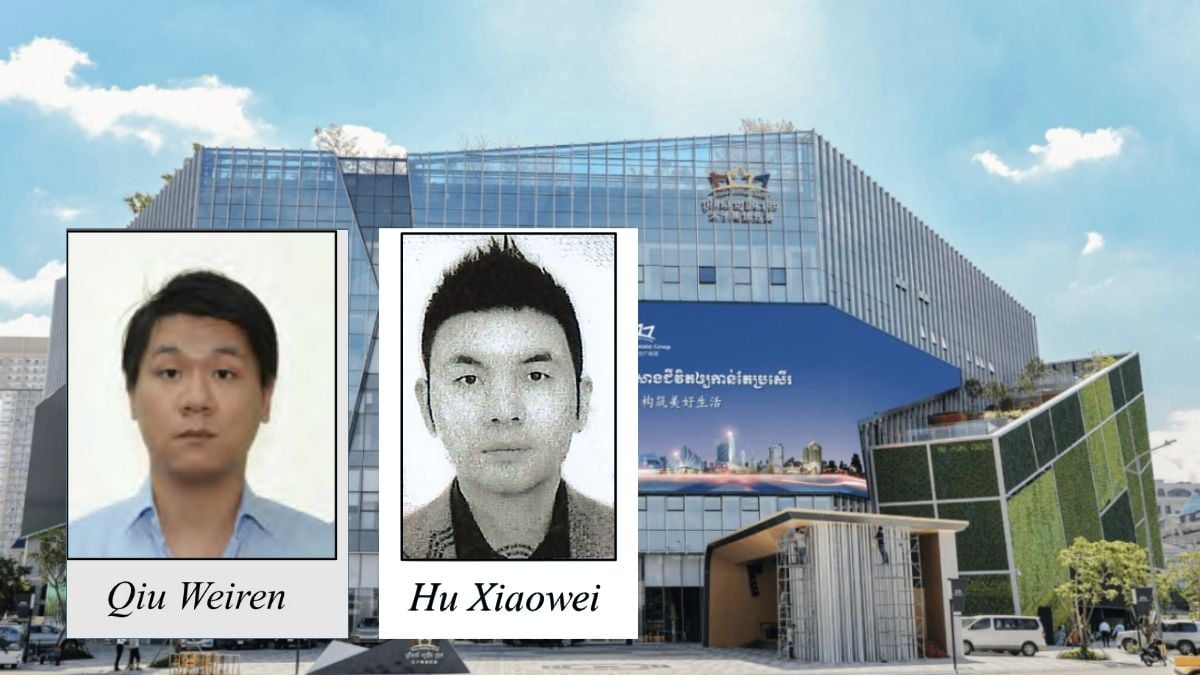
Prince Holding Group (Prince Group), which Chen founded and chairs, is one of Cambodia's largest conglomerates, with interests spanning real estate, financial services, hospitality, banking and e-commerce.
Founded in 2015, the group claims operations across more than 30 countries and has said it oversaw more than US$2 billion in development projects in Cambodia, including Prince Plaza in Phnom Penh.
US charges and international sanctions
In October 2025, the US government charged Chen in absentia with wire fraud conspiracy and money laundering. US authorities alleged that Chen orchestrated a large-scale cryptocurrency scam linked to forced labour camps across Southeast Asia, exploiting trafficked workers to defraud investors worldwide.
Prosecutors alleged that proceeds from the scams were used to purchase luxury assets, including yachts, private jets and a Picasso painting.
On 14 October 2025, Chen was sanctioned by both the United States and the United Kingdom. The US Department of the Treasury designated the Prince Group network as a transnational criminal organisation. If convicted in the United States, Chen faces a maximum sentence of 40 years for wire fraud and money laundering conspiracy.
US authorities have cited varying figures for Bitcoin seized in connection with the investigation. US authorities stated at the time of the charges that more than US$14 billion worth of Bitcoin had been seized, while the US Justice Department subsequently cited a figure of approximately US$15 billion.
Taiwan's Taipei District Prosecutors' Office separately recorded the seizure of approximately 127,271 Bitcoin, valued at more than US$11 billion at the time of its March 2026 statement. The differing figures likely reflect distinct seizure tranches or different valuation dates, and each has been reported with its respective source.
Following Chen's extradition, China's Ministry of Public Security labelled him the "ringleader of a major cross-border gambling and fraud syndicate" and urged his associates to surrender voluntarily. Beijing said those who confessed before 15 February could receive lighter sentences, while those who refused to cooperate would face an "all-out" pursuit.
Charges against Chen in China include opening a casino, fraud, illegal operations and concealing criminal proceeds, according to the Ministry of Public Security.
Taiwan indictment adds to global enforcement picture
The Hong Kong court order forms part of a broader pattern of coordinated international enforcement actions against Prince Group and its associates.
On 4 March 2026, the Taipei District Prosecutors' Office announced the conclusion of its investigation into the group's transnational operations in Taiwan, indicting 62 individuals and 13 companies on charges including violations of Taiwan's Organised Crime Prevention Act and Money Laundering Control Act, as well as illegal gambling and document forgery offences.
Prosecutors calculated that the total amount laundered through Taiwan reached approximately NT$10.8 billion (roughly US$341 million). Seized assets across the Taiwan investigation total more than NT$5.5 billion (approximately US$173.9 million), comprising real estate, luxury vehicles, bank account funds, and movable assets.
Taipei prosecutors are seeking the maximum statutory term of 13 years' imprisonment for Chen under Taiwan law, on the basis that his conduct represents the most serious tier of culpability in the case. The investigation was opened on 15 October 2025, the day after the US Office of Foreign Assets Control sanctions were publicly announced.
Disruption to Prince Group operations
Since Chen's arrest, several Prince Group development projects have faced disruption. Sales were suspended at multiple developments following a public order issued by Cambodia's Real Estate Business and Pawnshop Regulator on 12 January 2026.
Affected projects included Prince Happiness Plaza, also known as The Pinnacle Residence, Prince Golden Bay Condominium, Prince Huan Yu Center Condominium, Prince One Tropica Residential Project and Phum Samrong Residential Project.
Regional context: Southeast Asia's scam industry
Cambodia has been identified by international observers as a major hub in Southeast Asia's transnational cyberfraud industry. Such operations have targeted victims globally through romance scams, fake investment schemes and cryptocurrency fraud.
International organisations estimate global losses from online scams reached up to US$37 billion in 2023, with at least 100,000 people estimated to be working in scam operations in Cambodia alone. Reports indicate some individuals were willing participants, while others were foreign nationals allegedly trafficked and forced to work under threats of violence.
Cambodian authorities say their anti-scam commission raided 118 scam locations and arrested approximately 5,000 people over the six months preceding Chen's arrest.
In mid-January 2026, Prime Minister Hun Manet reaffirmed that tackling crime and digital threats remained a primary national priority, describing cybercrime as a "serious danger to society" and a "complex threat" faced by countries worldwide.