Singapore to embed baseline AI skills across all higher education courses by 2027: Desmond Lee
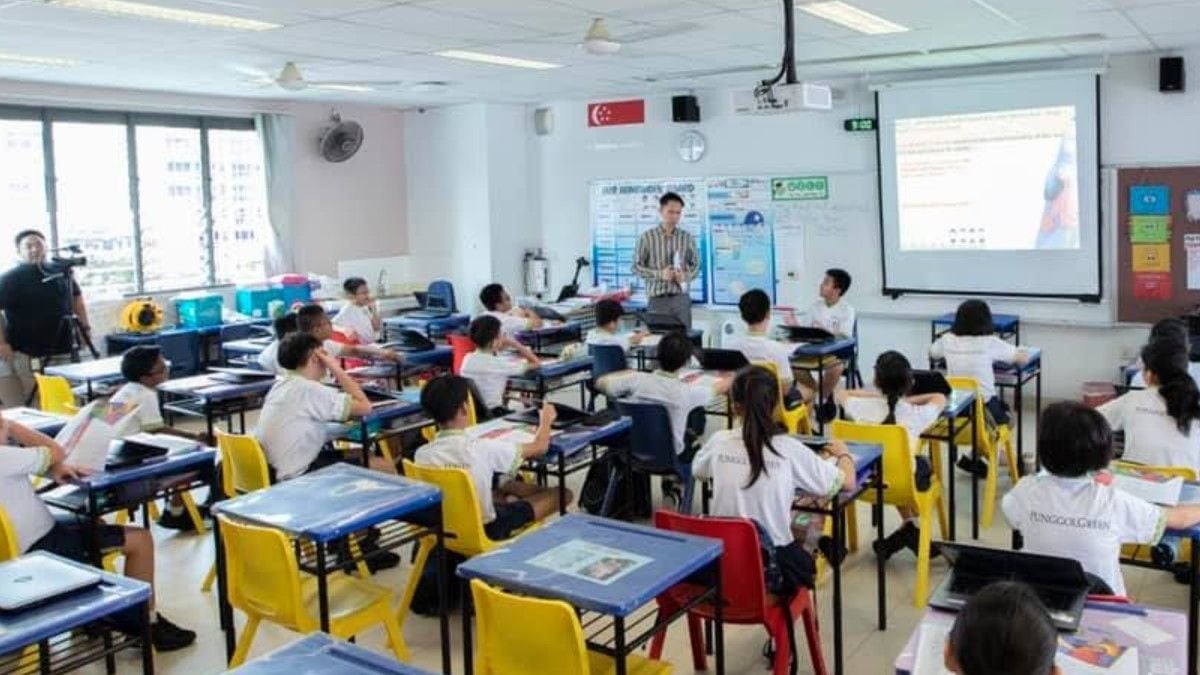
Singapore will require all higher education students to receive baseline artificial intelligence training from 2027, as institutes of higher learning overhaul curricula to prepare students and adult learners for an AI-driven economy.

- Singapore will introduce compulsory baseline AI competencies across all higher education institutions from 2027.
- Universities, polytechnics and ITE will integrate AI skills and ethics into existing curricula and compulsory modules.
- Education Minister Desmond Lee said AI must support, not replace, deep human learning and critical thinking.

SINGAPORE: All students across Singapore’s institutes of higher learning (IHLs) will receive opportunities to develop artificial intelligence competencies within their own disciplines from academic year 2027, as the Government moves to strengthen the country’s workforce readiness for the AI age.
Education Minister Desmond Lee announced the initiative on 21 May 2026 during the National University of Singapore’s (NUS) 120 Distinguished Speaker Series.
The move will see autonomous universities, polytechnics and the Institute of Technical Education (ITE) introduce baseline AI competencies through compulsory modules for all incoming students.
Separate competency frameworks have been developed for autonomous universities and for the polytechnics and ITE sectors.
Lee said the frameworks are intended to ensure every student receives “a consistent and strong foundation in AI competencies” regardless of which institution they attend.
“What is important is the mastery to combine and apply both AI and their deep knowledge meaningfully within their own discipline,” Lee said.
The Education Ministry (MOE) said the initiative forms part of a broader effort to create a coherent learning pathway for students, beginning from secondary school and junior college before continuing into higher education and eventually the workforce.
According to Lee, the frameworks are designed as a “deliberate step-up” from existing AI exposure in schools.
The competency frameworks are structured around MOE’s “Four Learns” model.
Under the framework, students will learn to understand the capabilities and limitations of AI systems, apply AI to deepen learning, use AI to analyse problems and generate solutions, and critically evaluate the ethical, social and legal implications of AI technologies.
“These are not just technical skills. They are the habits of mind we want every IHL student to carry with them beyond graduation,” Lee said.
AI integrated into compulsory curriculum
Singapore’s higher education institutions have already begun revising curricula to align with the new frameworks.
All first-year ITE students currently undergo a module on AI prompt engineering, where they learn how to craft questions to obtain relevant responses from AI systems.
Nanyang Technological University (NTU) has also incorporated AI tools into approximately 40 per cent of its undergraduate courses.
The university is using AI to personalise learning and teach students how AI agents can solve real-world problems.
NTU will also introduce a mandatory course titled Science and Technology for Humanity, which will emphasise the responsible use of AI.
Lee stressed that technology should support pedagogy rather than dictate it.
“AI must never replace deep, human learning in our schools and Institutes of Higher Learning,” he said.
Referencing commentary by NUS President Professor Tan Eng Chye published in The Straits Times earlier in the week, Lee said the struggle involved in researching, questioning and grappling with difficult concepts remains fundamental to education.
“So even though AI can shortcut or short-circuit this process, with quick answers and access to information, our approach must be clear,” Lee said.
“We must continue to ensure that our students are given opportunities to experience such learning struggles.”
Lee added that graduates should become not only competent AI users, but individuals capable of leading, questioning and steering the technology responsibly.
Focus on discipline-specific AI applications
Beyond establishing common competencies, Singapore’s higher education sector will increasingly focus on helping students apply AI within their specific fields of study.
Lee said “the future will belong to professionals” who can combine AI tools with deep disciplinary expertise.
From academic year 2027, all IHL students, including adult continuing education and training (CET) learners, will have opportunities to develop AI competencies directly related to their own disciplines as part of full qualification programmes.
Lee cited examples from NUS’s College of Design and Engineering to illustrate how AI tools are already being integrated into teaching.
Students in the Product Design and Innovation module use large language models such as ChatGPT to refine problem statements and sharpen their thinking during the design process.
Brainstorming tools including Miro are also used to rapidly generate and organise ideas into themes.
Meanwhile, Figma Make enables students to convert written descriptions into product prototypes without building everything manually from scratch.
Despite increasing AI adoption, Lee emphasised that students must continue mastering core disciplinary fundamentals and professional judgement.
“This allows them to apply such domain knowledge when using AI to create and critically evaluate output, refining or rejecting those that fall short of user needs or design objectives,” he said.
Industry consultation and workforce preparation
Singapore’s higher education institutions will continue working closely with industry representatives to ensure programmes remain aligned with evolving workforce demands.
Lee said industry experts already participate through advisory committees, boards and sector coordinating teams.
These representatives provide direct feedback on workforce needs and emerging economic trends.
“Our IHLs will continue to work closely with industry representatives to understand the economy’s evolving needs, and continually adjust their offerings to help prepare students to be work-ready,” Lee said.
The minister also stressed that AI competencies and frameworks must remain flexible as technologies continue evolving.
He said institutions would regularly refresh teaching methods, pilot new approaches and share successful practices across the education sector.
“Even as our IHLs coordinate more tightly and set a common baseline, each institution must continue to develop its own approaches suited to its students’ and courses’ contexts,” Lee said.
He added that institutions should continue “piloting, remembering the broad frame, sharing knowledge with one another, competing as Team Singapore”.
The latest announcement builds on earlier moves by the Government to strengthen AI governance and deployment in education.
In April 2026, Lee announced the formation of a committee to guide AI use across Singapore’s higher education sector.
The committee was established to support the National AI Council, an inter-ministerial body tasked with helping Singapore leverage AI as a strategic advantage.