Truth decay and AI in courts: Chief Justice Menon on challenges facing Singapore judiciary
Singapore's Chief Justice Sundaresh Menon has warned that social media-fuelled truth decay poses a fundamental challenge to public trust in courts, while outlining a traffic light framework governing the judiciary's cautious adoption of artificial intelligence.
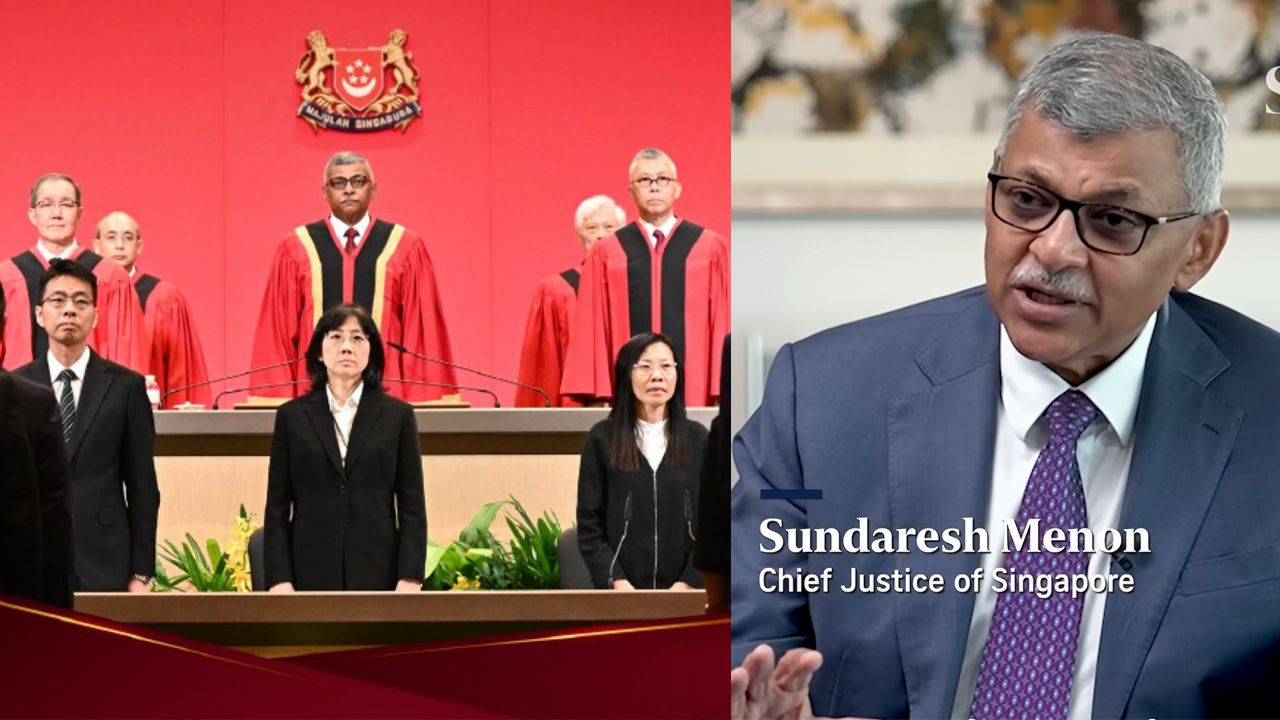

Singapore's Chief Justice Sundaresh Menon has cautioned that the erosion of objective truth, accelerated by social media, poses a structural threat to public trust in courts, which he described as fundamentally truth-seeking institutions.
Speaking to local media at the Supreme Court on 22 May 2026 to mark the judiciary's bicentennial — 200 years since the Second Charter of Justice 1826 established Singapore's modern legal system — Chief Justice Menon addressed a range of issues including artificial intelligence (AI), access to justice, and the renewal of the legal profession.
Truth decay and social media
Chief Justice Menon said that when he looks at social media feeds, he sees a significant number of people commenting on court verdicts without having read even the case summaries provided by the courts.
"They might have read a headline, and then, based on the headline, they jump to various conclusions," he said, adding that he does not believe the problem is widespread and cautioned against overreacting to it.
He nonetheless warned that social media has contributed to a broader, long-term phenomenon of truth decay, by giving anyone with mass reach the platform to propose their own version of facts.
Chief Justice Menon cited an interview by former United States Senator Ben Sasse to The New York Times, which described how the proliferation of news outlets had fragmented audiences into echo chambers, contributing to the breakdown of shared truth in the United States.
He said this matters deeply for courts because, if most people believe the judiciary is making decisions in ways other than discerning truth from evidence, the consequences extend far beyond online commentary.
"You have a huge breakdown, a breakdown of confidence in the courts, breakdown of order in society," he said.
Case summaries and plain language
To guard against this, Chief Justice Menon said the judiciary makes it a priority to publish reasons for its judgments and to make them accessible to a general audience.
The courts produce case summaries written to be comprehensible to laypeople, and Chief Justice Menon said judges must write with multiple audiences in mind.
"You're also writing judgments to speak to the parties, and more importantly, in a sense, you're writing judgments to speak to your country," he said.
He also described the establishment of an Access to Justice division within the courts, whose focus extends beyond pro-bono legal assistance to encompass every point of friction a court user might encounter.
This includes redesigning official court correspondence, which had historically been drafted with lawyers in mind and was laden with legal jargon. Letters have since been redesigned using plain language, highlights and visual cues, to make key information immediately accessible to self-represented parties and laypeople.
He noted that surveys of court users show people generally leave courts feeling they have had a fair hearing, and that Singapore is among the few countries where public trust in institutions outranks trust in corporations.
"I think that that is a track record that we have to work really hard to preserve," he said.
Traffic light model for AI
On the use of AI in the courts, Chief Justice Menon described a traffic light framework developed by the judiciary to evaluate and govern AI adoption.
Under the model, areas categorised as red are those the courts will not consider delegating to AI. These include judicial decision-making and the prediction of case outcomes. Chief Justice Menon said that even when AI predictions prove accurate, permitting them risks compromising judicial integrity.
He explained that judgement — the human act of weighing evidence, understanding a person's circumstances and emotions, and applying moral reasoning — is a core judicial function that cannot be delegated.
"At a variety of levels, as human beings, when you come before the law and you stand before a judge, you want to feel that the person who judges you understands your emotions, understands your life, understands your situation, and is able to judge those imponderables," he said.
Amber zones cover areas requiring cautious evaluation. These include AI-assisted tools to help self-represented litigants structure and articulate their arguments more clearly, and the use of AI to summarise lengthy submissions for judges.
On the latter, Chief Justice Menon noted a practical concern: where parties have submitted 500 pages of arguments they considered necessary, condensing this to under 100 pages using AI risks producing disputes over accuracy and adequacy — and raises the question of whether the court can be said to have considered all material that was placed before it. The judiciary has not approved such use.
Green zones encompass areas where AI has already been deployed or is being actively developed. These include AI-powered translation and case summarisation tools at the Small Claims Tribunals, as well as AI-assisted legal research through LawNet.
The courts are also developing guided platforms to assist parties in uploading evidence in an organised sequence, rather than submitting all documents as a single undifferentiated batch. AI would then assist in summarising the uploaded material.
An additional green-zone development under consideration is the use of AI algorithms to suggest maintenance quantum in divorce proceedings.
Under the proposed approach, if both parties accept the AI-generated figure, it can be incorporated into a court order. If a party contests the suggestion and ultimately obtains no better outcome from litigation, they may bear the costs of that choice.
Responsibility, not prescription
Chief Justice Menon explained that the judiciary's governance approach for AI does not set out prescriptive rules, on the basis that policing AI use is impractical in a world where AI is embedded in commonly used software such as Microsoft Word.
Instead, the framework rests on a principle of personal accountability: lawyers and self-represented litigants are responsible for everything they submit to the court and cannot use AI as a shield against that obligation.
Internally, judges are encouraged to use AI for legal research and database queries, but are prohibited from using it to draft judgments or to summarise documents submitted to the court.
Chief Justice Menon also flagged the risk of over-reliance, noting that AI often produces answers that appear highly credible, which can cause users to lower their guard. He also identified the digital divide as a concern, saying AI must not become a barrier to justice for those who lack digital literacy or access to technology.
"It is not just about learning how to use AI, but more importantly about understanding its limitations and what it cannot do, so that we always remain alert and cautious in applying it," he said.
Impact on young lawyers
Chief Justice Menon expressed concern about the effect of AI on the formation of legal skills among younger lawyers.
He said that lawyers of his generation built their analytical abilities through years of iterative manual work — repeated drafting, research and reading — that cumulatively developed a disciplined method of legal reasoning.
Given that ChatGPT became widely prominent from December 2022, the current crop of newly qualified lawyers will have undertaken much of their legal training with AI as a significant presence.
"It's going to be a real challenge for us to figure out how we deal with the generation of people who have gone through their legal training entirely in AI," he said.
He said the judiciary must closely monitor how AI shapes — or impairs — the acquisition of foundational lawyering skills. The lawyers of tomorrow, he added, will need to be able to work with technology in ways that amplify rather than substitute for genuine legal knowledge and reasoning.
The path ahead
Looking ahead, Chief Justice Menon said the judiciary's core priorities remain preserving public trust, expanding access to justice, monitoring AI developments closely and ensuring the legal profession continues to produce capable lawyers.
On the composition of the Supreme Court bench, he noted its current diversity — drawing from private practitioners, former prosecutors and academics — and reflected that his own two decades in private practice materially changed his perspective.
"I don't think I am the same lawyer I was when I left private practice," he said.
He expressed gratitude that the courts had not struggled to attract people of the right calibre and character. "I hope that will continue," he said.
Chief Justice Menon declined to comment on his own retirement plans, emphasising instead the resilience of the judiciary as an institution that does not depend on any single individual.
Under Singapore's Constitution, the standard retirement age for Supreme Court judges, including the Chief Justice, is 65, with provisions for extensions.
This report is compiled from quotes published by CNA, The Straits Times, and Lianhe Zaobao.