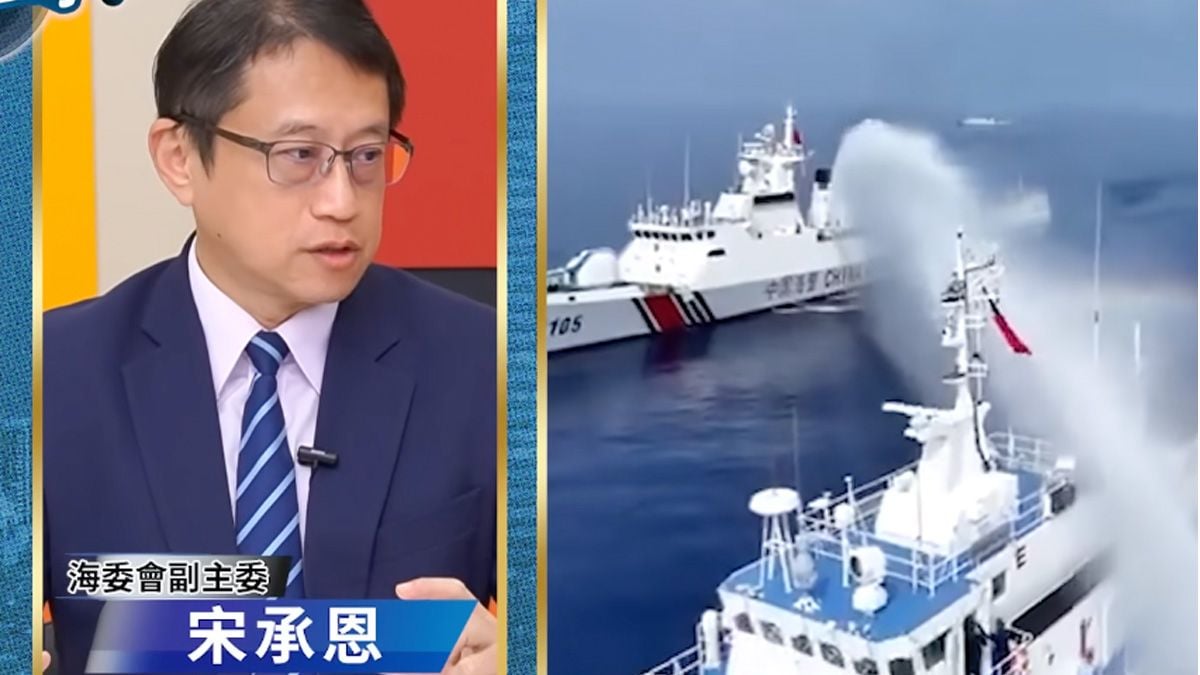
China escalates military and coast guard pressure on Taiwan over two days as Japan-Philippines maritime talks draw Beijing's ire
China deployed coast guard and naval assets around Taiwan across two consecutive days on 1 and 2 June 2026, as Beijing condemned Japan-Philippines plans to negotiate maritime boundaries in waters it claims east of Taiwan.

- China Coast Guard, led by CCGS Daishan, patrolled east of Taiwan on 1 June citing Japan-Philippines maritime boundary talks.
- Taiwan's MND reported PLA naval vessels operating around Taiwan across both 31 May–1 June and 1–2 June 2026.
- Seven PLA aircraft sorties all entered Taiwan's southwestern ADIZ on 1–2 June; ROC Armed Forces responded with CAP aircraft and missiles.

China mounted two consecutive days of elevated military and coast guard activity around Taiwan on 1 and 2 June 2026, as Beijing condemned Japan and the Philippines for announcing plans to begin negotiations on maritime boundary delimitation in waters east of Taiwan that China claims as its own.
Taiwan's Ministry of National Defense (MND) documented People's Liberation Army (PLA) naval and coast guard deployments across both reporting periods, activating combat air patrol (CAP) aircraft, navy ships, and coastal missile systems on each occasion.
Coast guard task group deployed on 1 June
At 0956 hours on 1 June 2026, China Coast Guard (CCG) spokesman Jiang Lue announced that a CCG task group led by CCGS Daishan had conducted routine law-enforcement patrols in waters east of Taiwan.
Jiang described the deployment as a direct response to what he called the "unilateral announcement" by Japan and the Philippines to begin maritime delimitation negotiations in those waters.
"This is a necessary operation in response to the announcement by Japan and the Philippines on their own, to begin negotiations on maritime delimitation in the waters east of China's Taiwan island, which seriously infringed upon China's territorial sovereignty and maritime rights and interests," Jiang said.
He demanded that Tokyo and Manila "immediately cease all illegal acts that undermine China's sovereign rights and interests" and said the CCG would "continue to strengthen control and management over relevant waters and take real actions to resolutely safeguard national sovereignty and maritime rights and interests."
China's Foreign Ministry had declared the Japan-Philippines talks "completely illegal, null and void" when they were announced the previous week.
Two days of PLA naval activity around Taiwan
Taiwan's MND, in its report covering the period from 0600 hours on 31 May to 0600 hours on 1 June 2026, detected seven People's Liberation Army Navy (PLAN) ships and four official vessels operating around Taiwan. No PLA aircraft were detected during that period; accordingly, no flight path illustration was provided.
ROC Armed Forces nonetheless deployed CAP aircraft, navy ships, and coastal missile systems in response to the naval activity.
In the subsequent reporting period — covering 0600 hours on 1 June to 0600 hours on 2 June 2026 — the MND detected a further seven sorties of PLA aircraft alongside eight PLAN ships and five official vessels operating around Taiwan. All seven aircraft sorties entered Taiwan's southwestern Air Defence Identification Zone (ADIZ). ROC Armed Forces again responded with CAP aircraft, navy vessels, and coastal missile systems.
Taiwan also reported detecting two Chinese vessels southeast of Orchid Island during this period, though both remained outside restricted waters. Taiwan's authorities condemned the CCG activity.
Japan and Philippines defend planned talks
Japan and the Philippines had announced the previous week that they would begin negotiations to define the maritime boundary between their exclusive economic zones (EEZs) and continental shelves in accordance with international law. An EEZ may extend up to 200 nautical miles from a country's baselines under the United Nations Convention on the Law of the Sea (UNCLOS).
Neither government has publicly released detailed coordinates for the area covered by the negotiations.
Japan's Chief Cabinet Secretary Minoru Kihara said any agreement between Japan and the Philippines on maritime boundary delimitation would not be legally binding on any third party, and that there was therefore "no issue under international law."
The announcement followed a summit in Tokyo between Philippine President Ferdinand Marcos Jr. and Japanese Prime Minister Sanae Takaichi, at which both leaders announced plans to deepen security and economic cooperation.
Marcos said both sides had agreed to begin talks on a General Security of Military Information Agreement, maritime border delimitation, and the possible transfer of Abukuma-class vessels to the Philippines.
"These are very important steps to further strengthen our defence cooperation and uphold a rules-based maritime order," Marcos said at a joint press conference with Takaichi.
Takaichi described the Philippines as one of Japan's closest like-minded partners and said both governments had agreed to elevate relations to a Comprehensive Strategic Partnership.
Economic and defence cooperation
Tokyo and Manila also signed a double taxation avoidance agreement. Marcos said the agreement was intended to improve the business environment and promote cross-border investment.
On defence equipment, Takaichi said both governments would accelerate exchanges over the possible transfer of Abukuma-class vessels and other military hardware. Japan has been in discussions with the Philippines on expanded cooperation, including warships, as both countries deepen security ties.
The two governments agreed to work on supply chain resilience and said they would explore upgrades to the Japan-Philippines Economic Partnership Agreement and the Japan-ASEAN Comprehensive Economic Partnership Agreement.
Takaichi also expressed support for strengthening medical product supply chains and for establishing an oil reserve system in the Philippines, as well as joint oil stockpiling among Association of Southeast Asian Nations (ASEAN) members.