Taiwan warns 17 Yiguandao followers remain detained in China after group labelled a 'cult'
At least 17 Taiwanese Yiguandao followers remain detained in mainland China, according to Taiwan's Mainland Affairs Council. Officials warned that Beijing now treats Yiguandao as a banned "cult" organisation, exposing followers to severe criminal penalties under Chinese law.
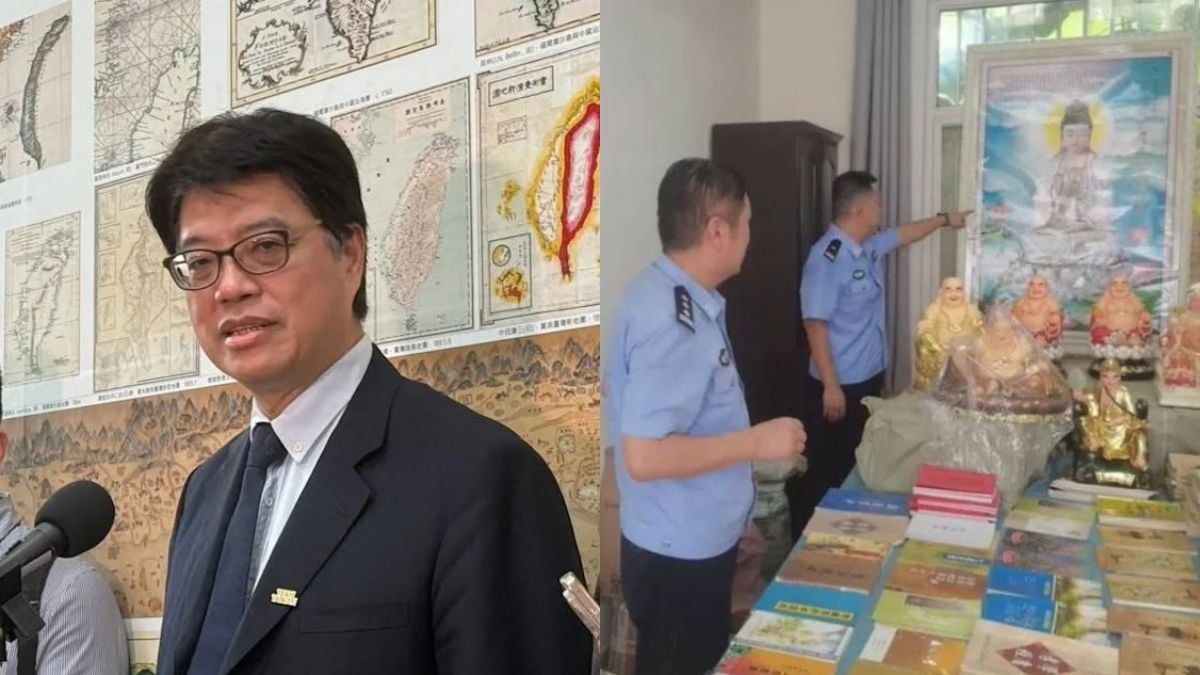
- Taiwan says 17 Yiguandao followers remain detained in mainland China.
- Officials warn Yiguandao followers may face prosecution under China's Criminal Law.
- Taipei is increasing warnings about risks linked to religious exchanges with China.

TAIPEI, TAIWAN: Taiwan's Mainland Affairs Council (MAC,大陸委員會) has disclosed that at least 17 Taiwanese followers of Yiguandao (一貫道) remain detained in mainland China, warning that adherents of the religious movement face heightened legal risks after Chinese authorities reportedly classified the group as a banned "cult" organisation.
The disclosure was made by MAC Minister Chiu Chui-cheng (邱垂正) during a legislative session on 17 June 2026, where lawmakers questioned the government's assessment of religious freedom and religious exchanges across the Taiwan Strait.
According to Chiu, a total of 20 Taiwanese citizens have been arrested or detained by Chinese authorities for religious-related reasons in recent years. Of those, 17 were followers of Yiguandao, while only three individuals have since been released.
"Relevant authorities in China have already classified Yiguandao together with Falun Gong as a cult organisation," Chiu told lawmakers.
"If prosecuted under China's Criminal Law Article 300, those convicted could face prison sentences of more than three years."
Concerns over religious exchanges
The issue was raised during questioning by Democratic Progressive Party legislator Chang Hung-lu (張宏陸), who questioned Beijing's approach towards religious exchanges with Taiwan.
Chang argued that Chinese authorities encourage religious exchanges on one hand while detaining some Taiwanese participants on the other, asking whether such actions reflected genuine religious freedom.
In response, Chiu said China's religious administration operates under the Chinese Communist Party's United Front Work Department and serves political objectives rather than religious freedom.
"Their religious management is for united front purposes and has nothing to do with religious freedom," Chiu said.
He added that Taiwanese authorities have been monitoring cross-strait religious exchanges and strengthening public awareness efforts regarding potential risks faced by religious groups travelling to mainland China.
Chiu singled out Yiguandao as one of the groups facing particularly elevated risks.
"We are actively explaining these risks to religious organisations. Followers of Yiguandao, in particular, should exercise extreme caution when travelling to mainland China for missionary activities," he said.
Warning over future prosecutions
Chang also expressed concern that Taiwanese Yiguandao followers could eventually face legal risks in China simply because of their religious identity, rather than specific missionary activities.
Chiu acknowledged such concerns.
"That possibility exists because Chinese authorities have formally classified Yiguandao as a cult organisation, which significantly raises the risks," he said.
He added that Taiwan had communicated its concerns to Chinese authorities through existing channels.
"If they do not welcome these followers, they can deport them. They should not use criminal law to sentence them," Chiu said.
The MAC said it continues to monitor individual cases and has sought to assist affected families through available channels.
Rise in detention cases
The warning comes amid broader concerns about the treatment of Taiwanese citizens travelling to mainland China.
According to figures provided by Chiu, the number of Taiwanese reported missing, unaccounted for or subjected to restrictions on personal freedom in China increased sharply following Beijing's release of the so-called "22 measures against Taiwan independence" in 2024.
Taiwan recorded 55 such cases in 2024.
The figure rose to 221 cases in 2025. As of May 2026, authorities had already recorded 85 cases this year.
Separately, Interior Minister Liu Shih-fang (劉世芳) previously estimated that more than 20 cases involving religious personnel had been officially reported to Taiwan authorities. However, she suggested the actual number could be significantly higher.
According to Liu, the total number of individuals from various religious groups affected by similar circumstances could be between 70 and 80 people, including cases that were never formally reported.
Earlier arrests drew attention
The issue gained public attention in 2024 after Chinese police reportedly raided a private residence in Zhongshan, Guangdong Province, where Yiguandao followers had gathered to read religious scriptures.
According to accounts provided by relatives and religious associates, three Taiwanese Yiguandao followers in their seventies were among those arrested during the operation.
The incident prompted family members in Taiwan to seek assistance from the Taiwanese government and appeal for intervention with Chinese authorities.
Taiwan's government has maintained that it supports normal religious exchanges between people on both sides of the Taiwan Strait.
However, officials have repeatedly stated that they oppose the detention of religious visitors without clear justification.
Legal implications under Chinese law
Taiwanese officials have highlighted Article 300 of the Criminal Law of the People's Republic of China as a key source of concern.
The provision criminalises organising or using religious sects, cult organisations or superstitious activities to undermine the implementation of state laws and administrative regulations.
Penalties under the article range from fines to lengthy prison terms, including life imprisonment in serious cases.
Taiwanese authorities argue that the broad scope of the provision creates significant legal uncertainty for followers of religious groups that Chinese authorities consider prohibited organisations.
Background on Yiguandao
Yiguandao, meaning "Consistent Way" or "Way of Pervading Unity", is a Chinese religious movement that combines elements of Confucianism, Buddhism and Taoism.
The faith originated in China in the early twentieth century and later expanded across Taiwan and overseas Chinese communities.
The movement has a substantial following in Taiwan and is known for charitable activities, moral teachings and religious outreach.