Taiwan holding the line against intensifying Chinese maritime pressure: officials
Taiwan's Ocean Affairs Council officials say Beijing is escalating maritime pressure around Taiwan, citing Chinese vessels entering restricted waters near Pratas and Itu Aba. The Coast Guard Administration has adopted a shadowing and monitoring strategy to deny access without using force.
- Officials say China is escalating maritime pressure across multiple areas around Taiwan.
- Coast Guard adopts shadowing and monitoring strategy to deny access without force.
- Incursions continued through the Dragon Boat Festival holiday, minister says.

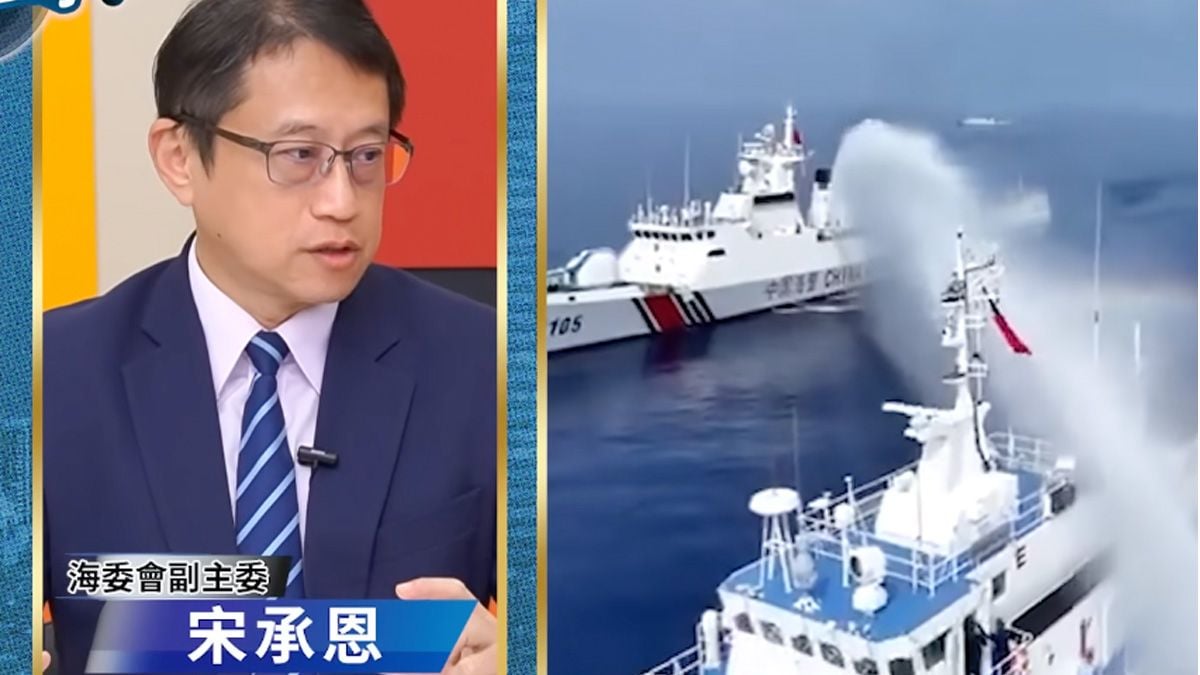
China is exploiting recently announced maritime boundary talks between Japan and the Philippines to justify expanding pressure on Taiwan, Ocean Affairs Council Deputy Minister Sung Chen-en said in an interview.
Beijing has launched a cognitive warfare campaign claiming Taiwan's government is too weak to protest the talks, and that China is therefore protesting on Taiwan's behalf, Sung said.
He rejected the claim outright, describing it as a pretext for Chinese expansion. Beijing is attempting to turn rights it does not possess into rights it claims to hold, manufacturing a dispute in an area where none exists, he said.
The remarks were made in an interview on the Chinese-language Liberty Times programme published on Friday, 19 June 2026.
Japan and the Philippines announced in late May that they would hold talks to delimit overlapping maritime areas. Sung said the talks carry the international-law principle that they do not bind third states.
The negotiations concern only the possible overlapping boundary between Japan's Ryukyu outlying islands and the Philippines' Batanes Islands, and the parties have repeatedly stated they do not affect third-party rights, he said.
Sung dismissed criticism from some commentators that the Coast Guard Administration (CGA) was weak, or that Taiwan's absence from the exclusive economic zone (EEZ) talks amounted to a surrender of sovereignty.
China had deepened its harassment of waters around Taiwan well before the talks were announced, which proves the claims are merely a pretext for its conduct, he said.
Elaborating on the principle that the talks do not bind third states, Sung made three points. First, international practice includes mechanisms to avoid encroaching on third-party rights, safeguarding Taiwan's interests.
Second, Taiwan can still negotiate separately with Japan and the Philippines, and has in fact signed fishing agreements or established joint operational zones with both, he said.
Third, the rights and obligations defined between Japan and the Philippines cannot be used to enforce against Taiwanese fishermen. Taiwan's maritime interests have not been harmed, and the government would never overlook the rights to which Taiwan is entitled, he said.
Confronting China's narrative campaign over jurisdiction, the council's primary strategy is transparency, Sung said. It has compiled events since May into a table shared with international partners, exposing and rebutting the unlawfulness of Beijing's conduct.
He cited the 2016 South China Sea arbitration as a precedent, in which the Philippines accused the People's Republic of China (PRC) of interfering with its fishermen and oil exploration. The tribunal ultimately ruled China's conduct unlawful.
A unilateral assertion of jurisdiction cannot stand and requires a legal basis, Sung said. The PRC and the Republic of China are not subordinate to one another, and the Chinese Communist Party has never governed Taiwan for a single day.
Beijing therefore has no jurisdiction over Taiwan's waters, he said. Its attempt to establish rights through grey-zone harassment does not hold legally, because power cannot be used to create rights.
On the practical response at sea, Sung said China had recently taken the unprecedented step of crossing the median line to broadcast at foreign-flagged merchant vessels, demanding navigational information such as their destination ports.
The captain of the Taiwanese vessel Changbin immediately broadcast a rebuttal in choppy seas, stating that China held no jurisdiction or sovereign authority in the area and telling the merchant ship it could disregard the demand.
The captain added that the vessel should report to Taiwan's coast guard ships if it required assistance. Sung described this as a firm measure that also signalled to the international community that Taiwan maintains order in the area.
On international cooperation, Sung said the victims of Chinese harassment included not only Taiwan but also Japan and the Philippines. Taiwan continues to deepen cooperation through liaison officers, policy dialogue, humanitarian and disaster-relief drills, and AI and drone-based maritime monitoring.
He highlighted the Philippines' experience with transparency, noting that a Philippine coast guard vessel had once used skilled manoeuvring that led a dangerously pursuing China Coast Guard ship to collide with one of its own military vessels, causing casualties.
Tonnage is not everything, Sung said. Taiwan's coast guard personnel are full of resolve, and their skills are no less capable than those of the Philippines, enabling them to repel an unlawful China through peaceful enforcement.