Who really serves? Singapore's national service burden falls on a shrinking few
Singapore maintains one of the more extensive national service obligations in the Asia-Pacific, yet imposes that burden on a demonstrably shrinking base of male citizens while exempting large portions of a growing immigrant population. Parliamentary records, a decade of survey data, official population figures and regional comparisons reveal a system whose equity assumptions have not kept pace with demographic and economic reality.
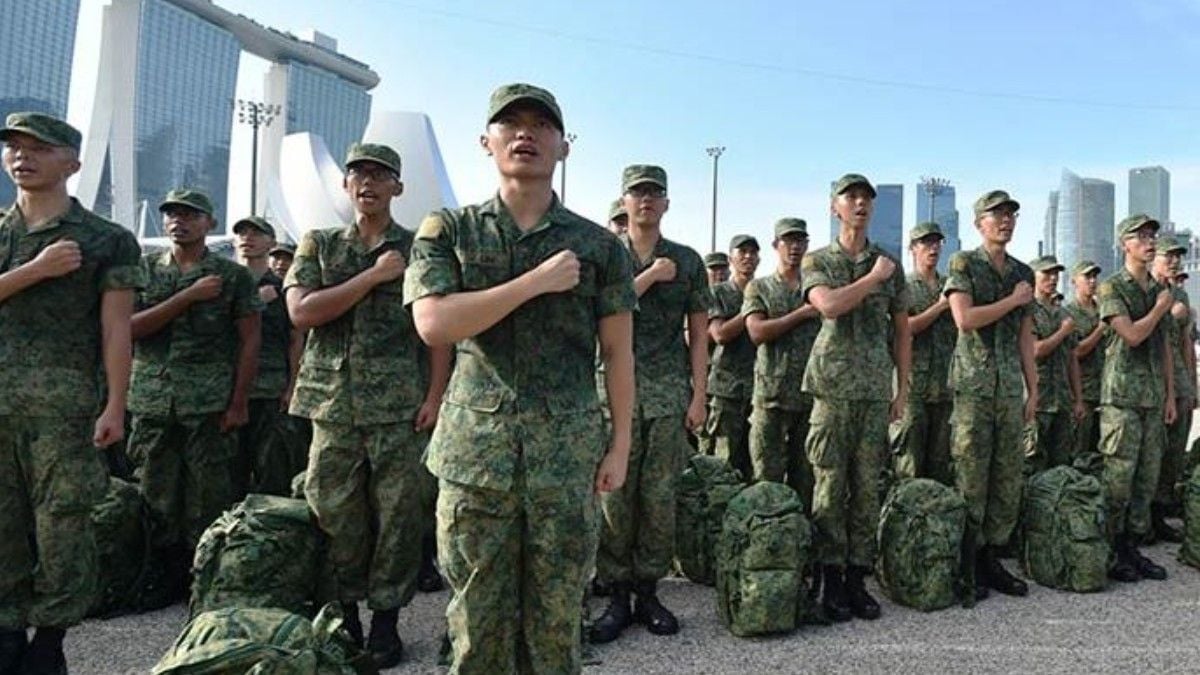

Singapore's national service obligation is among the most extensive maintained by any country in the Asia-Pacific.
Male citizens serve two full years of full-time national service, followed by operationally ready national service — commonly known as reservist — extending across roughly two decades of their working lives.
That two-year obligation is the most visible component of what is in practice a multi-decade commitment.
After completing full-time national service, male Singaporeans enter the operationally ready national service cycle which runs for roughly a decade and includes annual in-camp training exercises and standby obligations.
The total liability — full-time service plus reservist — extends from enlistment at 18 to discharge in the early forties for non-officers and the early fifties for commissioned officers.
This editorial focuses primarily on the full-time national service component and its equity dimensions, but the reservist obligation compounds the opportunity cost and career disruption arguments at every stage of a man's working life.
That commitment is broadly accepted. Research consistently shows strong public support for national service as an institution.
What the same research also consistently shows, and what official discourse has been slower to address, is that the burden is falling on an increasingly narrow demographic base, the civilian value of the obligation is declining in public estimation, the exemption architecture contains a documented citizenship timing pathway that continues to exist within the current policy framework, and the opportunity cost borne by those who serve has never been honestly quantified in official debate.
The obligation in regional context
Singapore's two-year full-time obligation exists alongside reservist liability extending to age 40 for non-officers and age 50 for commissioned officers.
The total duration of obligation — from enlistment at 18 to reservist discharge in the early forties — spans roughly a quarter of a male citizen's working life.
Regional comparisons require care because threat environments differ, but the comparisons are nonetheless instructive.
South Korea faces an active armistice with a nuclear-armed neighbour. Its legislature recently passed an amendment to the Military Service Act raising the age of exemption from mandatory service from 38 to 43, after the Military Manpower Administration documented more than 5,000 individuals per year being disposed of as wartime workers by exploiting the age exemption threshold — primarily through long-term overseas residence.
The Korean legislature's implicit finding was that the unsuitability-due-to-age rationale for exemption had become a mechanism for deliberate evasion, and responded by extending obligations rather than narrowing them. The principle embedded in the amendment is that age alone does not extinguish a duty that was never discharged.
Korea's reservist obligation runs for eight years after discharge from full-time service, followed by up to five years in the Civil Defense Corps, with full discharge at age 40 — a comparable total obligation window to Singapore's, but maintained against a demonstrably more acute threat environment.
Taiwan, facing direct cross-strait military pressure from the People's Liberation Army sufficient to justify reinstating a full year of compulsory service for males born from 1994 onward, sets its upper conscription age at 36 — lower than Singapore's 40 for non-officers.
According to a senior military official cited by the Central News Agency (CNA) in March 2025, the number of Taiwanese conscripts performing a full year of service in 2025 increased by 41 per cent compared to 2024, reflecting a deliberate policy expansion in direct response to a deteriorating security environment.
Singapore's official threat assessment characterises the regional environment as stable.
The government's defence posture rests on deterrence and the Five Power Defence Arrangements rather than active threat response.
The government has never publicly argued that Singapore faces a threat environment comparable to South Korea or Taiwan, yet its total obligation — full-time service plus reservist liability — sits alongside or exceeds those of states facing demonstrably more acute security circumstances.
The nation-building justification is the more honest official rationale for the two-year duration, and it deserves engagement rather than dismissal.
Institute of Policy Studies (IPS) research conducted in October 2013, drawing on a nationally representative sample of 1,251 citizens, found that the top three purposes Singaporeans associated with national service were instilling discipline and values, national defence, and transforming boys into men — framing it as a formative social institution as much as a military one.
A decade later, the 2022 IPS study found that nearly all respondents — 98 per cent — agreed that national service is necessary for Singapore's defence, and 93 per cent said they would support compulsory national service even if there were no immediate threat. These are not the numbers of a population chafing against an unwanted institution.
But public support for national service as an institution and public satisfaction with how its burdens are distributed are different questions.
The same research reveals a widening gap between what national service is valued for and what it actually delivers to those who serve it.

A shrinking cohort bearing a fixed burden
The Ministry of Defence's (MINDEF) written reply to Parliament on 12 February 2026 provided enlistment data that makes the demographic position visible.
Annual average full-time national service enlistment across the Singapore Armed Forces (SAF), Singapore Police Force (SPF) and Singapore Civil Defence Force (SCDF) fell from approximately 23,300 in the 2016 to 2020 period to approximately 21,300 in the 2021 to 2025 period.
The decline is a direct consequence of Singapore's falling birth rate. Deputy Prime Minister Gan Kim Yong told Parliament on 26 February 2026, during the budget debate for the Prime Minister's Office, that birth rates are falling at an unprecedented pace.
Singapore's resident total fertility rate hit a new historic low of 0.87 in 2025, down from 0.97 in 2024, with approximately 27,500 resident births recorded — the lowest in the country's history and an 11 per cent decrease from the 30,808 births in 2024.
The population pyramid published in Population in Brief 2025 makes the structural position visible.
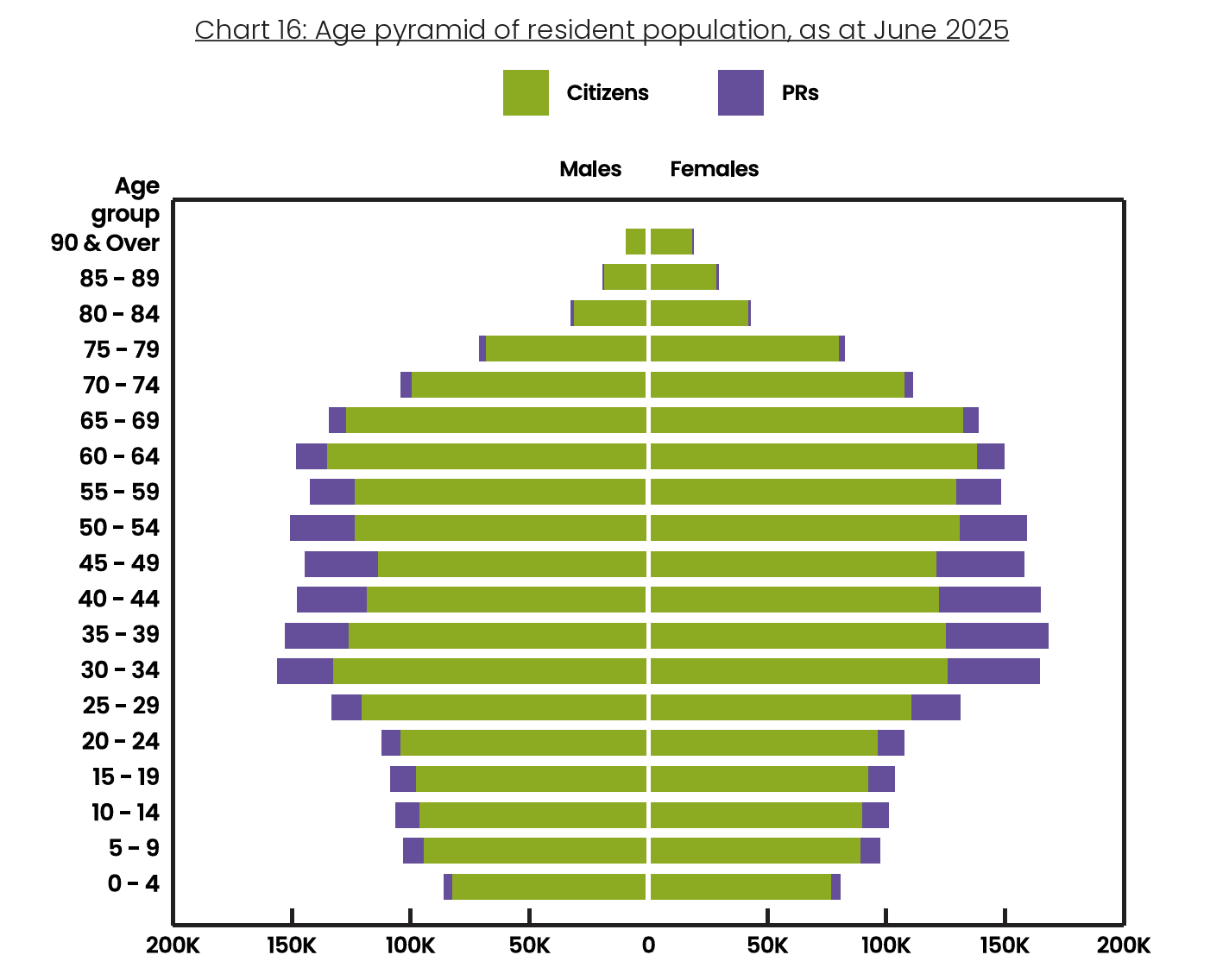
The male citizen cohorts in the core national service age bands are visibly narrower than the cohorts above them. The pipeline feeding future enlistment cohorts, represented by the youngest age bands, is the narrowest of all.
Then-Defence Minister Ng Eng Hen acknowledged the consequence directly in Parliament in August 2022. Without the contribution of new citizens and permanent residents, he said, the SAF's smaller birth cohorts would have impacted manpower needs more acutely. New citizens and permanent residents now form approximately 20 per cent of annual full-time national service enlistees.
The NS system is, by the government's own account, increasingly reliant on immigration to offset shrinking birth cohorts.
Yet the same immigration system contains categories of new citizens and permanent residents who do not bear equivalent obligations. The result is a manpower model that depends on immigration while distributing the burden of service unevenly within that immigrant intake.
Who serves and who does not
The rules governing national service liability for new citizens and permanent residents were stated clearly by Ng in his August 2022 ministerial statement, delivered to correct what he characterised as misleading assertions by then-Non-Constituency Member of Parliament Leong Mun Wai.
Under the Enlistment Act, all male Singapore citizens and permanent residents between the ages of 18 and 40 for non-officers and 50 for officers are liable for national service.
However, males who receive citizenship as mature adults, typically in their 30s and 40s, are not enlisted.
The stated rationale is twofold: they are not suitable for full-time national service at that age, and they did not enjoy socioeconomic benefits prior to their citizenship.
New male citizens who stayed in Singapore when young and enjoyed economic and social benefits are enlisted when they reach 18 years of age.
Ng stated that roughly half of new male citizens registered each year are enlisted for NS. The remaining group consists primarily of males who naturalised as mature adults and are exempt from enlistment.
In 2024, Singapore granted 22,766 new citizenships and 35,264 new permanent residencies, according to Population in Brief 2025.
During the August 2022 exchange, Leong repeatedly sought the cumulative number of new citizens who had not performed NS.
Ng repeatedly responded with the number of new citizens who had served or would serve NS.
The cumulative figure requested by Leong was not provided during the exchange and has not appeared in any subsequent parliamentary answer.
The Korean amendment illustrates an alternative policy approach, one that treats age-based exemption as a factor that may require legislative intervention where it creates pathways for avoidance.
Singapore has acknowledged the existence of the citizenship timing pathway but has not proposed legislation to alter it.
Permanent residents who do not convert to citizenship fall largely outside the obligation structure, yet continue to benefit from many public goods and state-supported systems that national service is intended to defend. They may purchase resale HDB flats, access public healthcare at subsidised rates relative to foreigners, and enrol their children in Singapore's public schools. The principal civic right they do not possess is the right to vote.
The opportunity cost that official debate ignores
The most consequential gap in Singapore's public debate about national service is the absence of any honest reckoning with what the obligation actually costs those who bear it.
A male Singaporean who completes secondary school or junior college and enters full-time national service at 18, completing at 20 before proceeding to a four-year university programme, will graduate at approximately 24 to 25.
A female peer, or a foreign-born male peer not subject to Singapore's NS obligation, entering the same university at 18 will graduate at 22 to 23 and enter the workforce two years earlier.
Based on median graduate employment outcomes published in March 2026, a representative university graduate entering the workforce two years later because of full-time national service would forego approximately S$148,000 in wages and CPF contributions over that period.
This is calculated on the median gross monthly salary of S$4,500 for recent graduates, employer CPF contributions of 17 per cent and employee contributions of 20 per cent at current rates effective 1 January 2026, across 24 months of foregone employment.
The figure is conservative — it does not account for foregone work experience and oppurtunities, delayed career progression, the compounding effect on lifetime CPF accumulation, or the delayed entry into the housing market that CPF accumulation enables.
It also does not account for the ongoing career disruption from reservist cycles across the subsequent decade of a man's working life.
The same principle applies to diploma holders.
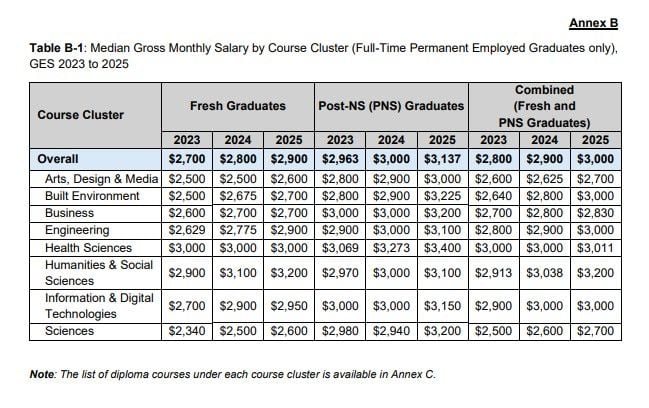
The 2025 Polytechnic Graduate Employment Survey reported a median gross monthly salary of S$3,000 for recent graduates in full-time permanent employment, implying a combined wage and CPF opportunity cost of approximately S$99,000 over two years — substantial by any measure, and borne entirely without CPF contributions during the NS period itself.
Against this, the NSF receives a monthly allowance of S$755 at recruit level rising to S$865 at second-year corporal rank, with no CPF contributions.
Total allowances received over two years at the corporal rate amount to approximately S$20,760.
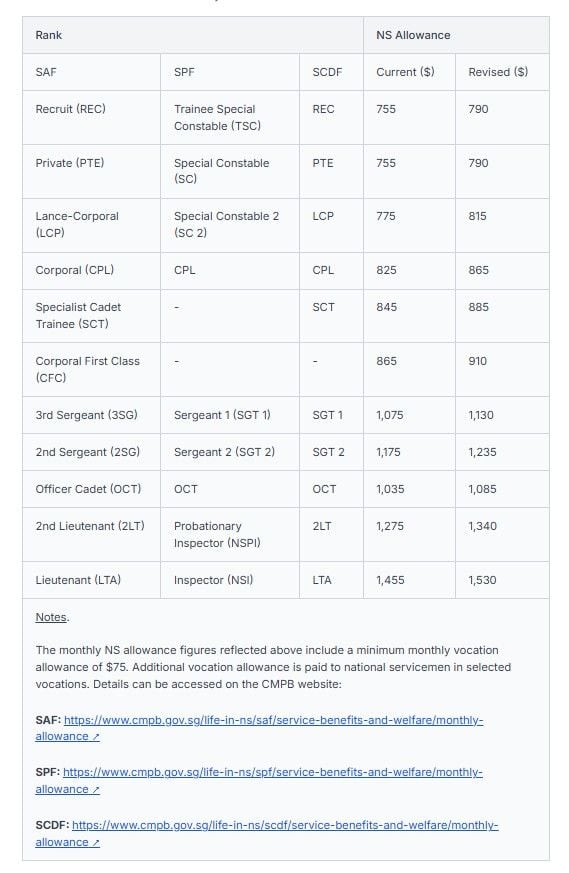
MINDEF's own lawyers told the High Court in 2016, in proceedings arising from the death of full-time national serviceman Lee Rui Feng Dominique Sarron, that the NSF allowance is neither a salary nor computed as one, and exists merely to support the serviceman's basic personal upkeep.
The gap between what male Singaporeans give up and what they receive in return has never been stated plainly in official debate.
The employment data compounds the argument.
The proportion of fresh university graduates who found full-time permanent roles fell from 79.4 per cent in 2024 to 74.4 per cent in 2025.
The 2025 Polytechnic Graduate Employment Survey found that 90 per cent of polytechnic graduates in the labour force were employed within six months of completing school or national service, down from 95.8 per cent in 2023.
Among those in the labour force, only 54.2 per cent secured full-time permanent employment.
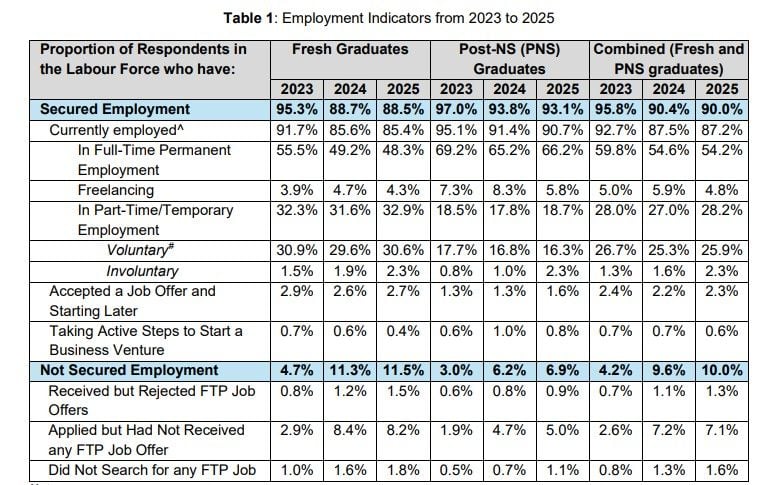
The challenge facing young men is therefore not simply that national service delays labour market entry.
It delays labour market entry into a market that has become visibly more competitive than it was only a few years earlier.
A male graduate entering the job market at 24 to 25 is doing so two years behind foreign-born peers who faced that same market when conditions were marginally better.
The allowance question — what Parliament has repeatedly asked
The allowance question is not new.
It has been raised in Parliament across multiple decades and has received the same essential non-answer each time.
In the Budget debate of 8 March 2004, People's Action Party (PAP) backbencher Leong Horn Kee, speaking in Parliament at Sitting No. 5 of the Tenth Parliament, made the argument plainly. NSF servicemen are relatively poorly paid compared to their regular counterparts, he said, and this gap should be narrowed or eliminated.
He further argued that the two and a half years of national service should be formally recognised as career seniority in the civil service and private sector, so that men who served are not penalised against non-Singaporean colleagues who spent those same years building experience and employer relationships.
Leong Horn Kee was not an opposition MP. He was a PAP member speaking from his own party's benches.
In the ministerial statement on national service defaulters delivered on 16 January 2006, then-Defence Minister Teo Chee Hean was explicit on the compensation question.
The government had over the years introduced initiatives to recognise the efforts and sacrifices of national servicemen, he said, but these initiatives can never fully compensate our NSmen for their sacrifice and the effort they commit to serving the nation.
In the same sitting, PAP Member of Parliament Amy Khor Lean Suan catalogued what the obligation actually demands: "Surely, this cannot be worth a mere $3,000 — the two to two-and-a-half years of tough, regimented training, 5.00 am stand-by beds, night topography exercises, being food to hordes of mosquitoes in the jungle, 20-kilometre route marches in full battle order."
Her point was about the inadequacy of penalties for defaulters, but the logical implication was identical to what Kenneth Tiong would raise twenty years later: if the sacrifice commands more than S$3,000 as punishment for those who dodge it, it commands more than S$755 a month for those who do not.
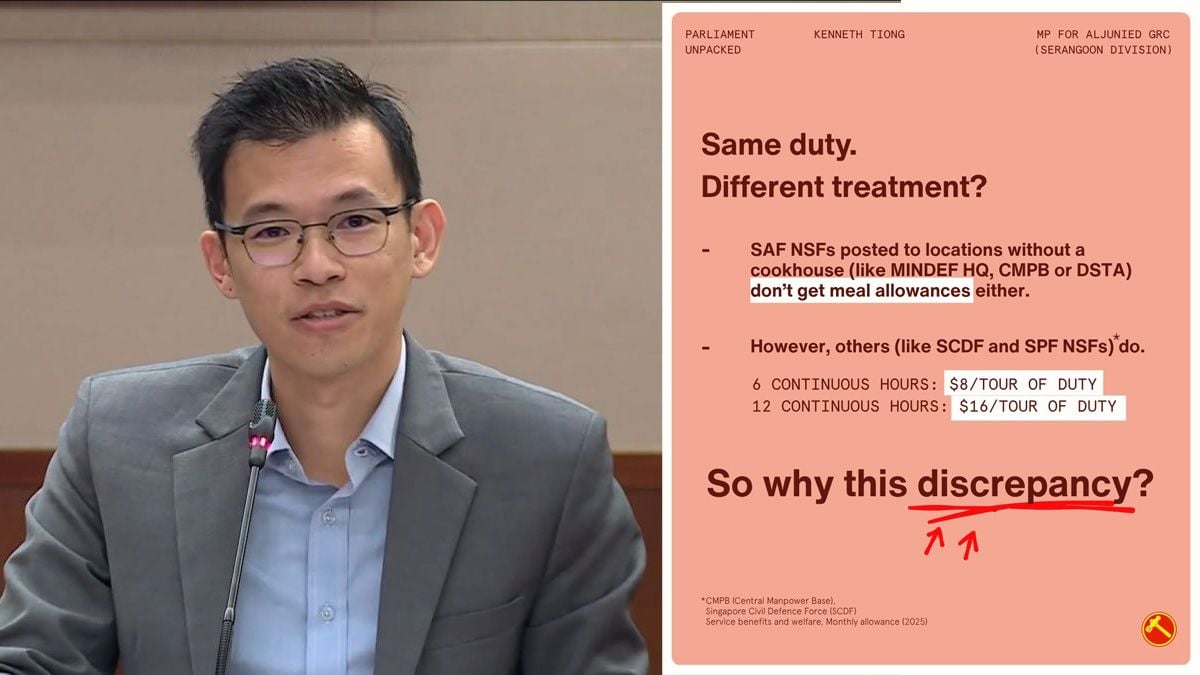
In the Committee of Supply debate of 27 February 2026, Workers' Party (WP) MP Kenneth Tiong Boon Kiat proposed raising second-year NSF allowances to the Local Qualifying Salary (LQS) floor of S$1,800, noting that a second-year corporal in a combat vocation earns approximately S$1,035 monthly with no CPF contributions.
The LQS is the administrative floor below which foreign workers on work permits and S passes cannot be employed in Singapore. Tiong estimated the cost of meeting the LQS floor for second-year NSFs at between S$150 million and S$200 million annually — less than one per cent of the S$25 billion defence budget.
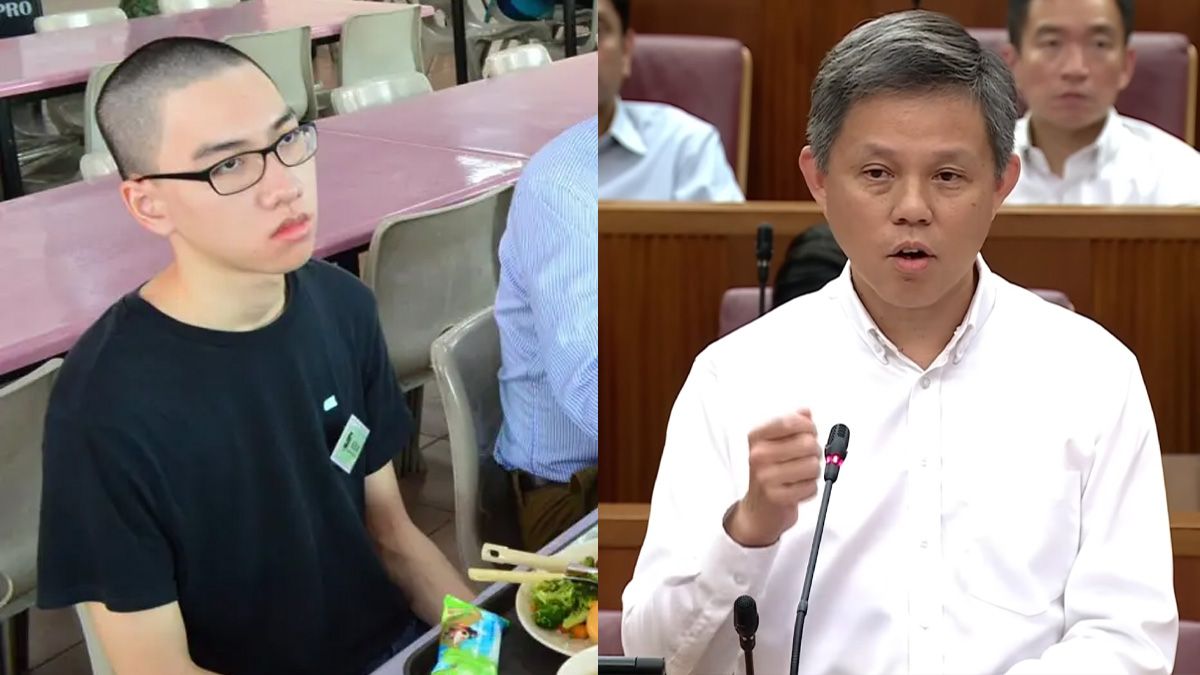
Defence Minister Chan Chun Sing declined, drawing a distinction between duty and compensation and warning against reducing national service into a transactional relationship.
The argument has now been made by a PAP backbencher in 2004, acknowledged as permanently under-compensated by a PAP defence minister in 2006, and refused again in 2026.
The men serving today are receiving the same answer Singaporeans were receiving two decades ago.
The only things that have changed are that the cost of living is substantially higher, the graduate opportunity cost is larger, the new citizen intake is greater, and the total fertility rate has fallen to 0.87 — the lowest ever recorded.
The civilian value question
The nation-building justification for the two-year duration requires that national service deliver something meaningful beyond military readiness — that the shared experience creates the cross-demographic bonds and common identity the government says it does.
The IPS data across a decade shows this rationale weakening in public estimation precisely in the domains that matter most for young men entering the workforce.
The 2013 IPS study found that to learn skills useful for civilian job employment ranked seventh out of eight stated purposes of national service, with a mean score of 4.35 out of 6. National service improves one's civilian employment prospects ranked last among perceived benefits, with 88 per cent agreeing — already the weakest finding in that category.
By 2022 that figure had declined to 81 per cent — a seven percentage point drop. The perceived importance of national service for learning skills useful for civilian employment had fallen by 13 percentage points among those rating it extremely or very important between 2013 and 2022, the steepest decline of any category measured across the nine years between studies.
The IPS 2022 study's own summary was direct: national service may increasingly be seen as a disruptor of work given the pace of change in the labour market.
The employer disadvantage compounds this. The 2022 IPS study found that 36 per cent of employed national servicemen felt their employer preferred to hire individuals without national service commitments — down from 42 per cent in 2013, but still more than one in three.
The study itself noted that employer support may be driven by the mandatory nature of national service obligations rather than genuine preference, a reading consistent with focus group testimony from human resources decision makers who described accommodating reservist absences as a compliance matter.
The lower-income dimension
The IPS 2022 study documented a dimension of the national service burden that receives little official attention.
Focus group participants from lower-income households described moonlighting during full-time national service to support their families, applying for leave to care for infirm parents, and experiencing financial hardship that official support structures did not adequately address.
The S$755 monthly recruit allowance is not designed to substitute for the income a young man from a lower-income household might otherwise contribute.
For families depending on that contribution, the two-year obligation is not an equal sacrifice. The S$99,000 opportunity cost figure computed for polytechnic graduates, while substantial, understates the proportional burden on households where even entry-level wages represent a significant share of family income.
What reform might look like
The IPS 2013 study found that 84 per cent of Singaporeans considered the two-year duration just right for fulfilling its defence mandate. That figure is frequently cited in arguments against reform. It requires context.
The survey was conducted among citizens only — permanent residents were excluded as the numbers were too small to be meaningful, meaning the sample systematically excluded those whose exemption from the obligation might have produced different views on its duration.
It was conducted in a pre-pandemic, pre-AI labour market that has since changed significantly. And the 2022 IPS study did not replicate the duration question directly, making a clean trend comparison impossible.
What the 2022 study did find was that the perceived importance of national service for instilling discipline and values had fallen by 19 percentage points between 2013 and 2022, and the perceived importance for transforming boys to men had fallen by 14 percentage points — precisely the nation-building functions most frequently invoked to justify the duration.
The reforms announced since the 2022 study address the experience of national service.
The Ministry of Defence has introduced SkillsFuture@NS learning platforms, Work-Learn Schemes allowing national servicemen to attain diplomas or partial university credits in selected vocations, and enhanced NS HOME awards providing CPF top-ups and cash credits at completion milestones. The July 2023 allowance increase was the fourth in a decade.
These measures address the experience of national service.
They do not address the duration question, the exemption architecture for mature new citizens, the structural position of permanent residents who bear no equivalent obligation, the citizenship timing pathway that allows the obligation to be avoided entirely, or the opportunity cost — S$148,000 for university graduates, S$99,000 for polytechnic graduates — that male Singaporeans absorb while their foreign-born peers accumulate the salary, CPF, and career experience they cannot. Nor do they address the decade of reservist obligations that follow, compounding the career disruption long after the two years of full-time service have ended.
Tiong's February 2026 parliamentary exchange proposed a concrete and costed reform: raising second-year national service allowances to at least the LQS floor of S$1,800, at a cost of less than one per cent of the defence budget.
Chan declined.
What the data shows across a decade is not a population that has lost faith in national service. It is a population that continues to support the institution while growing more sceptical of its civilian value, more aware of its unequal distribution, and less persuaded that the duration and architecture of the obligation have kept pace with the demographic and economic reality in which it now operates.
This matters because the strongest public case for two years of national service has historically rested not merely on military necessity but also on nation-building and character formation. Yet IPS data suggests public confidence in precisely those functions has declined over the past decade. If Singapore continues to require two years of full-time service, the burden increasingly falls on policymakers to explain why that duration remains necessary in today's demographic and economic environment.
The question is not whether Singapore needs national service. The question is whether the current structure of that obligation — its duration, its exemptions, its allowances, its distribution, and its hidden cost — reflects the principles of equity and universality that have always been its stated foundation.