Singapore retrenchments rise to 3,830 in 1Q2026 as restructuring hits degree holders and PMETs
Singapore's retrenchments rose to 3,830 in the first quarter of 2026, driven largely by restructuring in manufacturing, financial services and professional services. Degree holders and PMETs remained the most affected, even as employment growth, hiring demand and AI adoption continued to reshape the labour market.
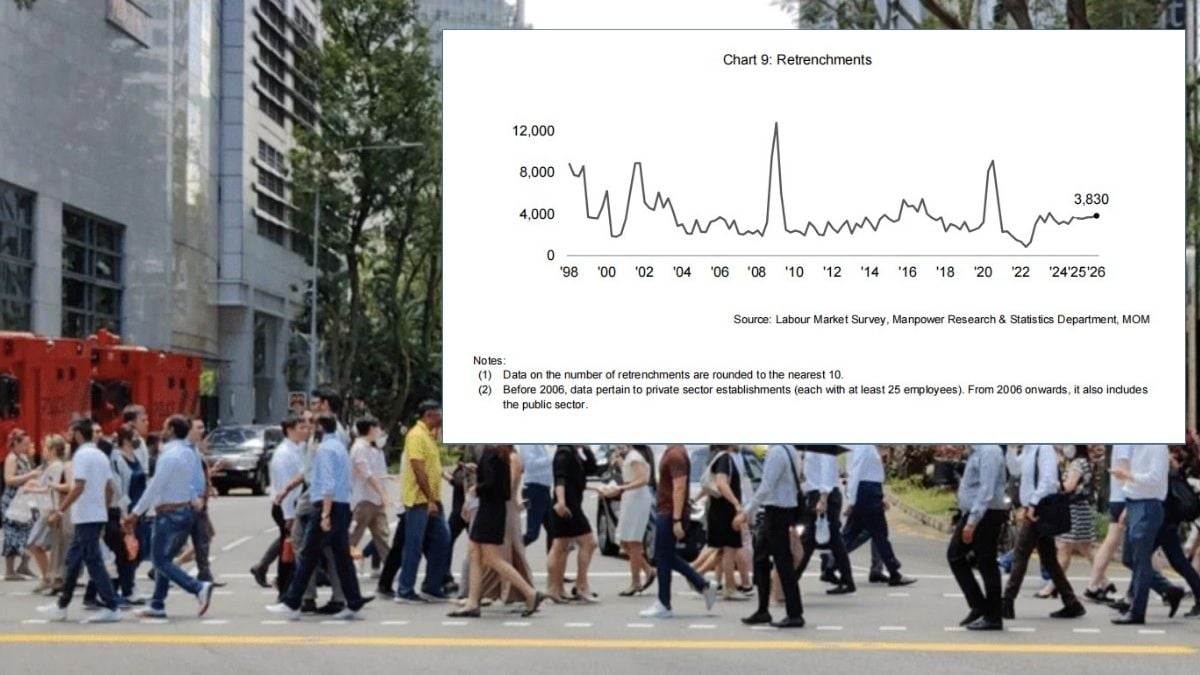
- Retrenchments rose to 3,830 in Q1 2026, driven mainly by restructuring rather than cost-cutting.
- Degree holders and PMETs recorded the highest retrenchment incidence among workers.
- Employment continued to grow and re-employment rates improved despite slower labour demand.

SINGAPORE: Retrenchments in Singapore increased during the first quarter of 2026 as businesses continued restructuring operations amid global economic uncertainty, with degree holders and Professionals, Managers, Executives and Technicians (PMETs) bearing the brunt of the layoffs.
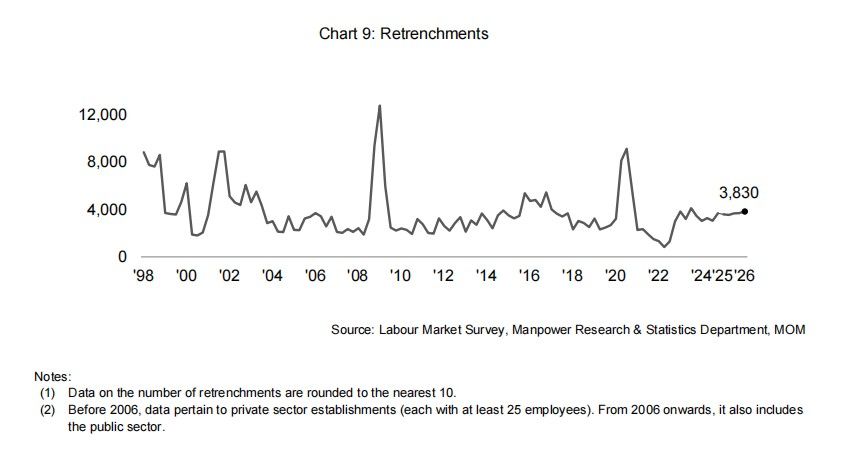
According to the Ministry of Manpower's (MOM) latest Labour Market Report, 3,830 employees were retrenched between January and March, up from 3,690 in the previous quarter.
While the increase marked a continuation of cautious labour market conditions, the ministry stressed that retrenchment levels remained within non-recessionary norms.
The rise was concentrated in outward-oriented sectors exposed to global economic developments, particularly manufacturing, financial services and professional services.
Business reorganisation and restructuring remained the dominant reason for layoffs, accounting for 73.8 per cent of retrenchments.
By comparison, only 9.3 per cent were attributed to cost-cutting measures.
MOM said the data suggested employers were primarily reshaping operations and workforce structures rather than responding to immediate financial distress.
"The increase in retrenchments was concentrated in external-oriented sectors such as Manufacturing, Financial Services and Professional Services," the ministry said in its report.
Retrenchment incidence remained at 1.6 per 1,000 employees, below the pre-pandemic non-recessionary average of 1.7 per 1,000 employees.
Restructuring impacts highly educated workers
The most notable shift during the quarter was among degree holders.
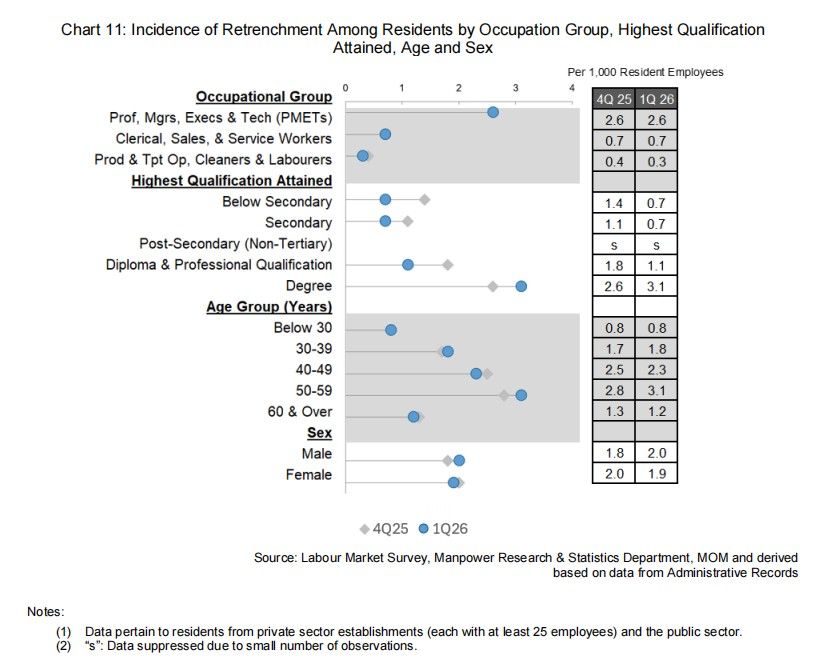
The retrenchment incidence for degree holders rose sharply from 2.6 to 3.1 per 1,000 resident employees, making it the highest among all educational qualification groups.
MOM said the trend reflected ongoing organisational restructuring in professional and knowledge-intensive industries, where higher-skilled employees are more heavily represented.
By contrast, retrenchment incidence fell among workers with lower educational qualifications.
Employees with secondary school qualifications or below recorded a retrenchment incidence of 0.7 per 1,000 resident employees, while those holding diploma and professional qualifications registered 1.1 per 1,000 resident employees.
PMETs continued to face the greatest retrenchment risk among occupational groups.
Their retrenchment incidence remained unchanged at 2.6 per 1,000 resident employees, significantly higher than clerical, sales and service workers at 0.7 per 1,000, and production-related workers at 0.3 per 1,000.
Older workers also experienced increasing retrenchment pressure.
Among residents aged 50 to 59, retrenchment incidence increased from 2.8 to 3.1 per 1,000 employees, the highest among all age groups. Workers below 30 continued to record the lowest incidence at 0.8 per 1,000 employees.
Manufacturing and services sectors drive layoffs
Manufacturing recorded the largest increase in retrenchments, rising from 570 workers in the fourth quarter of 2025 to 670 in the first quarter of 2026.
Financial services retrenchments increased from 510 to 560 workers, while professional services saw a sharper jump from 410 to 570 workers.
Within the broader services sector, retrenchments also rose in information and communications, increasing from 480 to 530 workers.
The data showed that PMETs accounted for the overwhelming majority of retrenched employees.
Of the 3,830 workers retrenched during the quarter, approximately 3,320 were PMETs, underscoring the concentration of restructuring among higher-skilled occupations.
Labour market remains resilient
Despite higher retrenchments, MOM maintained that overall labour market conditions remained resilient.
Total employment expanded by 9,400 in the first quarter, marking the 18th consecutive quarter of growth.
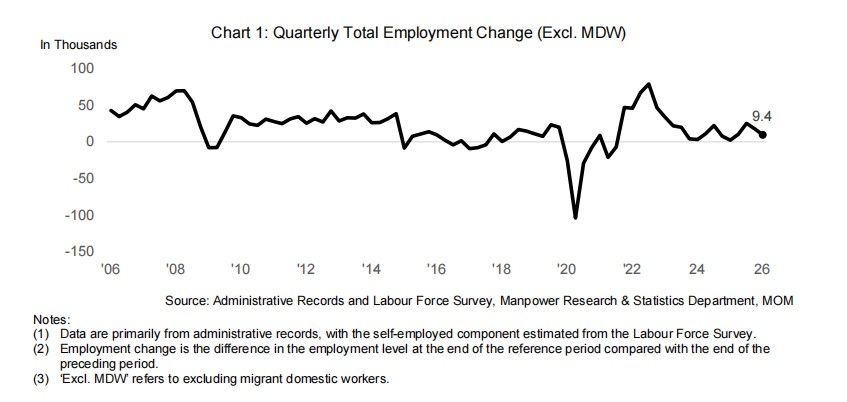
Although slower than the 17,700 increase recorded in the previous quarter, the moderation was mainly due to weaker growth in non-resident employment, particularly in construction and manufacturing.
Resident employment growth actually strengthened during the quarter, rising from 3,100 in the fourth quarter of 2025 to 5,400 in the first quarter of 2026.
Administrative and support services generated significant gains, particularly in employment activities and travel-related services.
Growth was also recorded in transportation and storage, as well as public administration.
Singapore's economy expanded by 6.0 per cent year-on-year during the quarter, providing continued support for labour demand.
Unemployment rates remained low and stable.
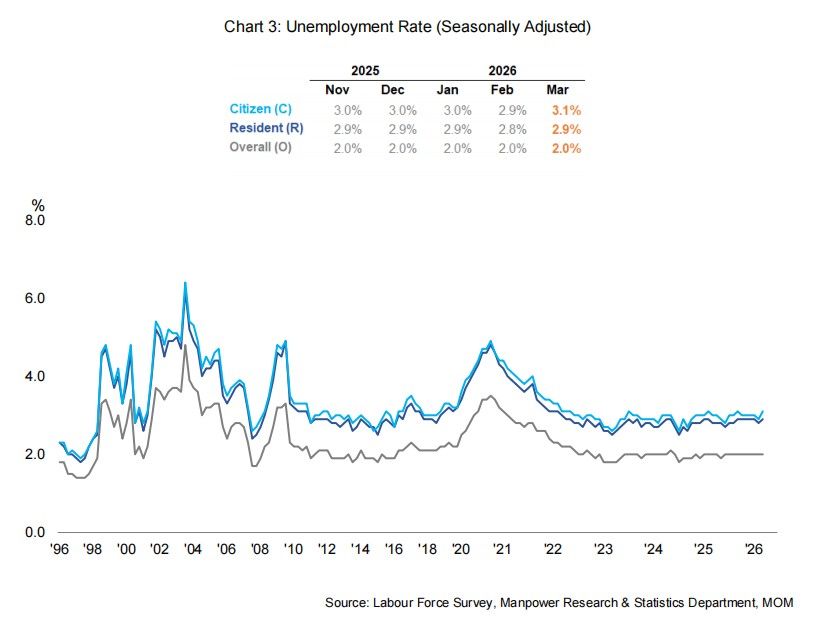
The overall unemployment rate stood at 2.0 per cent in March 2026, while resident and citizen unemployment rates were 2.9 per cent and 3.1 per cent respectively.
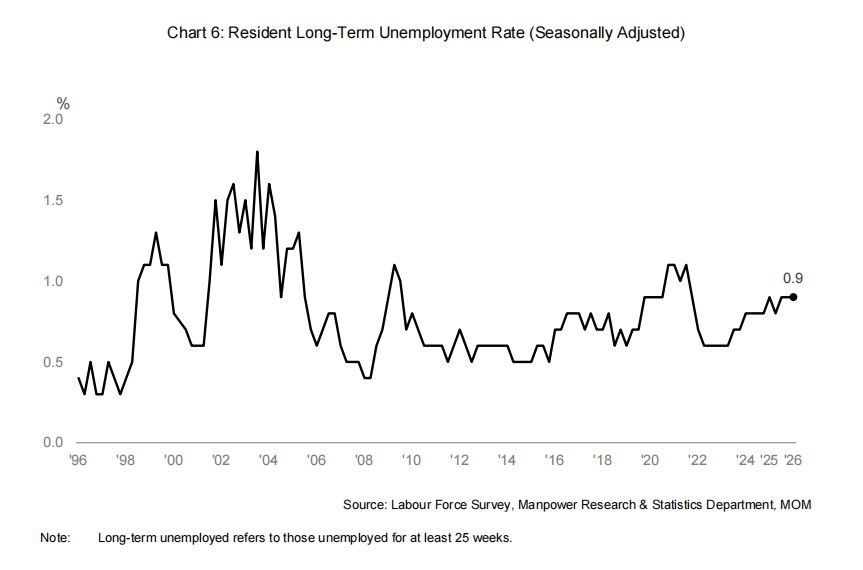
The resident long-term unemployment rate remained unchanged at 0.9 per cent.
More retrenched workers finding jobs
One of the strongest indicators of labour market resilience was the improvement in re-employment outcomes.
The proportion of retrenched residents who found employment within six months increased to 60.7 per cent, up from 57.4 per cent in the previous quarter.
Among those retrenched a year earlier, 69.4 per cent had successfully returned to work.
The improvement was broad-based across educational and occupational groups.
Re-employment rates among PMETs rose from 56.4 per cent to 59.6 per cent.
Degree holders also recorded better outcomes, with re-entry rates increasing from 53.9 per cent to 58.3 per cent.
Younger workers below 30 experienced one of the strongest improvements, with re-employment rates climbing from 70.8 per cent to 87.1 per cent.
Speaking to reporters, Manpower Minister Dr Tan See Leng acknowledged the challenges facing affected workers but pointed to improving re-employment outcomes as an encouraging sign.
"Retrenchment is never easy. But what encourages me is that we are seeing more retrenched workers finding their way back to employment quicker," he said.
Dr Tan added that the newly established Skills and Workforce Development Agency would be better positioned to support workers through enhanced career guidance, job matching and reskilling initiatives.
AI reshaping jobs rather than replacing them
For the first time, MOM's quarterly labour market report included a dedicated assessment of artificial intelligence's impact on employment.
The findings suggest AI is currently changing the nature of work more significantly than reducing overall workforce numbers.
Only 28.5 per cent of companies in Singapore reported adopting AI technologies in 2025.
Adoption rates were highest in digitally intensive sectors, including information and communications, professional services, and financial and insurance services.
Among firms implementing or piloting AI, only 6.2 per cent reported headcount reductions linked to the technology.
A further 8.5 per cent reported lower hiring levels.
By contrast, 18.9 per cent said they had redesigned job functions after adopting AI.
The findings indicate that employers are more likely to restructure tasks and workflows than eliminate positions outright.
"AI will indeed change the way we work, but what we are seeing so far is that it's actually helping to reshape jobs more than replace them," Dr Tan said.
Workers also reported largely positive experiences with the technology.
According to MOM's survey findings, about 85 per cent of AI users experienced improvements in productivity, time savings or work quality.
"This is exactly why helping workers to pick up new skills and adapt to changing job requirements matters so much as more companies adopt AI," Dr Tan added.
The minister noted that around 400 individuals participated in Workforce Singapore career conversion programmes for redesigned roles, including positions involving AI-related functions, during 2025.
Hiring slows as uncertainty grows
While labour demand remained positive overall, signs of moderation became more visible during the quarter.
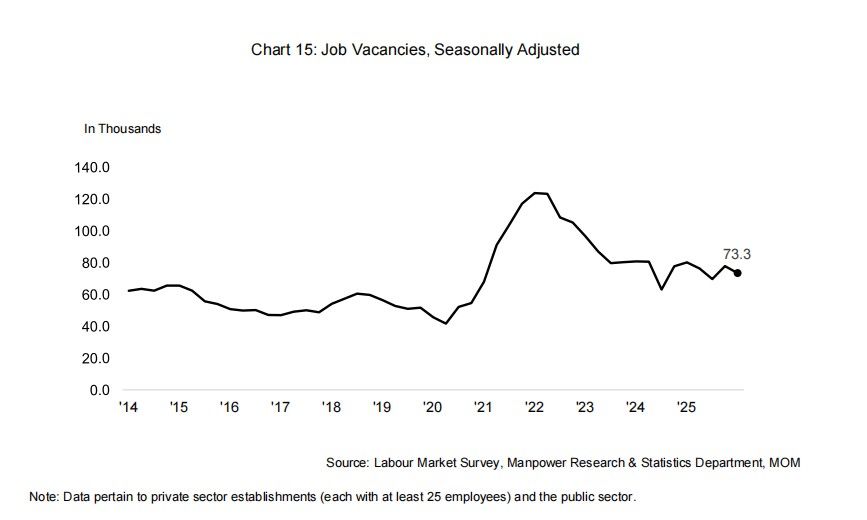
Job vacancies fell from 77,700 in December 2025 to 73,300 in March 2026.
The ratio of vacancies to unemployed persons declined from 1.58 to 1.46, though vacancies still exceeded the number of job seekers.
Recruitment activity also weakened.
The average monthly recruitment rate fell to 1.6 per cent, while the resignation rate dropped to a record low of 1.0 per cent.
MOM said the trend reflected slower labour market churn rather than widespread weakness.
Workers appeared increasingly reluctant to leave existing positions amid economic uncertainty, while employers adopted a more selective hiring approach.
The financial and insurance services sector recorded its lowest-ever resignation rate at 0.6 per cent.
Food and beverage services and retail trade also saw resignation rates fall to multi-year lows.
At the same time, firms increasingly relied on temporary workforce adjustments instead of retrenchments.
The number of employees placed on short work-weeks or temporary layoffs rose to 1,230, the highest level since the fourth quarter of 2021.
Most of the increase occurred in construction and manufacturing.
MOM said the trend suggested employers were choosing reduced working hours as a temporary response to softer demand rather than implementing permanent job cuts.
Looking ahead, the ministry expects labour market conditions to remain generally resilient but cautioned that hiring and wage growth could soften if geopolitical tensions, elevated costs and global uncertainty persist.
Business surveys conducted by MOM showed fewer firms planning to hire or raise wages in the coming months, indicating a more cautious outlook among employers despite continued economic expansion.