Political ideology linked to Messi or Ronaldo preference, global study finds
An international survey of more than 10,000 people across 26 countries finds that liberals tend to favour Lionel Messi while conservatives lean towards Cristiano Ronaldo, with the effect strongest among younger adults.
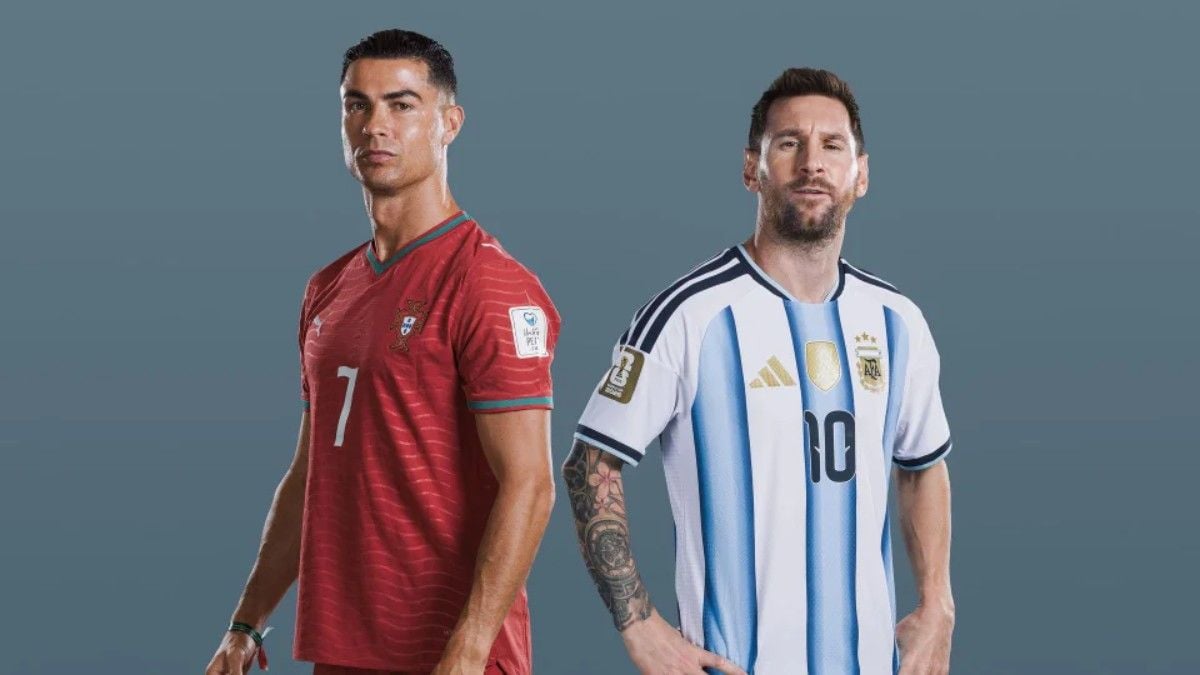
- Liberal respondents across 26 countries more likely to prefer Messi; conservatives to prefer Ronaldo.
- Effect is strongest among younger adults and weakens significantly in older cohorts.
- Short-form video use, self-esteem, and authoritarian attitudes also independently predict Ronaldo preference.

A global survey of more than 10,000 people has found that political ideology is the strongest individual-level predictor of whether someone prefers Lionel Messi or Cristiano Ronaldo, with liberals tending to favour Messi and conservatives tending to favour Ronaldo.
The study, led by Associate Professor Saifuddin Ahmed of the Wee Kim Wee School of Communication and Information at Nanyang Technological University, Singapore (NTU Singapore), surveyed 10,661 respondents across 26 countries spanning six continents between April and May 2026.
The findings, published as a preprint, argue that political identity now organises cultural preferences well beyond the domain of politics — and that this pattern is not confined to the United States, where most prior research has been conducted.
The Messi-Ronaldo divide
The study used a seven-point favourability scale to measure how each respondent rated both players, computing the difference as a Relative Player Preference index. Positive values indicated a lean toward Ronaldo; negative values toward Messi.
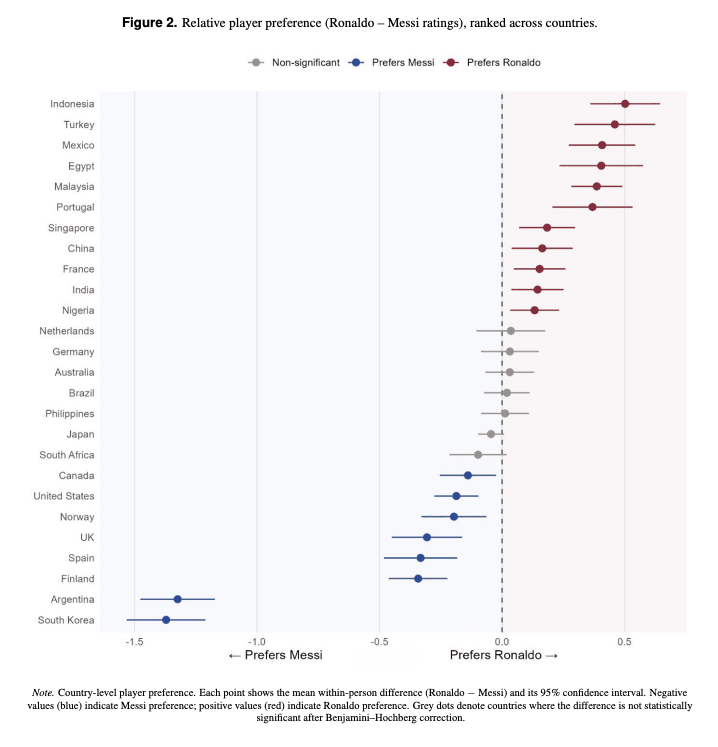
Of the 26 countries surveyed, 19 showed statistically significant differences in how respondents rated the two players. Eight countries showed a preference for Messi, including South Korea, Argentina, Finland, Spain, the United Kingdom, Norway, the United States, and Canada.
Eleven countries leaned toward Ronaldo: Nigeria, India, France, China, Singapore, Portugal, Malaysia, Egypt, Mexico, Turkey, and Indonesia. Seven countries showed no statistically clear preference.
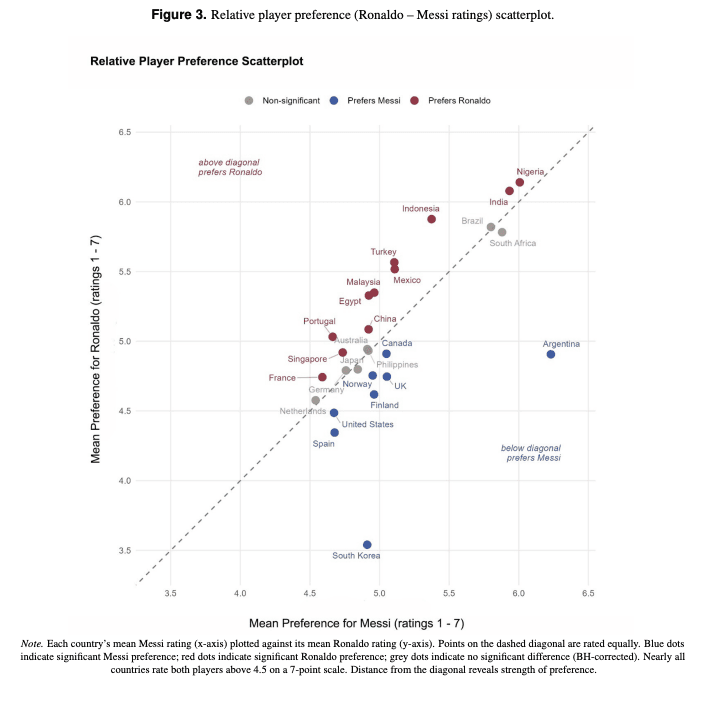
South Korea recorded the strongest relative preference for Messi, alongside Argentina. However, the researchers noted the two countries arrived at similar outcomes through different combinations of ratings. South Korea's lean was driven almost entirely by an unusually low rating for Ronaldo — the lowest in the sample — rather than by an elevated rating for Messi. Argentina's lean, by contrast, reflected an exceptionally high rating for Messi.
Indonesia showed the strongest lean toward Ronaldo among all countries surveyed, followed by Turkey and Mexico.
The role of political ideology
Within each country, political ideology was the most robust individual-level predictor of player preference, surviving adjustment for age, gender, education, social class, political interest, and media consumption habits.
Assoc Prof Ahmed said the two players project markedly different public personas that appear to map onto ideological divides. Messi is widely characterised as quiet, team-oriented, deferential, and family-focused. Ronaldo is associated with individual dominance, open self-promotion, and the explicit pursuit of personal excellence.
According to the study, this contrast maps onto a dominance-communitarian axis that researchers have long linked to ideological differentiation. More liberal respondents, the study found, consistently preferred the communitarian persona; more conservative respondents preferred the dominant one.
The effect held across consolidated democracies, multi-party systems, and authoritarian states alike, indicating the pattern does not require a competitive party system to operate. The researchers suggested the dominance-communitarian contrast is legible across political environments because it taps a dispositional dimension that global media exposure has made widely recognisable.
Age moderation
The ideology effect was moderated by age. Among younger respondents — approximately 15 years below the country-mean age — the ideology slope was steeper. The effect weakened with age and became statistically non-significant for respondents more than approximately 11 years above their country's mean age.
Across the full sample, the ideology effect was statistically significant for an estimated 74 per cent of respondents.
The age moderation was specific to ideology. Authoritarianism, self-esteem, and short-form video news use showed no comparable age dependence, which the researchers said argues against a general explanation based on older respondents simply being less variable in their preferences.
The researchers interpreted the pattern as consistent with a generational account: cohorts socialised under conditions of heightened political sorting carry the political-cultural link into domains their predecessors did not.
Short-form video, self-esteem, and authoritarianism
Beyond ideology, the study identified three further individual-level predictors of a preference for Ronaldo, each operating independently of political leaning.
Respondents who consumed more news through short-form video platforms such as TikTok and Instagram were more likely to prefer Ronaldo. The researchers attributed this partly to Ronaldo's stronger and more frequent presence on visually oriented social media platforms, which may reinforce existing evaluative tendencies through repeated exposure.
Higher self-esteem was also associated with a preference for Ronaldo. The study connected this to research on role models and reflected glory — the tendency of people with higher self-esteem to identify with aspirational, dominant public figures rather than disengage from them. The researchers noted that parasocial distance, the mediated nature of fan relationships with global celebrities, may remove the direct-comparison threat that in face-to-face settings can make identification feel self-threatening.
Higher approval of authoritarian attitudes — measured by support for strong leadership unconstrained by parliament — independently predicted a preference for Ronaldo. The researchers said this extended earlier findings linking authoritarian orientation to preferences for dominant figures and aesthetic judgments, now applying to a global public figure whose dominance is curated and performed rather than inferred abstractly.
Empathy did not significantly predict player preference. Cognitive reflection showed a small association with Messi preference that weakened under post-stratification age weighting.
Country-level patterns
At the country level, a nation's FIFA World Ranking showed no association with aggregate player preference. Respondents in football powerhouses such as Brazil and Germany showed similar patterns to those in countries where football holds less cultural centrality, such as Japan and India.
The study found a marginal negative association between a country's liberal democracy index and a preference for Ronaldo, though the finding did not reach conventional statistical significance with only 26 country-level units. The direction was as the researchers predicted: more democratically consolidated countries showed a slight lean toward Messi.
National affiliation with a player was neither necessary nor sufficient to explain country-level preference. Portugal ranked below Indonesia, Turkey, Mexico, Egypt, and Malaysia in its preference for Ronaldo. Argentina's home-country pull for Messi was approximately four times the size of Portugal's equivalent pull for Ronaldo.
The researchers noted that South Korea's comparatively low rating for Ronaldo may partly reflect lingering public sentiment over a 2019 exhibition match in Seoul in which Ronaldo did not play despite being the event's main attraction.
Limitations
The researchers acknowledged that the cross-sectional design leaves the direction of causation open. Preference for a dominant or communitarian public figure could reinforce political self-identification rather than follow from it. The short-form video finding is equally consistent with platform selection — individuals already drawn to dominance-coded content migrating to platforms that deliver it — and with exposure-driven reinforcement.
Single-item measures of ideology and authoritarianism, standard in comparative research, do not capture the full multidimensional structure of those constructs. The team said longitudinal and experimental designs will be needed to adjudicate these questions.
Assoc Prof Ahmed said the results offer a starting point for examining how political identity may increasingly intersect with popular culture and everyday choices across different institutional and cultural contexts.