‘Mediocre at best’: Hidayah Amin criticises revamped Malay Heritage Centre over historical coverage and heritage portrayal
Singaporean author Hidayah Amin has criticised the revamped Malay Heritage Centre, citing weak storytelling, limited pre-1819 historical narratives and insufficient attention to Kampong Gelam’s significance, while calling for deeper heritage interpretation.
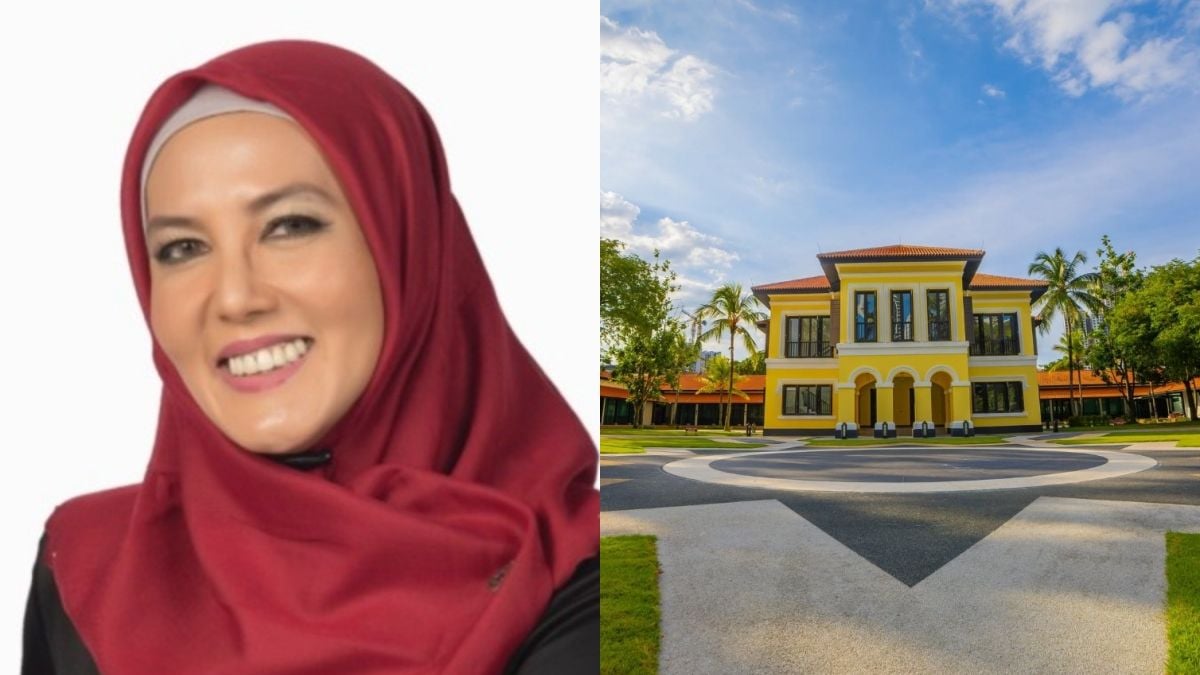
- Hidayah Amin criticised the revamped Malay Heritage Centre for weak storytelling and limited historical depth.
- Hidayah questioned the exhibition’s focus on post-1819 narratives and Kampong Gelam’s heritage.
- Public reactions online were mixed, with both criticism and support for the redevelopment.

Singaporean author Hidayah Amin has criticised the revamped Malay Heritage Centre (MHC), describing the redevelopment as “mediocre at best” and raising concerns over what she said were weak storytelling, limited historical coverage and insufficient recognition of Kampong Gelam’s significance.
In a commentary shared on Facebook on 25 June 2026, Hidayah said she had written to the Forum page of The Straits Times to express her views on the revamped museum, but the letter was not published.
She said she decided to share her views publicly after the unsuccessful submission.
Hidayah, an award-winning Singaporean author, former Fulbright Scholar and founder of the Haji Yusoff Memorial Museum, said she visited the MHC the previous week with friends from Malaysia who had travelled to Singapore specifically to see the revamped institution.
“I was full of expectations of a rejuvenated MHC led by a new team under the National Heritage Board,” she wrote.
She said the centre’s open and well-landscaped courtyard suggested a fresh direction, but she felt the exhibition did not meet expectations.
“The MHC lives up to the Malay proverb, ‘indah khabar dari rupa’, the reality does not match the pomp, glory and hype the opening ceremony exuded,” Hidayah said.
Criticism over historical narratives
Hidayah said she was disappointed with what she described as the second revamp of the MHC, particularly questioning the exhibition’s decision to begin its narratives around 1819.
She said there was little mention of Sang Nila Utama and Singapore’s history before the arrival of Stamford Raffles.
Hidayah also raised concerns about the placement of nobat instruments within the exhibition.
She noted that the instruments appeared after information about Tengku Hussein being installed by Raffles as Sultan, arguing that this sequence could give visitors the impression that Sultan Hussein’s ascension was unquestionably legitimate.
She said nobat instruments are traditionally associated with royal ceremonies, including the coronation of kings.
“The narratives started around 1819,” Hidayah said, questioning the limited representation of earlier periods in Singapore’s history.
Concerns over exhibition structure
Hidayah criticised the exhibition’s overall organisation, saying there was no clear theme and that the narratives appeared disconnected.
“There is no clear theme, the narratives are all over the place, explanations lacking, and the curation uninspired,” she wrote.
She questioned why certain historical themes were not more prominently featured, including Singapore’s role as a pilgrimage hub connecting communities to the wider world and its importance as a publishing centre in Southeast Asia.
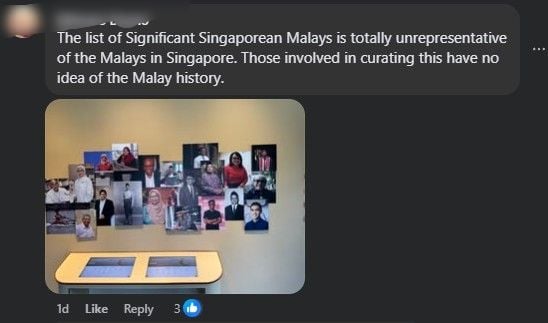
Hidayah also questioned the selection of figures highlighted as prominent Malays in the exhibition.
“Who are those Malays being heralded as prominent figures?” she asked, adding that she was uncertain about the contributions of some individuals beyond their professional achievements.
She also questioned why only contemporary books by Malay authors were highlighted, arguing that Malays of earlier generations had also been entrepreneurial and intellectual.
“The Malays of the past were entrepreneurial and intellectual, yet none of this information is showcased,” she said.
Kampong Gelam’s historical role
Amin said the location of the MHC in Kampong Gelam meant visitors would expect greater attention to the area’s history.
Kampong Gelam is a historic quarter of Singapore associated with Malay heritage, cultural activities and the development of the Malay community.
She said museum visitors generally seek to understand the history of places, as well as the tangible and intangible heritage of communities.
Hidayah said museum researchers and curators carry responsibility for the information presented because visitors often accept exhibition content as factual.
“If museums exist as a form of cultural dialogue, then I am afraid that conversations about the MHC would be as superficial as some of the artefacts being displayed,” she wrote.
She concluded her criticism by describing the revamped centre as “mediocre at best”.
“I shudder at the amount of taxpayers’ money that was used to fund the ‘much-anticipated’ revamp,” Hidayah said.
The Online Citizen has reached out to the National Heritage Board (NHB) for comments on the concerns raised by Hidayah.
The queries included issues relating to limited representation of pre-1819 history, exhibition sequencing and interpretation, the cost of the revamp, and plans to strengthen future storytelling and historical depth at the Malay Heritage Centre.
Comments voice concern over gaps in historical storytelling
Comments observed on Amin’s Facebook page showed differing views on the criticism.
Some commenters agreed that the exhibition contained gaps in historical storytelling, while others said presenting complex historical narratives was challenging.
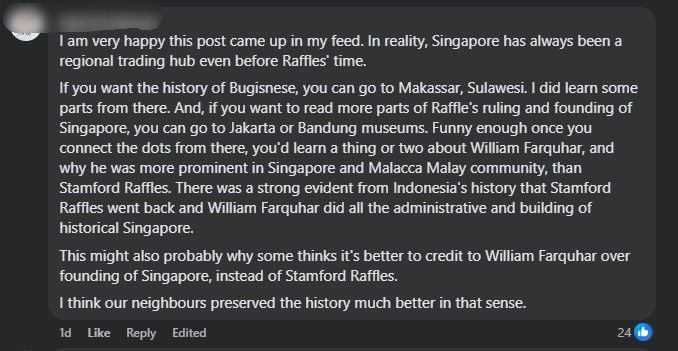
One commenter argued that Singapore had long been a regional trading hub before 1819.
The commenter suggested that visitors seeking deeper understanding of regional history could visit places such as Makassar in Sulawesi or museums in Indonesia to explore connections involving historical figures such as William Farquhar and Stamford Raffles.
Mixed feedback on guided experience and curation
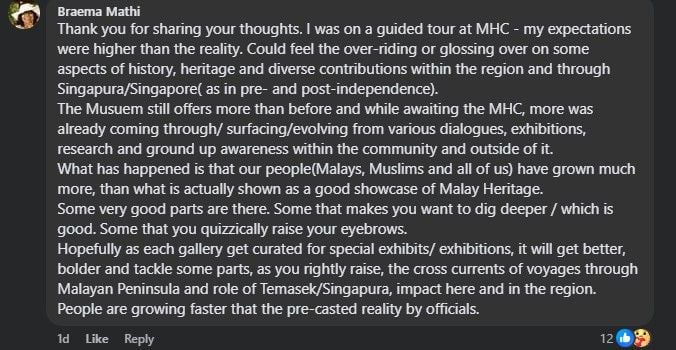
Another commenter said a guided tour had fallen short of expectations, citing what they described as an “over-riding or glossing over on some aspects of history”.
However, the commenter also acknowledged that the revamped museum “still offers more than before” and could improve through future curatorial work.
The same commenter said some sections were strong while others “make you want to dig deeper”, suggesting that the museum represented an evolving understanding of Malay heritage.
Criticism of representation and coherence
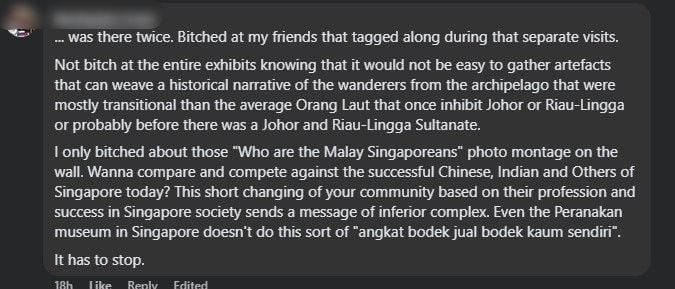
Another visitor said they had visited the museum twice and were critical of specific elements rather than the entire exhibition.
The visitor highlighted a photo montage titled “Who are the Malay Singaporeans” and said it reinforced “inferior complex” narratives while lacking nuance in representation.
Other commenters criticised the exhibition’s coherence.
One wrote, “So hodgepodge… What’s the story?? No substantial connection,” describing the redevelopment as “tragic & most disappointing” after years of work.
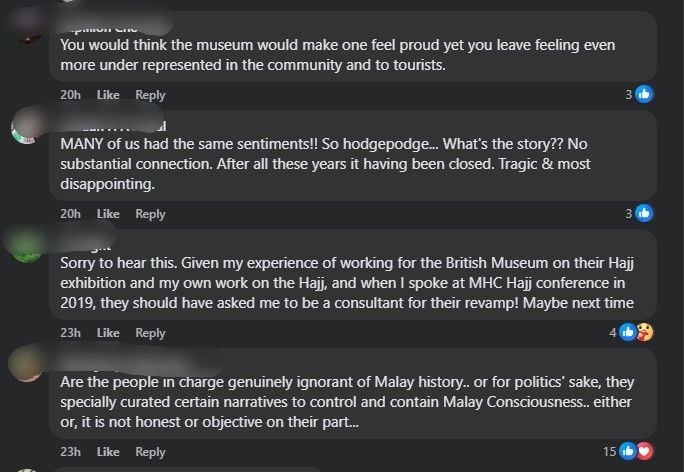
At the same time, another respondent suggested that external specialists could contribute to future improvements.
The commenter said experts working on themes such as the Hajj could have been consulted to strengthen the exhibition’s curatorial depth.
Background of the Malay Heritage Centre
According to its official website, the Malay Heritage Centre was officially opened in June 2005 as a heritage and cultural institution dedicated to presenting the history, culture and contributions of the Malay community in Singapore.
Its permanent exhibition traces the evolution of the Malay community through centuries of movement, trade and cultural exchange across the Malay Archipelago.
Prime Minister Lawrence Wong announced during his National Day Rally speech in August 2025 that the centre would reopen on 25 April 2026 following redevelopment.
At the reopening ceremony, Wong described the centre as both a refreshed cultural space and a symbol of Singapore’s shared national identity.
He said Malay heritage in Singapore was “part of our national story” and emphasised that “your heritage is Singapore’s heritage”, highlighting historical links between Singapore and the wider Malay world.
Wong said the revamped centre, also known as Taman Warisan Melayu, followed years of consultation with heritage experts, community groups and stakeholders.
He said the redevelopment was needed not only because facilities had aged, but also to ensure the institution remained a “living centre” capable of engaging younger generations through immersive and interactive storytelling.