What living in Taiwan taught me about Singapore's ATM problem
Singapore's banks have committed to placing an ATM, branch or cashpoint within 500 metres of every HDB block by 2027. Having lived in Taiwan for close to four years, where any ATM accepts any bank card for NT$5, I find myself wondering why Singapore is still solving a problem Taiwan resolved decades ago.
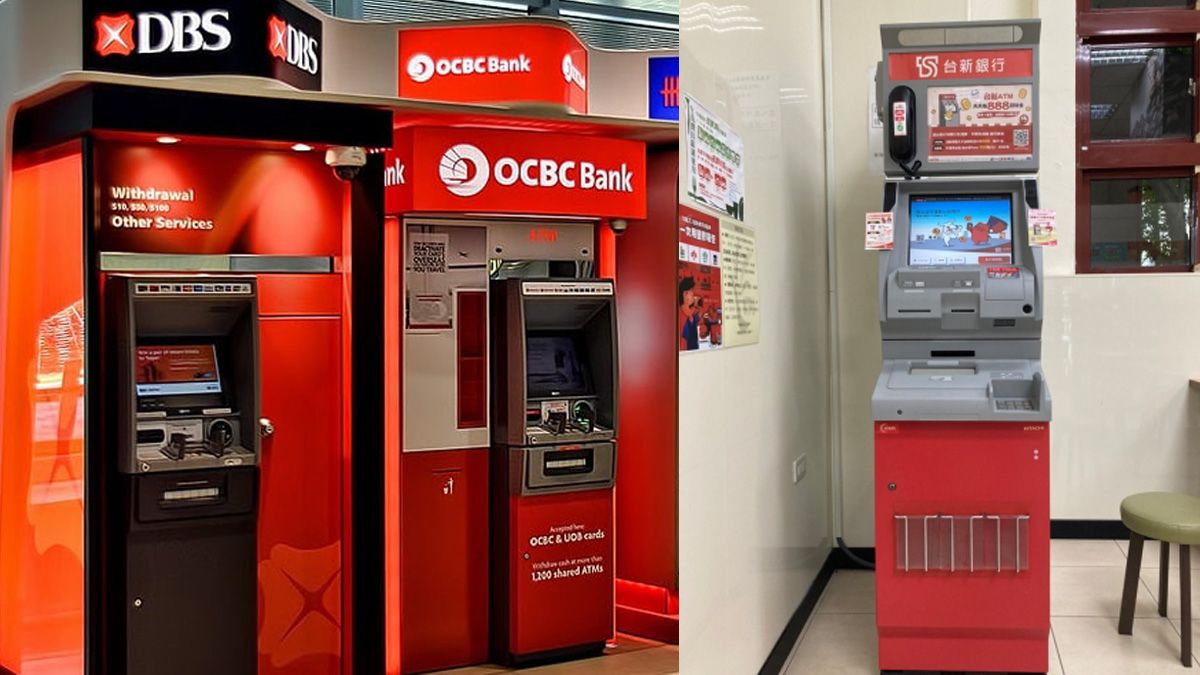

When I read that Singapore's major banks had committed to placing an ATM, branch or cash point within 500 metres of every Housing and Development Board block by end-2027, my first reaction was not admiration. It was bewilderment.
Not because the goal is unworthy. Access to cash matters, particularly for elderly residents who are less mobile and less comfortable with digital payments. The Association of Banks in Singapore (ABS) is right about that. My bewilderment is of a different kind: that in 2026, Singapore is still treating ATM coverage as a function of how many machines each bank is willing to build, when a fundamentally different approach has been operating elsewhere since the late 1980s.
I have lived in Taiwan for close to four years. I bank with a Taiwanese bank. And for the first several months after moving here, I did what I had always done in Singapore: I looked for my own bank's ATM. It did not occur to me to try another bank's machine. That was simply not how banking worked — or so I assumed.
It took me an embarrassingly long time to realise I had been wrong. Any ATM would do. The fee for withdrawing from another bank's machine is NT$5 during banking hours — roughly S$0.21. No purchase required. Any card, any participating bank, any time. I can also make deposits across banks at the same machines.
When I finally worked this out, I felt equal parts silly and amazed: silly for having spent months unnecessarily hunting for a specific machine, and amazed that something so straightforward had never existed in the country I came from.
Having grown up in Singapore, I had simply accepted that every bank maintained its own island of machines. It never occurred to me that it could be organised differently.
After a while in Taiwan, you stop noticing who owns the machine because ownership is simply not relevant to the user. It was only when Singapore's banks announced their 500-metre commitment that I found myself wondering why we were still debating where to place bank-specific ATMs at all.
Curious about why the system worked this way, I eventually looked into how it had been built.
Taiwan's shared ATM network began in the 1980s under a Ministry of Finance initiative and is now operated by Financial Information Service Co., Ltd. (財金資訊股份有限公司, FISC) under the supervision of the central bank and Financial Supervisory Commission.
By 2015 it connected 374 financial institutions through more than 27,000 ATMs island-wide, processing 440 million transactions annually. Any qualifying financial institution can join on equal, transparent, non-discriminatory terms. The rules are set by statute. The regulator supervises. The infrastructure is shared.
The result is that the question of which bank's ATM is nearest to you is largely irrelevant in Taiwan. The nearest ATM is your ATM.
What makes this more than a technical achievement is the philosophy behind it. Rather than allowing banks to compete over proprietary ATM real estate — building machines next to each other to lock customers into their own ecosystems — Taiwan's Ministry of Finance and central bank treated the interbank network as shared public infrastructure from the outset. The system was also designed for inclusivity at every level.
Taiwan has a large network of small, localised agricultural and fishery credit unions serving rural communities. Rather than encouraging banks to compete by building proprietary ATM networks, Taiwan treated the ATM network itself as common infrastructure on which banks could compete in services, pricing and products instead.
The practical result is that a farmer using a small rural credit union card can walk into a major bank's ATM in central Taipei and withdraw cash without friction. The size of your bank and the location of its nearest branch are simply not factors.
None of this suggests that Singapore could replicate Taiwan's model overnight. Different banking markets evolved under different regulatory histories. But Taiwan demonstrates that interbank ATM interoperability is a policy choice rather than a technological impossibility.
Singapore has already demonstrated that it is willing to promote and coordinate interoperability where it considers common infrastructure to be in the public interest. PayNow is precisely that — a MAS-led common platform, launched in 2017, that allows customers of competing banks to transfer funds seamlessly across institutions. What remains unclear is why the same reasoning stops at physical cash access.
Taiwan is not the only comparison worth making. On 15 June 2026 — ten days before Singapore's banks announced their 500-metre commitment — the Association of Banks in Malaysia, together with PayNet, the country's national payments network, announced that interbank ATM withdrawal fees would be abolished entirely from 1 July 2026. Malaysian debit cardholders can now withdraw cash from any of the country's 14,000 ATMs and smart recycler machines, regardless of which bank operates them, at no charge.
Malaysia already had a unified interbank ATM network through MEPS, the Malaysian Electronic Payment System, connecting 14 domestic banks and seven foreign banks. Abolishing the RM1 fee was the final step in removing friction from a system that had already solved the interoperability question. The infrastructure was never in doubt — only the cost.
Singapore's immediate neighbour, with whom it shares a land border and a broadly similar banking heritage, moved to free universal ATM access. Ten days later, Singapore announced a target to place machines within 500 metres of HDB blocks by end-2027.
Singapore does have shared payment infrastructure. NETS handles point-of-sale and debit transactions; FAST and PayNow handle digital transfers. The fragmentation is more specific: ATM cash withdrawals remain split across proprietary networks that do not fully connect to one another.
DBS, which operates the largest ATM fleet on the island with over 1,100 machines, participates in no shared ATM withdrawal network with the other major retail banks. OCBC and UOB share a bilateral arrangement.
A separate grouping called atm5 connects six qualifying full banks — HSBC, Standard Chartered, Maybank, Bank of China, Citibank and State Bank of India — across roughly 200 machines. These two networks do not interconnect with each other, and neither connects to DBS.
This means that for the majority of Singapore residents who bank with DBS, walking to an OCBC or UOB ATM achieves nothing for cash withdrawal. For residents who bank with HSBC or Maybank, a DBS machine — by far the most common on the island — is similarly inaccessible for their own accounts. The 500-metre commitment solves a geographic problem while leaving the structural problem entirely intact.
The government's standard response to this gap is to point to merchant cashout services — programmes that allow customers to withdraw cash when making a purchase at outlets such as 7-Eleven, Giant and Sheng Siong. But the conditions attached to these services are significant.
At 7-Eleven and Cold Storage, the withdrawal limit is S$200 per transaction and a purchase is required. At Guardian and Buzz, the cap is S$100, also with a mandatory purchase. An elderly resident needing S$300 to pay a bill or cover household expenses cannot simply walk in and withdraw it. They must first buy something, and even then fall short.
Having used both systems, what strikes me is how differently they treat cash access. In Taiwan, the convenience store ATM is simply an ATM. It is not tied to a retail purchase, it is not limited by which bank issued your card, and it does not cap you at an amount that may be insufficient for your needs.
The structural consequence of Singapore's fragmented approach is visible in the parliamentary record.
In February 2026, Sengkang Member of Parliament Louis Chua disclosed in Parliament that Rivervale Sengkang — an estate of over 18,000 households — had ATMs in only two locations. The nearest machine to the Rivervale Shores BTO cluster, which houses a significant proportion of elderly residents in two-room flexi flats, required a walk of more than 20 minutes.
Chua had spent years appealing to HDB and the banks for a solution, and only succeeded after personally approaching DBS management, who agreed in February 2026 to install a single additional machine.
Had Singapore operated a unified network, the problem would not have existed in the same form. Residents needed a DBS ATM specifically. Under a shared infrastructure model, any participating ATM in the vicinity could have served the same purpose.
The banks, it should be said, are responding rationally to the incentives the regulator has created. If each institution is expected to compete through proprietary ATM networks, expanding those networks is the logical response.
Coverage gaps sometimes end up being resolved through lobbying by elected representatives not because the banks are indifferent, but because the system creates no mechanism for any single institution to solve a problem that is structural rather than commercial. The question is whether MAS should continue treating ATM interoperability as a commercial matter rather than as shared infrastructure.
That question has been raised in Parliament before. In February 2017, Former Member of Parliament for Jurong GRC, Dr Tan Wu Meng asked what measures the Monetary Authority of Singapore (MAS) was taking to ensure ATMs were fully interoperable to enable access for the elderly and those with mobility needs.
Then-Deputy Prime Minister Tharman Shanmugaratnam's response was instructive. He noted that each of the two local bank networks already had coverage reaching at least 90% of HDB households within 500 metres — the same benchmark being celebrated again in 2026 — and described full interoperability as "a commercial issue between the two bank networks." He added: "We are not foreclosing the issue from MAS' point of view."
Nine years later, the issue remains where Tharman left it. MAS has not mandated interoperability. The two local bank networks have not merged. DBS remains outside both. And the policy response to the resulting coverage gaps is, once again, to ask the banks to expand their separate proprietary footprints — one machine at a time, approved by HDB, negotiated estate by estate.
In February 2026, when Louis Chua pressed for regulatory intervention in Parliament, Minister for National Development Chee Hong Tat confirmed that MAS was "monitoring the trends" on cash access and would "carefully assess if and when intervention is needed." The language has barely shifted in nine years.
To be clear: the ABS announcement of 25 June 2026 contains genuinely useful measures. The commitments on estate administration, lasting power of attorney processes, and staff training to recognise cognitive decline among elderly customers reflect real thinking about real needs. These are not nothing.
But the headline commitment on ATM coverage is a different matter. It is a formalisation of the co-regulatory posture MAS has maintained since at least 2017 — the posture that ATM infrastructure is a matter for commercial negotiation rather than regulatory mandate, and that coverage gaps are best addressed by asking each bank to build more of its own machines.
The ABS announcement asks how every resident can reach an ATM within 500 metres. That is a reasonable question. But Taiwan answered a different question nearly four decades ago: why should it matter whose ATM it is?
Until Singapore addresses that question, it will continue solving yesterday's problem one machine at a time.