Singapore's Online Safety Commission begins operations amid parliamentary concerns
Singapore's Online Safety Commission launched on 29 June 2026 to handle victims of online harms, though the legislation underpinning it drew significant debate in Parliament over the breadth of powers given to the new agency.

- The OSC begins with powers to address five categories of online harm, with eight more to follow progressively.
- Victims may report doxxing, intimate image abuse and child abuse imagery directly to the OSC; courts must award at least S$5,000 per image for the most serious cases.
- Six online service providers face additional obligations under OSRAA, and non-compliance with the Commissioner's directions is a criminal offence.

Singapore's Online Safety Commission (OSC) began operations on 29 June 2026, providing victims of online harms with a new avenue to seek redress and placing fresh obligations on platforms and perpetrators.
The launch also brings into force statutory torts under the Online Safety (Relief and Accountability) Act 2025 (OSRAA), giving victims new civil remedies against perpetrators and platforms that fail to act.
The OSC was established under the office of the Commissioner of Online Safety created by OSRAA, which Parliament passed in November 2025 after a lengthy and at times contentious debate. The agency will be administratively supported by the Infocomm Media Development Authority (IMDA).
Five harms covered in first phase
In its first phase, the OSC will handle five categories of online harm: online harassment (including sexual harassment), doxxing, online stalking, intimate image abuse and image-based child abuse. Eight further categories under OSRAA — including inauthentic material abuse, online impersonation and incitement of enmity — will be introduced progressively.
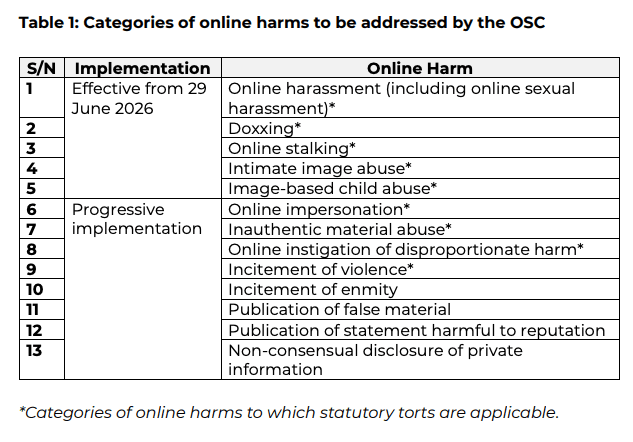
Victims of harassment and stalking must first report harmful content to the platform hosting it. If the platform fails to respond within 24 hours, they may escalate to the OSC. For more severe harms — intimate image abuse, image-based child abuse and doxxing — victims may approach the OSC directly through its website at www.osc.gov.sg. There is no fee to file a report.
Parents and guardians may file on behalf of victims under 18. An adult victim may also authorise another individual or organisation to submit a report on their behalf.
Once a report is received, the Commissioner may issue directions to stop or limit the harm. These can be addressed to the person who posted the content, the administrator of the group or page where it appeared, or the platform hosting it. Non-compliance with a direction is a criminal offence. Individuals face fines of up to S$20,000 or imprisonment of up to 12 months, while entities may be fined up to S$500,000.
Six online service providers have been prescribed under OSRAA with additional obligations, reflecting their significant reach or impact in Singapore.
A two-stage appeal mechanism is available. Eligible persons may first apply to the Commissioner for reconsideration within 14 days of an initial decision, at no cost.
Those still dissatisfied may appeal to an independent Online Safety Appeal Panel within 14 days of the reconsidered decision, with a S$200 application fee. The panel is chaired by Prof Leslie Chew SC, Dean of the School of Law at the Singapore University of Social Sciences, and includes Dr Natalie Pang of the National University of Singapore as vice-chairperson.
Victims who do not know the identity of their harasser may apply to the OSC for End-User Identity (EUI) information, provided they intend to commence civil proceedings. Applications must be made within 12 months of the harm occurring or being discovered.
Under the statutory tort provisions, courts must award at least S$5,000 for each image or recording in successful claims of intimate image abuse and image-based child abuse.
Community partners available to provide support include Fei Yue Community Services, Samaritans of Singapore, SHE – SG Her Empowerment (SHE), Singapore Children's Society and TOUCH Community Services.
Parliamentary debate: broad support, pointed concerns
While Members of Parliament on both sides of the House supported the Bill's passage in November 2025, the debate exposed substantive disagreements over the architecture of the legislation.
The Workers' Party (WP) tabled several amendments, all of which were ultimately rejected by the House.
Ms He Ting Ru (Sengkang GRC) argued the Bill failed to cover two categories of harm with severe consequences for victims: the publication of online material encouraging or promoting suicide or self-harm, and sexual grooming of minors and vulnerable adults. She noted that an Institute of Policy Studies study had identified both as among the harms Singaporeans considered most serious.
The Government, represented by Minister for Digital Development and Information Josephine Teo and Minister of State Rahayu Mahzam, maintained that both were already addressed by existing laws — sexual grooming by the Penal Code, and suicide-promoting content by the Broadcasting Act — and that the OSRAA's design, which relies on user-initiated reports, was ill-suited to harms where victims may not recognise themselves as victims.
Threshold for commissioner action
A sharper dispute arose over the threshold at which the Commissioner may issue directions. The Bill sets this at "reason to suspect" that online harm has occurred. Non-Constituency Member of Parliament (NCMP) Andre Low argued this was too low, calling it a subjective test that could permit action on little more than an intuition. He proposed raising it to "reasonable grounds to believe" — the standard used in comparable legislation in the United Kingdom and Canada — which requires evidence that would satisfy a reasonable person.
The Government rejected the change, saying the lower threshold was necessary to stop harms quickly and that it was already used in comparable Singapore legislation such as the Online Criminal Harms Act. Minister of State Rahayu argued the existing reconsideration and appeal mechanisms provided sufficient safeguard against overreach.
Several PAP Members also opposed the amendment. Ms Tin Pei Ling (Marine Parade-Braddell Heights GRC) said raising the threshold would extend victims' exposure to harm while investigators assembled the required evidence.
Ms Mariam Jaafar (Sembawang GRC) argued that the OSC framework, where the "reason to suspect" standard enables early intervention while reconsideration provides a check, was already aligned with how comparable regulators in Australia operated.
Appeals and judicial oversight
The WP also sought to give aggrieved parties the right to appeal decisions of the Appeal Committee to the General Division of the High Court — on grounds of law, factual error or technical infeasibility. Mr Low argued that when state powers could affect livelihoods and reputations, there should be an independent judicial route beyond the existing judicial review mechanism, noting that judicial review is typically limited to questions of process rather than the merits of a case.
Minister for Law Edwin Tong rejected the proposal, warning that allowing court appeals would draw in legal representation from well-resourced platforms and create a "David and Goliath" dynamic that would deter individual victims from coming forward. He said the existing framework — administrative reconsideration followed by an independent panel, with judicial review remaining available — was calibrated to provide both speed and fairness.
Mr Tong added that the Appeal Committee's members were not bound by statute to publish reasons, unlike the Commissioner's reconsidered decisions. Leader of the Opposition Pritam Singh separately asked why the reconsideration stage did not require the Commissioner to provide reasons, while the Appeal Committee did. The Government said it would provide further details as the OSC's operational framework was refined.
Fair comment and public interest
NCMP Low also sought to insert explicit carve-outs for fair comment and public interest into the definitions of online harassment, non-consensual disclosure of private information and online instigation of disproportionate harm. He gave examples of journalism, whistleblowing and victims identifying their harassers to warn others, arguing these could inadvertently fall within the Bill's broad definitions.
The Government said such factors were already captured in the OSC's case-by-case assessment framework under clause 27, which allows the Commissioner to consider whether conduct was reasonable and the circumstances in which it occurred. Making them express exceptions, Minister of State Rahayu argued, could provide cover for bad actors behind a claim of "public interest."
Other concerns raised
Beyond the formal amendments, a wide range of Members raised concerns about implementation. Questions focused on the OSC's anticipated caseload and whether it would be sufficiently resourced; the speed and transparency of its decision-making; service standards for different severity levels of harm; and how cases involving private messaging platforms such as WhatsApp and Telegram would be handled.
Several Members flagged potential gaps in cross-border enforcement and the limits of Access Disabling Directions against overseas platforms, particularly where users might resort to virtual private networks (VPNs) to circumvent restrictions.
Dr Wan Rizal (Jalan Besar GRC) called for the OSC to establish clear service benchmarks and escalation lanes for frontline workers — including healthcare staff and teachers — who face online abuse in the course of their duties. Mr Gabriel Lam (Sembawang GRC) raised the risk of perpetual online shaming of individuals who have already served criminal sentences, and asked that the appeals framework be "fair but finite."
Concerns about the Commissioner's independence were raised by NCMP Eileen Chong, who noted that political officeholders could themselves file reports with the agency, creating a potential conflict of interest in cases involving content critical of the very minister responsible for the Commissioner's appointment. The Government said it had no intention of using Ministerial directions to interfere in individual cases, and that the OSC would be bound by objective criteria.
On annual reporting, the WP's proposed amendment requiring the Commissioner to submit annual reports to Parliament — covering complaint volumes, directions issued, trends and privacy measures — was rejected. The Government said the OSC would consider publishing regular reports on its website, and that Members could file Parliamentary Questions to request information not in the public domain.