Kenneth Jeyaretnam: a man who would not stay quiet
Kenneth Jeyaretnam, Reform Party leader and elder son of J.B. Jeyaretnam, has died aged 67. Terry Xu remembers a Cambridge-trained economist who gave up a finance career to take up his father's fight, and who never softened a hard truth into a slogan.
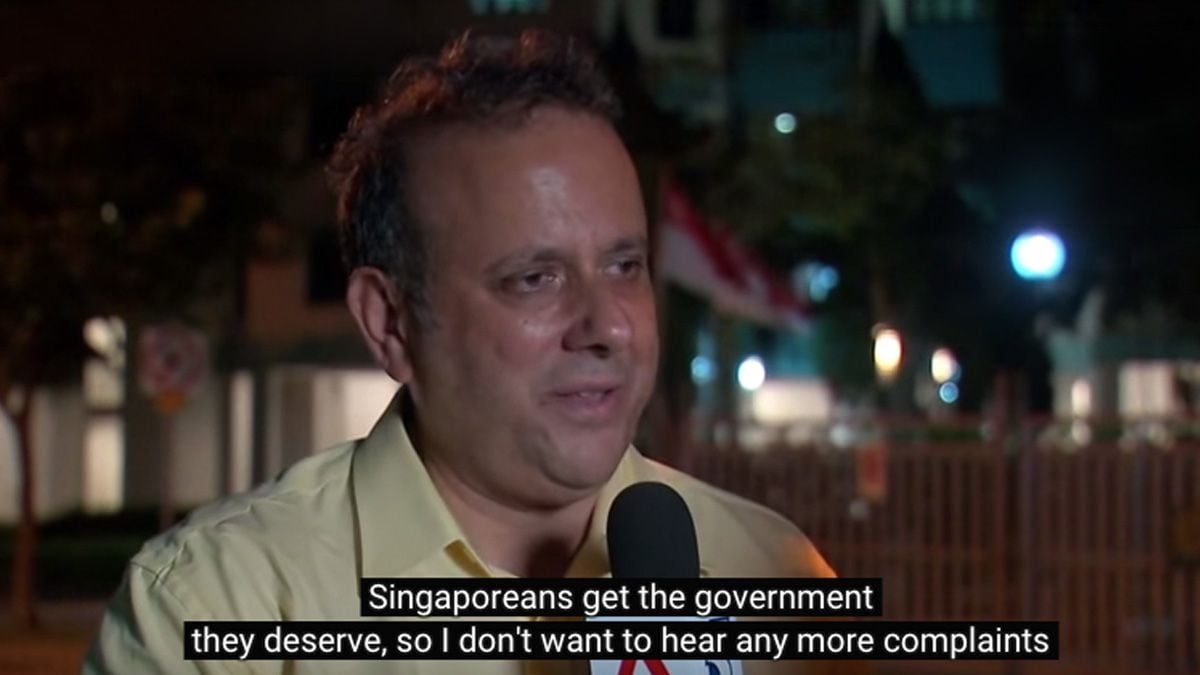

"Singaporeans get the government they deserve, so I don't want to hear any more complaints."
Kenneth Jeyaretnam said that live on Channel NewsAsia on the night of the 2015 general election, standing outside the West Coast counting centre as the sample counts came in and the scale of his party's defeat became clear. It was blunt, a little ungracious, and entirely him.
Kenneth Andrew Jeyaretnam has died. He was 67.
His wife, Amanda, shared the news on Facebook on Sunday, 19 July 2026. She wrote that he passed away peacefully in his sleep the day before, on Saturday, 18 July 2026, surrounded by family.
He leaves behind Amanda and their son, Jared, to whom she described him as a loving and devoted father. A small family service is being arranged, with a memorial to follow at a later date.
I first encountered Kenneth as a voter, when his Reform Party came to contest Chua Chu Kang, the group representation constituency where I then lived. Later I came to know him as editor of The Online Citizen, covering his party's activities and the statements he made.
In his final years I knew him differently again, staying in contact from outside Singapore as his own situation abroad wore on. The vantage point from which I saw him kept changing over the years, and with it, so did my sense of the man.
He was the elder son of Joshua Benjamin Jeyaretnam, the first elected opposition Member of Parliament in independent Singapore. Like his father, he did not shy away from speaking against the powers that be, and he paid for it in much the same way.
Kenneth read economics at Queens' College, Cambridge, graduating with Double First Class Honours in 1983. His career was built in finance — at Wardley, the merchant banking arm of HSBC, and at Continental Bank, Banque Indosuez and Nomura International.
He later set up and ran his own event-driven hedge funds, from 2004 to 2008. This matters, because it explains something about him.
He was a successful economist and fund manager. He had no material incentive to enter Singapore politics, and everything to lose by doing so. He did it anyway.
When J.B. Jeyaretnam died in late 2008, Kenneth took over the Reform Party. He led it into the general elections of 2011, 2015 and 2020, fielding teams in wards including Chua Chu Kang, West Coast, Ang Mo Kio and Radin Mas.
He never won a seat. In Singapore's electoral system, an opposition figure without a party machine faces a steep climb, and Kenneth knew it better than most.
He was not, in my view, the finest politician Singapore has produced. Nor was he the worst. But that was never quite the point of him.
Watching him campaign, it was plain he was not a natural at it. The handshakes, the walkabouts, the retail craft of an election were not his instinct. He lacked the easy charisma the format rewards, and carried instead the exacting, precise manner of the hedge-fund manager he had been. He was a man of the spreadsheet and the argument, not the rally.
That candour in 2015, telling voters they got the government they deserved, was of a piece with the rest of him. He could not soften a hard truth into a slogan, and would not have wanted to.
I have long thought that under a different system — the single-member contests of the United Kingdom, or a proportional arrangement — a candidate of his profile might have found his way into a legislature. That he kept standing anyway, against the odds and the naysayers, is to his credit.
Kenneth's real contribution lay in his writing. On his blog, The Ricebowl Singapore, and across his social media, he turned his training as an economist on the government's spending, its reserves, and its transparency.
His commentary was incisive and unsparing. He wrote about the sale of NTUC Income to Allianz, about MRT disruptions, about the Budget and the reserves — subjects many preferred to leave alone.
It was his account of ministers renting state bungalows at Ridout Road that drew the widest attention, prompting questions in Parliament and sustained public debate. The government contested some of his specific claims; the conversation he forced open outlasted the dispute.
In 2012, he took the government to court over a US$4 billion contingent loan the Monetary Authority of Singapore had offered the International Monetary Fund. He argued it required parliamentary and presidential approval under Article 144 of the Constitution.
He lost. In October 2013, the Court of Appeal dismissed his case, finding neither an arguable claim nor the standing to bring it. He argued much of it himself, in person, against the state's senior counsel.
For the record, the loan was never drawn. The IMF's own funding held, and the money stayed within Singapore's Official Foreign Reserves throughout. The commitment was later restructured, as such standby pledges routinely are.
His style kept him in the crosshairs of Singapore's laws. He received nine correction directions under the Protection from Online Falsehoods and Manipulation Act, more than any other individual, and his accounts were declared online locations by the authorities.
There is a backhanded compliment buried in that record. A government does not train its correction machinery on writing that changes nothing. That the authorities returned to him again and again suggests his commentary was read, and was felt to matter.
Kenneth spoke often, publicly and to those who knew him, of feeling pursued for what he wrote. He was invited to attend police interviews in Singapore but remained abroad, describing his time in London as an involuntary medical exile brought on by illness.
He said he intended to return, when he was well enough to fly, to challenge the directions in court. That day did not come.
I will remember him as someone who understood exactly what his outspokenness would cost him, and chose to pay it. In a place where silence is often the safer investment, Kenneth Jeyaretnam kept spending.
Of everything J.B. Jeyaretnam left behind, the hardest thing to inherit was the fight. It was not the obvious path, nor the comfortable one, and Kenneth was not the obvious man to take it up. He took it up anyway.
If there is a place where he has now gone to meet his father, I think Kenneth can hold his head up. He did not fill the shadow, but he never once hid from it.