Open letter urges MOH to tackle burnout and retain experienced allied health staff, not just recruit more
An open letter published by The Honest Healthcare Worker has urged Singapore's Ministry of Health to address burnout, unsustainable workloads and staff retention among allied health professionals, arguing that recruitment alone cannot replace the experience, mentorship and institutional knowledge lost when senior clinicians leave.
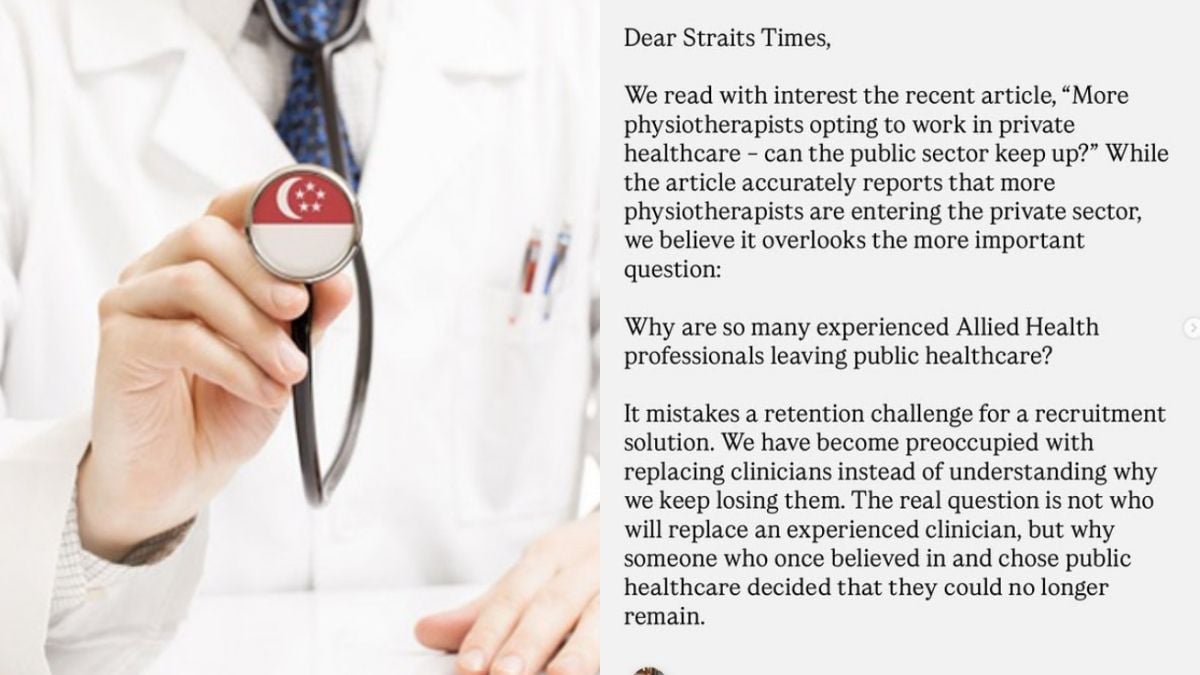
- An open letter urged MOH to prioritise retaining experienced allied health professionals by addressing burnout and workplace culture.
- The group argued that recruitment alone cannot replace the clinical expertise, mentorship and institutional knowledge lost through staff departures.
- The letter responded to a Straits Times report showing more physiotherapists moving into the private sector despite overall workforce growth.

An open letter published by a group calling itself The Honest Healthcare Worker has urged Singapore's Ministry of Health (MOH) to address what it described as the underlying causes driving experienced allied health professionals out of the public healthcare system, arguing that expanding recruitment alone will not resolve long-term workforce challenges.
The letter, shared through their Instagram account on 13 July 2026, contended that policymakers have focused too heavily on bringing new clinicians into the profession while failing to adequately address burnout, unsustainable workloads and poor staff retention.
According to the group, public healthcare risks losing valuable clinical expertise, mentorship and institutional knowledge if experienced professionals continue leaving the sector.
The letter was published in response to a Straits Times article released on 6 July titled "More physiotherapists opting to work in private healthcare – can the public sector keep up?"
Physiotherapists increasingly moving to private sector
The ST report highlighted a growing migration of physiotherapists from Singapore's public healthcare system to private practice, even as the profession continues to expand overall.
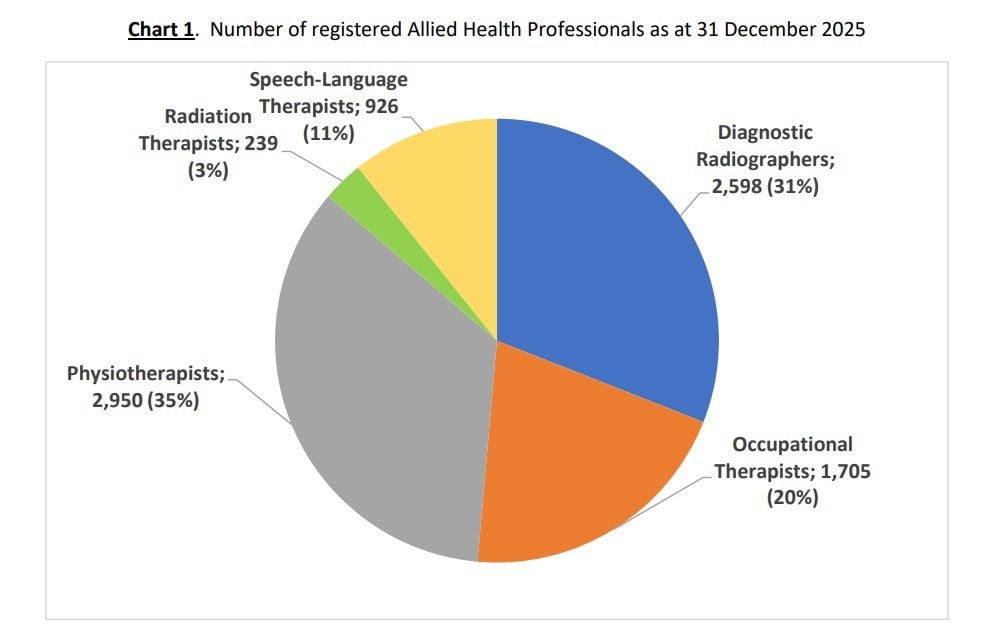
According to the Allied Health Professions Council's 2025 annual report, Singapore had 2,950 registered physiotherapists at the end of 2025.
Almost one in three physiotherapists, or 31.1 per cent, were employed in private hospitals, clinics, centres and schools, compared with 25.5 per cent in 2021.
During the same period, the number of physiotherapists employed in the public sector also increased to 1,130.
However, the public sector's share of the workforce declined from 42.2 per cent in 2021 to 38.3 per cent in 2025.
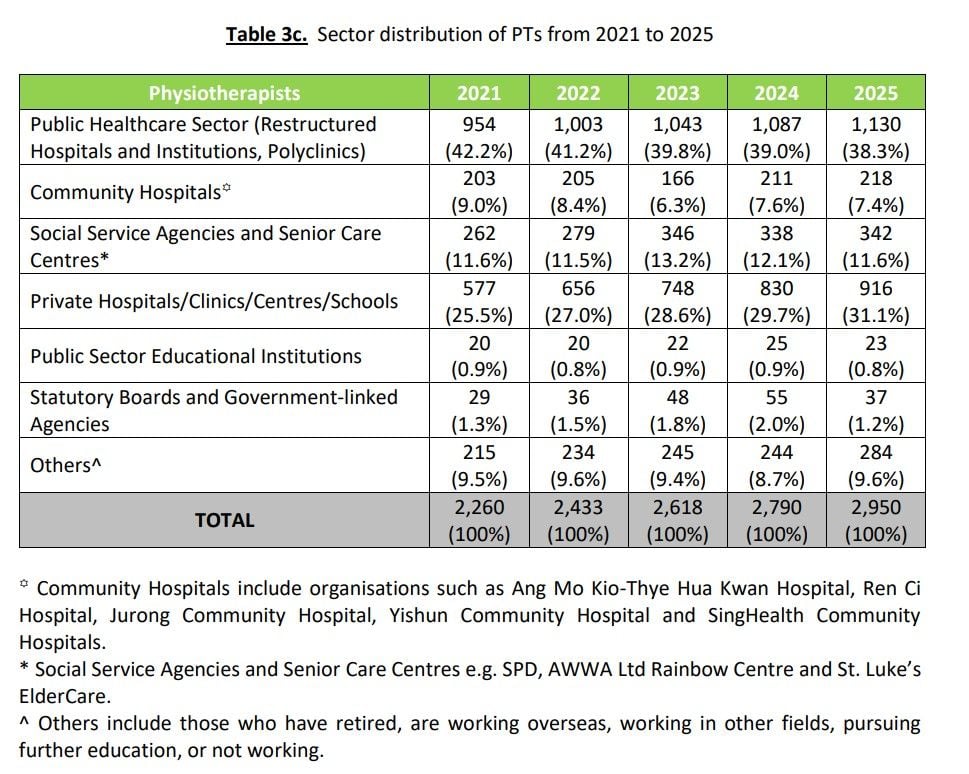
The report noted that if the trend continues, physiotherapists working in private practice could eventually outnumber those employed in public healthcare, raising concerns about the long-term availability of subsidised physiotherapy services.
MOH and the three public healthcare clusters — NHG Health, SingHealth and the National University Health System (NUHS) — told The Straits Times there had been "no immediate impact" on physiotherapy services despite the shift.
MOH expanding training and retention efforts
In response to the workforce trend, MOH said it intends to increase the intake of physiotherapy students while continuing to work with healthcare clusters to "attract, develop and retain a fair share of physiotherapists" within the public healthcare system.
Student intake for the Singapore Institute of Technology's physiotherapy degree programme is expected to increase from 175 in 2024 to 220 by 2027.
The ministry also said it would continue expanding public healthcare scholarships, career conversion programmes and the recognition of overseas qualifications to strengthen the supply of allied health professionals.
MOH noted that the absolute number of physiotherapists in the public sector has continued growing, increasing by about 44 professionals annually since 2021.
It also said attrition among public-sector physiotherapists declined from 12.1 per cent in 2022 to 10 per cent in 2025.
Public healthcare says services remain stable
Healthcare leaders interviewed by ST said patient care has not been significantly affected despite increasing competition for physiotherapy manpower.
The Singapore Physiotherapy Association attributed the shift to a combination of rising demand for rehabilitation services, expansion of private healthcare and individual career preferences, while adding that the situation "must be monitored".
The three public healthcare clusters said they continue investing in recruitment, staff retention, career development, digital innovation and partnerships with community providers to ensure physiotherapy services remain accessible.
MOH also said it is working to keep allied health careers attractive through competitive remuneration, meaningful career progression and supportive workplace environments.
Open letter calls retention the real challenge
While acknowledging the figures reported by ST, The Honest Healthcare Worker argued that the discussion had overlooked what it considered the central issue facing the profession.
"While the article accurately reports that more physiotherapists are entering the private sector, we believe it overlooks the more important question: Why are so many experienced Allied Health professionals leaving public healthcare?" the letter stated.
The group argued that policymakers were treating a retention problem as a recruitment challenge.
It added: "We have become preoccupied with replacing clinicians instead of understanding why we keep losing them."
According to the letter, the more important issue is understanding why experienced clinicians who had once chosen careers in public healthcare eventually decide they can no longer remain.
The group argued that departures rarely result from a single negative incident or one difficult manager.
Instead, it said clinicians leave after years of accumulating pressures, including excessive workloads, increasing administrative responsibilities, burnout that has become normalised, feeling undervalued despite personal sacrifices, and an organisational culture where staff feel their concerns are repeatedly unheard.
"We believe healthcare leadership has not done enough to create a culture where experienced clinicians can thrive and choose to remain," the letter said.
It argued that while individual pressures may be manageable, their cumulative effect convinces many dedicated clinicians that remaining in public healthcare is no longer sustainable.
Experience cannot be replaced overnight
The letter said healthcare differs from many professions because experience forms part of the care patients receive.
"This is why we cannot recruit our way out of a retention problem," the letter stated.
It argued that every senior clinician who leaves takes with them years of clinical judgement, mentorship and institutional knowledge that cannot simply be replaced by newly graduated professionals.
"They leave behind not just an empty position, but one fewer mentor, one fewer teacher and one fewer leader for the next generation."
The group said junior allied health professionals remain talented, compassionate and committed to caring for patients.
However, it argued they are increasingly expected to shoulder greater responsibilities while losing opportunities to learn from experienced colleagues who continue leaving the system.
According to the letter, this creates a cycle in which heavier workloads accelerate burnout among those who remain, contributing to further resignations.
"Each resignation makes the next one more likely. That is the vicious cycle we must break."
Concerns over long-term patient care
The group also argued that patients may already be experiencing the effects of workforce pressures without recognising the underlying causes.
It suggested consultations may become increasingly rushed as clinicians face mounting demands on their time.
According to the letter, healthcare professionals may have less opportunity to listen to patients, provide education, offer reassurance and carefully discuss complex treatment decisions.
The group also warned that longer intervals between follow-up appointments could become increasingly common.
It stressed that these outcomes should not be viewed as failures by frontline clinicians.
Instead, it argued they are predictable consequences of a healthcare system that has struggled to retain the experienced professionals upon whom high-quality care depends.
The letter further warned that allied health could be approaching a tipping point where experience is being lost faster than it can be rebuilt.
It argued that once such a threshold is crossed, rebuilding decades of clinical judgement, mentorship and institutional memory would become substantially more difficult than simply filling vacant positions.
Appeal to address underlying causes
The Honest Healthcare Worker said the overwhelming majority of allied health professionals still want to build long-term careers serving Singaporeans.
It argued, however, that years of cumulative workplace pressures have made remaining in public healthcare increasingly difficult to justify.
The group concluded by urging MOH to look beyond recruitment initiatives and instead address the underlying causes affecting staff retention.
"We hope the Ministry of Health will look beyond recruitment and address the underlying causes of retention, so that Singapore can continue to build a public healthcare system that is not only well staffed, but rich in experience, mentorship and excellence," the letter said.
View this post on Instagram