URA orders removal of batik mural on Arab Street shophouse as netizens praise its beauty
URA has ordered the removal of a batik mural from a preserved shophouse at 59 Arab Street, saying facade murals are not allowed. Utopia Apparels founder Sherry See disputes the decision, arguing the artwork preserves Kampong Gelam’s batik heritage.

- URA has instructed Utopia Apparels to remove a batik mural from a preserved shophouse at 59 Arab Street, citing heritage guidelines.
- Founder Sherry See argues the mural reflects Kampong Gelam’s batik and textile heritage.
- Appeals supported by Kampong Gelam Alliance were rejected, with URA reaffirming that facade murals are not allowed along Arab Street.

SINGAPORE: The Urban Redevelopment Authority (URA) has requested that a batik mural painted on the facade of a preserved shophouse at 59 Arab Street be removed by the unit’s tenant, Utopia Apparels, citing conservation guidelines.
The directive has sparked public debate, with many netizens praising the mural’s aesthetics and cultural relevance, while others defended URA’s enforcement of heritage rules.
According to local media Berita Harian, Sherry See, 45, founder of Utopia Apparels, said the mural was created to celebrate and preserve batik heritage, which she described as synonymous with Kampong Gelam and the fabric and textile trade along Arab Street.
She said the mural was not intended as a provocation or mere decoration, but as a reflection of the stories and cultural identity embedded in the area.
Batik, she added, represents art, culture, and heritage rather than just a textile.
URA: Facade murals not allowed on preserved shophouses
According to local media Berita Harian, a URA spokesperson said murals painted on the facades of preserved shophouses are not permitted under existing guidelines.
“Murals are generally not permitted on the facades of preserved shophouses except in Haji Lane,” the spokesperson said.
“This is because they may disrupt the architectural features of the preserved buildings and clash with the atmosphere of the historic district,” the spokesperson added.
URA noted that murals are instead allowed on side walls of end units and rear walls, which usually do not contain significant architectural features.
URA explained that Haji Lane is a specific exception, following consultations with the Kampong Gelam community.
The authority said most shophouses along Haji Lane were built in an earlier and simpler architectural style, without elaborate decorative features that might be obscured by mural art.
Murals along Haji Lane are therefore permitted as a form of creative expression reflecting the lane’s eclectic character, URA said.
Utopia Apparels, which sells batik-based clothing, has operated in Kampong Gelam since 2006.
The brand itself was founded in 2001 with a mission to preserve batik heritage and promote appreciation of the craft through fashion.
The shop moved to 47 Haji Lane in 2020 and remained there for five years. Ms See said she left the unit after rent increased to S$13,000.
Details of the batik mural
Utopia Apparels relocated to 59 Arab Street in September 2025. Ms See noted that a similar mural had previously been allowed at her former Haji Lane premises.
The mural at Arab Street features various batik styles, including Buketan batik, Tumpal batik, Lereng batik, Cap batik, and Ceplok batik.
It also incorporates traditional motifs such as Isen-Isen, Nitik, Lung Lungan, and Kawung, each symbolising themes such as beauty, balance, transformation, and freedom.
Appeal rejected after consultations
Ms See said she could not find clear online information stating that murals were prohibited on shophouse facades outside Haji Lane.
She submitted an appeal in late 2025 to retain the mural, with support from the Kampong Gelam Alliance (KGA). The appeal was rejected.
URA confirmed it had consulted KGA and the Heritage and Identity Partnership (HIP), adding that both agreed existing mural guidelines for preserved shophouses should be upheld.
The authority said Arab Street is a focal point of traditional activities in Kampong Gelam and features architecture that reflects Singapore’s urban development history.
Allowing facade murals there would affect the area’s ambience and the consistency of its architectural heritage, URA said.
Ms See has until 26 February to repaint the shophouse walls to comply with URA guidelines.
Public invited to view mural before removal
On its official social media pages, Utopia Apparels said the mural was created as a tribute to batik and Kampong Gelam’s cultural heritage.
While acknowledging that its appeal was unsuccessful, the shop invited members of the public to visit 59 Arab Street before 24 February to view and photograph the mural before it is repainted.
“We appreciate the conversations, support, and love shown, and we’ll continue celebrating batik and craftsmanship in ways that respect heritage spaces,” the post said.
Netizens praise mural’s aesthetics
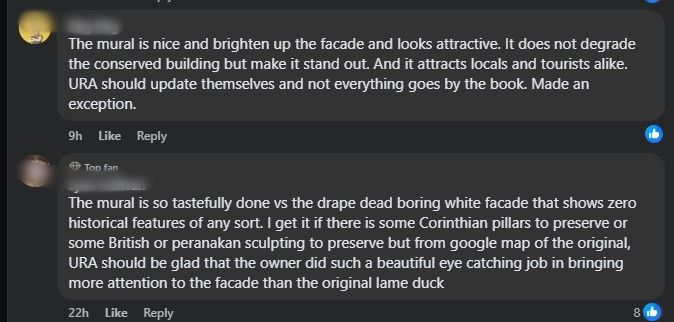
Online reactions were largely supportive, with many netizens describing the mural as beautiful, tasteful, and more visually engaging than what they viewed as a plain white facade.
Some said the artwork enhanced Arab Street’s appeal, helped attract tourists seeking photo-worthy locations, and aligned better with the area’s cultural identity.
Others criticised URA’s approach as overly rigid, arguing that strict adherence to rules contributes to Singapore becoming visually sterile.
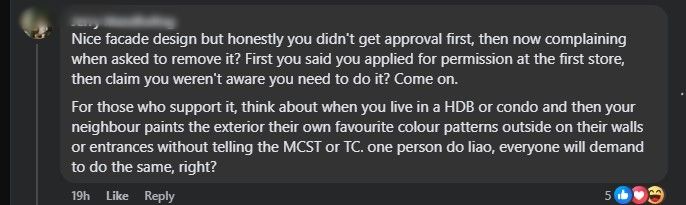
However, a smaller group defended URA, saying approval should have been sought beforehand and warning that allowing unapproved facade changes could lead to disorder in conserved areas.
URA allowed controversial Chinatown mural to remain after public outcry in 2024
According to BH, URA investigates about 50 cases of unauthorised work on conserved buildings each year.
In 2024, a mural by artist Sean Dunston depicting a Samsui woman holding a cigarette on a shophouse at 297 South Bridge Road sparked public controversy.
The building, located in Singapore’s conserved Chinatown district, drew attention after the owner was fined for carrying out the mural without prior approval from URA.
Following public discussion and further engagement, URA allowed the mural to remain, although the building owner was fined S$2,000 for breaching conservation guidelines.