Singapore upgrades 2026 growth outlook as GDP expands 5% in 2025
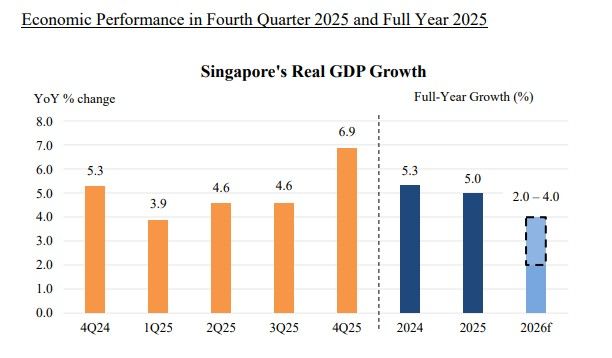
Singapore upgraded its 2026 growth forecast to 2–4 per cent after GDP expanded 5 per cent in 2025, driven by manufacturing, wholesale trade, finance, and robust AI-related demand despite global trade headwinds.

- Singapore’s economy grew 5% in 2025.
- The MTI raised the 2026 GDP forecast to 2–4 per cent.
- Manufacturing, wholesale trade, and finance led growth, while non-oil domestic exports rebounded strongly.

Singapore upgraded its economic growth forecast for 2026 on 10 February 2026, after data showed the economy expanded by 5 per cent in 2025. The stronger-than-expected performance came despite ongoing global trade uncertainties and tariff pressures.
The Ministry of Trade and Industry (MTI) said Singapore’s economy is now expected to grow by between 2 per cent and 4 per cent in 2026. This is an upward revision from the earlier forecast range of 1 per cent to 3 per cent.
The full-year GDP growth figure for 2025 exceeded MTI’s advance estimate of 4.8 per cent released in January.
However, it was slightly lower than the 5.3 per cent growth recorded in 2024, according to MTI’s data.
Growth momentum strengthened towards the end of the year. MTI reported that GDP expanded by 6.9 per cent year-on-year in the fourth quarter of 2025, accelerating from the 4.6 per cent increase in the third quarter.
On a quarter-on-quarter, seasonally adjusted basis, the economy grew by 2.1 per cent in the fourth quarter. This marked a moderation from the 2.6 per cent growth recorded in the preceding quarter.
Global conditions outperform earlier expectations
MTI said its earlier growth projection, issued in November 2025, assumed that economic activity in major economies would ease as United States tariffs filtered through the global economy. These expectations did not fully materialise.
Instead, most major economies posted stronger-than-expected growth in the fourth quarter of 2025. According to MTI, global trade activity also remained resilient despite the imposition of US tariffs.
“Notably, global trade activity remained resilient despite the US tariffs,” MTI said. It attributed this to lower effective tariff rates, trade diversion enabled by supply chain adjustments, and robust artificial intelligence-related exports amid the AI investment boom.
Manufacturing, trade and finance drive growth
Singapore’s 2025 growth was driven mainly by the manufacturing, wholesale trade, and finance and insurance sectors. These sectors benefitted from strong external demand and improving global financial conditions, according to MTI.
Within manufacturing, the electronics cluster recorded particularly strong growth. MTI said this was supported by robust demand for AI-related electronics, especially semiconductors linked to data centre expansion.
The wholesale trade sector also performed well. Growth was led by the machinery, equipment and supplies segment, reflecting strong regional and global demand for technology-related products, according to the ministry’s release.
The finance and insurance sector saw broad-based growth across all segments. This reflected higher business activity, improved market conditions, and increased demand for financial services, MTI said.
In contrast, the food and beverage services sector contracted in 2025. MTI attributed this partly to a decline in restaurant sales volumes, as consumer dining preferences continued to shift.
Outlook for 2026 supported by AI and fiscal stimulus
Looking ahead, MTI said the growth momentum seen in the final quarter of 2025 is expected to carry into 2026. The ongoing AI investment boom remains a key external driver supporting demand.
Several major economies are also expected to adopt expansionary fiscal policies. MTI highlighted that accommodative global financial conditions should support global growth in the coming quarters.
“Taking these factors into account, the GDP growth outlook for Singapore’s key trading partners for 2026 has improved compared to the outlook in November,” MTI said.
In manufacturing, the electronics cluster is projected to grow faster than previously expected. MTI cited strong demand for semiconductor chips in the data centre end-market as a key supporting factor.
The information and communications sector is also expected to benefit. Sustained enterprise demand for AI-enabled and other digital solutions is likely to underpin growth in the sector, the ministry added.
Risks from tariffs and geopolitics remain
Despite the improved outlook, MTI cautioned that growth is still expected to ease from 2025 levels. This reflects the drag from the full-year impact of US tariffs and rising global trade barriers.
MTI outlined both upside and downside risks. A stronger-than-projected upswing in the AI investment cycle could further boost electronics demand and lift equity markets.
Conversely, a renewed escalation in tariff actions or flare-ups in geopolitical tensions could dampen business and household sentiment, weighing on global and regional growth prospects.
Trading partners show mixed prospects
Among Singapore’s major trading partners, GDP growth in the US is expected to remain broadly stable. MTI said this would be supported by AI-related investments and fiscal stimulus from the One Big Beautiful Bill Act.
In the Eurozone, growth is projected to weaken due to US tariffs and elevated uncertainty. However, accelerated fiscal spending in Germany and the India-EU trade deal could partially offset these headwinds.
China’s GDP growth is expected to moderate as softer growth among its key trading partners weighs on export performance. Southeast Asian economies are projected to grow on the back of consumption and investment, albeit at a slower pace than in 2025.
Export performance improves markedly
Separately, Enterprise Singapore reported that non-oil domestic exports (NODX) rose by 4.8 per cent in 2025.
This marked a sharp improvement from the 0.2 per cent growth recorded in 2024.
Enterprise Singapore said growth was driven by electronics such as personal computers, semiconductors, and disk media products. Non-electronics growth was supported by ship and boat structures, non-monetary gold, and pharmaceuticals.
Electronic NODX expanded by 12.7 per cent year-on-year in 2025.
According to Enterprise Singapore, this momentum is expected to carry into 2026.
The agency also upgraded its NODX growth forecast for 2026 to between 2 per cent and 4 per cent, reflecting improved external demand conditions and sustained strength in the electronics cycle.