A verdict after a trial that wasn't theirs
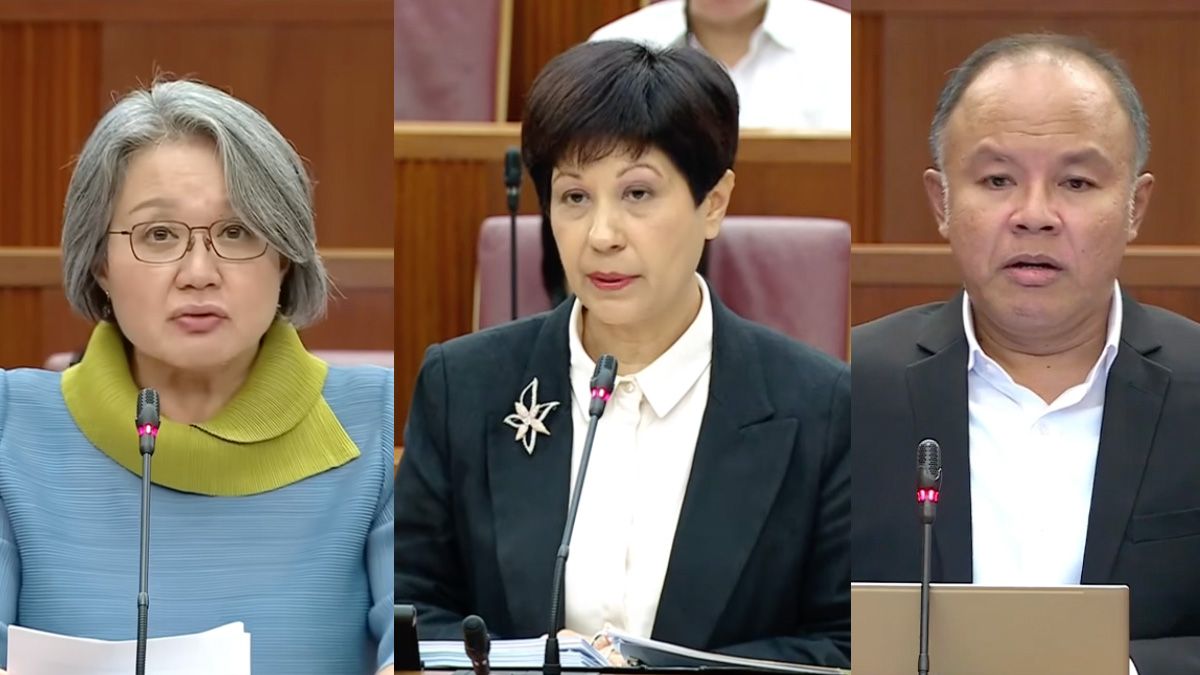
The COP found in 2022 that Lim and Faisal lied — but deferred deciding what to do until after Singh's trial. That process never came. On 7 July, Indranee delivered a verdict anyway, built on a trial they weren't party to. Lim raised this objection in January. It was never actually answered — just left standing.

On 15 February 2022, Parliament did not merely take note of the Committee of Privileges' findings on Sylvia Lim and Faisal Manap. It voted on them — and passed a specific resolution holding the question open. The final resolution of that day's Second Motion reads:
That this Parliament further resolves that the findings in the Report of the Committee of Privileges... regarding Mr Pritam Singh's, Ms Sylvia Lim's and/or Mr Muhamad Faisal Bin Abdul Manap's respective roles... in relation to the untruth... and Ms Lim/Mr Faisal's stating of untruths to the Committee on oath/affirmation; and the appropriate sanctions in respect thereof, be deferred until after the conclusion of the investigations and criminal proceedings (if any) against Mr Singh.
That is the actual instrument Indranee Rajah invoked on 7 July 2026 to explain why "no further action need be taken" against Lim and Faisal. It is worth being precise about what it did and didn't do. It didn't close anything. It scheduled a return to the question — expressly contingent on Singh's criminal case running its course.
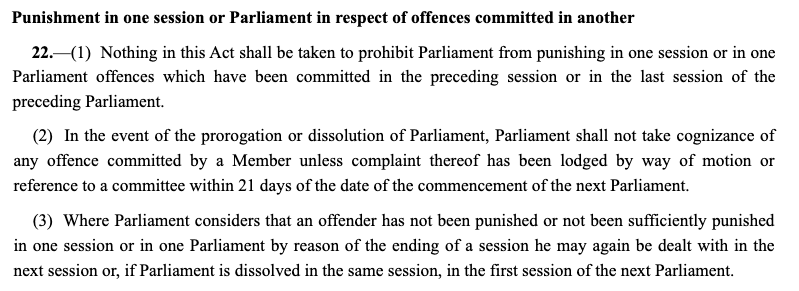
And when Singh's case finally did run its course, the 14th Parliament had been dissolved, an election had passed, and Section 22 of the Parliament (Privileges, Immunities and Powers) Act — which limits punishment to conduct in the current or immediately preceding session — had quietly closed the PPIPA window the resolution had reserved for reopening.
Parliament's political voice was not itself time-barred — it remained free, as Indranee herself noted, to pass a fresh motion expressing regret, the same route used against Singh in January.
What expired was narrower: Parliament's power to impose PPIPA sanctions on Lim and Faisal for the 8 August 2021 meeting.
What the Resolution Actually Rested On
The COP's own reasoning for that deferral is worth recovering, because it explains what was supposed to happen to Lim and Faisal, not just to Singh.
The Committee was explicit that Parliament had the power to deal with Singh itself — that was the default mechanism. It recommended a trial process anyway because it thought, given the seriousness of the allegation, Singh's case warranted the additional safeguards a criminal process provides.
As it put it, referring Singh to the Public Prosecutor meant the prosecutor could weigh the evidence afresh, Singh could defend himself with counsel, and a court could decide the matter against the higher threshold of proof beyond reasonable doubt.
None of that criminal-process apparatus was ever built for Lim and Faisal. The Committee explicitly declined to recommend referring Lim for prosecution over the lying finding — her role was "subsidiary," she'd been "somewhat helpful."
Faisal's referral to the Public Prosecutor covered only his refusal to answer questions, not the lying finding; that referral was closed when he was issued a police advisory on 18 March 2024, advising him to familiarise himself with the conduct expected of MPs under the Act and to refrain from any act that may be in breach of it — an advisory Faisal acknowledged.
So the question the 2022 resolution actually deferred — what Parliament should do about the COP's finding that Lim and Faisal lied about the 8 August meeting — was never routed to any process resembling the one the COP thought Singh's case deserved.
It was left to Parliament alone, to be picked up "at an appropriate time." That time never came, because the statutory limit built into the Act meant the window expired.
They Never Agreed the Premise, Either
It's also worth recalling that Lim and Faisal did not accept the deferred resolution's basis in 2022. When the vote was taken, Pritam Singh asked for the dissent of Workers' Party MPs to be recorded — Lim and Faisal stood among them.
Singh stated on the floor that although he and Faisal had no objection to being referred to the Public Prosecutor, they rejected the resolution because its premise was that they had told untruths to the Committee, a finding they disputed.
That objection remained on the record and was never revisited through any subsequent process. It simply sat there, unaddressed, for four years — until the underlying question could no longer be addressed at all.
Lim Already Made This Objection — In January
This is not a new dispute. On 14 January 2026, when Parliament passed the motion on Singh's suitability as Leader of the Opposition, its fifth limb noted that the High Court judgment and the COP's findings "have implications" for Lim and Faisal, "which have to be considered separately."
Lim used her speech that day to reject the linkage outright.
Neither she nor Faisal, she said, had participated in Singh's trial or given evidence in it; she had been interviewed by police but never called as a witness by either side.
"The Court's findings cannot be held against us," she told the House.
Indranee's response at the time laid out the exact reasoning she would repeat, almost word for word, six months later: the COP had found under oath that the 8 August meeting happened and that Lim and Faisal were present when the "take it to the grave" statement was made; the High Court, in a separate case, found the same meeting happened and the same statement was made; "so, that being the case, it has implications... it must follow, logically."
Lim held her ground: "I am still going to maintain that those findings cannot be held against me, and perhaps, at the next phase, or whenever it is, I will take this up again."
7 July: Neither Side Reopened It
That "next phase" arrived on 7 July — and what happened is more precise, and in some ways more telling, than a simple denial of a hearing.
When Indranee moved to close the matter, Lim rose. She did not object to the outcome — no further action suited her position fine — and she explicitly declined to relitigate the substance: "I'm not standing up to object to it, but I think it's important for me to also state that my response on some of the issues that she mentioned, I've made them on the 14th of January... and I don't think I need to repeat them."
Indranee's reply mirrored the move exactly: she thanked Lim for not objecting, and noted that her own responses from 14 January were "on record" too.
So the substantive dispute was never adjudicated beyond the original COP finding. It wasn't that Lim was denied a chance to answer — she chose, reasonably, not to repeat an answer already sitting in Hansard once the practical outcome had gone her way.
But that means the only thing actually settled on 7 July was that no further sanction would follow. The underlying question — whether Lim and Faisal lied about the 8 August meeting — was left exactly where it stood in January: Indranee's "it follows logically" on one side, Lim's "the Court's findings cannot be held against us" on the other, neither side required to test the claim any further, both simply left standing.
That asymmetry matters because of where each statement sits. Indranee's version was delivered as a ministerial statement — a formal government pronouncement, reported as the outcome of the matter.
Lim's rebuttal is a rejoinder in a Q&A exchange, referred back to rather than restated, carrying none of the same institutional weight. Both are technically "on the record." They do not carry the same public force.
The 7 July Statement Itself
Setting the exchange with Lim aside, the ministerial statement's substance has the same underlying problem.
Indranee told the House that "the Court's findings directly contradict Lim's and Faisal's evidence" and that it "follows logically" that their COP testimony was untrue.
The High Court's findings were made in a trial to determine Singh's guilt. Lim and Faisal were not parties to it, gave no evidence in it, and had no opportunity through counsel to test the evidence bearing on their own conduct.
Treating that judgment as confirmation against two non-parties relies on findings from a process built around one person’s liability and applies them to people who had no standing in that process — and who had already told Parliament, on the record, that they never had a defence of their own in it — the same safeguards the COP itself thought Singh's case warranted.
Second, she said: "Had the timelines been different, I would have proposed a different course of action." That sentence does no legal work — Section 22 closes the matter regardless of what follows it. Its only function is to signal, on the record, that she believes further punitive action was warranted and only just missed the window. It is an accusation insulated from ever being tested, delivered in the same breath as an acknowledgment that no test remains available.
She added, by way of explanation, that "this outcome has happened because... it decided to give Ms Lim and Mr Faisal the benefit of the doubt" — passing off years of Parliament's own inaction, protected by the very Act now cited as the obstacle, as generosity toward the two MPs rather than as the reason the matter was never properly tested at all.
What Actually Happened
Put together, plainly: in 2022, Parliament accepted the COP's finding but deferred deciding what to do about it pending a process it never built for Lim and Faisal specifically, while they were on record rejecting even the premise of the deferral.
In January 2026, Lim raised the specific objection that would matter most — that a judgment from a trial she wasn't party to could not be held against her — and Indranee answered with the "logically follows" reasoning she would use again in July. Neither side treated the point as settled; both simply left it standing.
On 7 July, with the practical outcome going Lim's way, neither side saw reason to reopen it — she declined to repeat herself, and Indranee declined to argue further, each content to let their January positions stand.
The result is that the only thing actually decided on 7 July was that no further sanction would follow. The COP did reach its own finding against Lim and Faisal, under oath, in 2022 — that much should not be understated. But everything downstream of that finding — the further stage Parliament itself reserved for deciding what, if anything, should follow — never happened.
Not through a process built for Lim and Faisal specifically; not through Singh's trial, to which they weren't parties; and not through Parliament's own two exchanges on the point, in which an assertion and a denial were simply logged against each other, six months apart, and left unresolved.
What the public actually got on 7 July was a ministerial statement — carrying the weight of a formal government pronouncement — repeating a conclusion whose consequences had been deliberately deferred to a further stage that, in the end, was never built.
Left to the Court of Public Opinion
Which leaves the matter to be settled nowhere, except in the one forum the Government itself has just spent the past month insisting cannot be trusted with verdicts.
On 5 November 2025, on a pre-recorded CNA programme, just one day after Singh’s appeal against his conviction was heard in the High Court, Singh said he believed "the court of public opinion can be bigger than any court in the world."
Following the broadcast, Minister for Law Edwin Tong issued a strong rebuke on 8 November 2025, calling Singh’s comments “outrageous, plainly wrong and completely unacceptable”.
By December 2025, after the Attorney-General's Chambers found the remarks contemptuous, Singh apologised "wholly and unreservedly," and the Ministry of Law welcomed his acknowledgment that it is "unacceptable for politicians to question or impugn the integrity of the Courts."
The message, repeated and enforced, was that public sentiment is not a substitute for judicial process, and that suggesting otherwise corrodes trust in the institution.
That principle applies with equal force to what happened to Lim and Faisal — except here it was Parliament, not Singh, treating a contested COP conclusion, whose next stage had been deliberately deferred, as though the deferred stage had supplied an answer.
No court decided a charge against them for whether they lied about the 8 August 2021 meeting.
Indranee’s position was that the High Court’s findings in Singh’s case directly contradicted their evidence and therefore effectively confirmed the COP’s conclusions about them.
But that confirmation came by inference from proceedings involving someone else, not from a process in which Lim and Faisal were parties.
The COP made a finding under oath; Parliament reserved further consideration of consequences; that consideration never took place; and what remained was a ministerial statement asserting the finding stood, met by a rejoinder that was never given a proper hearing to test.
Both are now propositions the public is left to weigh for itself — precisely the "court of public opinion" the Government insists should carry no legal authority.
It is one thing to tell an Opposition leader that public sentiment cannot override a court's verdict. It is another to present a contested finding as effectively resolved after the very process reserved for considering its consequences has disappeared.