Singapore MRT reliability nears record high as Circle Line performance jumps 50%
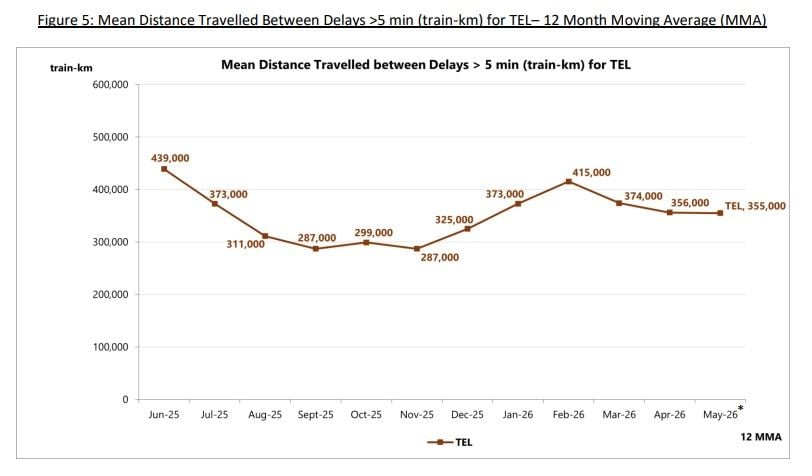
Singapore’s MRT network reliability improved to 2.5 million train-km between delays in May 2026, the second consecutive month above the 2 million mark, with the Circle Line recording a 50 per cent improvement and no delays exceeding 30 minutes across the main MRT network.
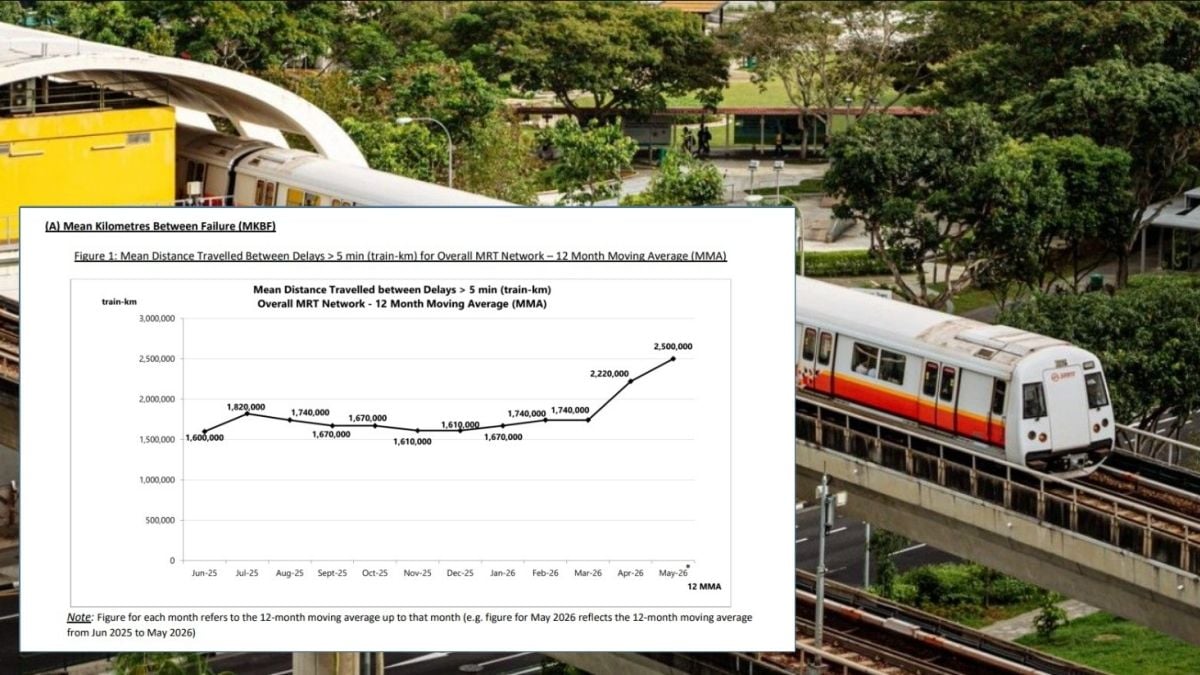
- MRT network reliability rose to 2.5 million train-km between delays in May 2026.
- Circle Line reliability improved by about 50 per cent from April.
- No MRT line recorded a delay exceeding 30 minutes during May.

Singapore’s MRT network reliability came close to matching its all-time high in May, supported by a sharp improvement on the Circle Line (CCL), according to the Land Transport Authority’s (LTA) latest monthly rail reliability report released on 12 June 2026.
The overall MRT network recorded a mean kilometres between failures (MKBF) of 2.5 million train-km in May, up from 2.22 million train-km in April.
The figure marks the second consecutive month that network reliability has remained above the 2 million train-km threshold.
LTA uses MKBF as its primary reliability indicator, measuring the average distance travelled before a train experiences a delay exceeding five minutes. The May figure remained below the record high of 2.627 million train-km achieved in June 2024.
Circle Line drives improvement
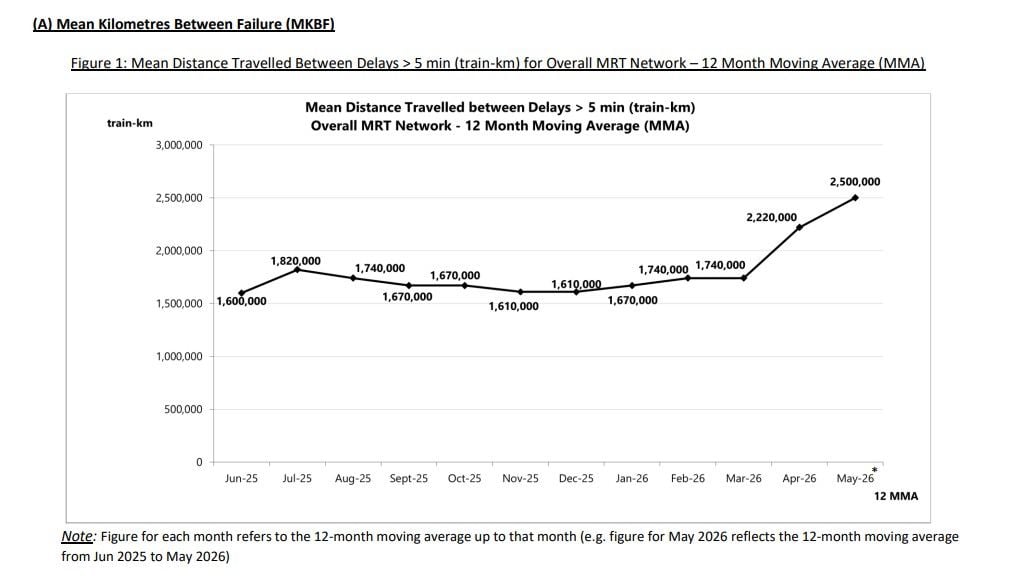
A significant contributor to the network-wide improvement was the Circle Line, which registered a roughly 50 per cent increase in reliability compared with April.
The Circle Line’s MKBF rose to 3.55 million train-km in May from 2.36 million train-km a month earlier, making it the strongest month-on-month improvement among Singapore’s MRT lines.
The North-South Line (NSL) also recorded a notable gain, improving to 1.65 million train-km from 1.42 million train-km in April.
Meanwhile, the North-East Line (NEL) edged up marginally to 4.46 million train-km from 4.45 million train-km.
Reliability on the East-West Line (EWL) and Downtown Line (DTL) remained unchanged from April at 2.02 million train-km and 4.2 million train-km respectively.
The latest report showed that no MRT line mentioned above recorded a service disruption exceeding 30 minutes in May. The last such incident on the main MRT network occurred in November 2025.
LTA’s data showed that the overall MRT network recorded zero delays exceeding 30 minutes in both April and May despite operating 3.397 million train-km during the month.
The authority noted that rail reliability is also assessed using the frequency of major service disruptions, with delays lasting more than 30 minutes regarded as severe incidents.
TEL remains outside headline reliability metrics despite 3 May disruption
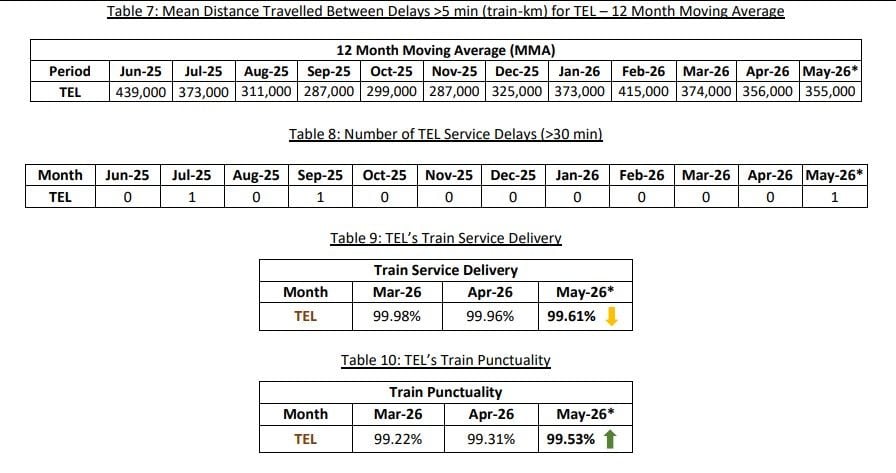
A disruption lasting more hours occurred on the Thomson-East Coast Line (TEL) on 3 May, but the line was excluded from the MRT network’s headline reliability calculations.
LTA said reliability indicators such as MKBF are less representative for newer rail lines, which typically operate lower mileage due to lower ridership and less frequent train services.
This can make reliability figures more volatile than those of mature lines.
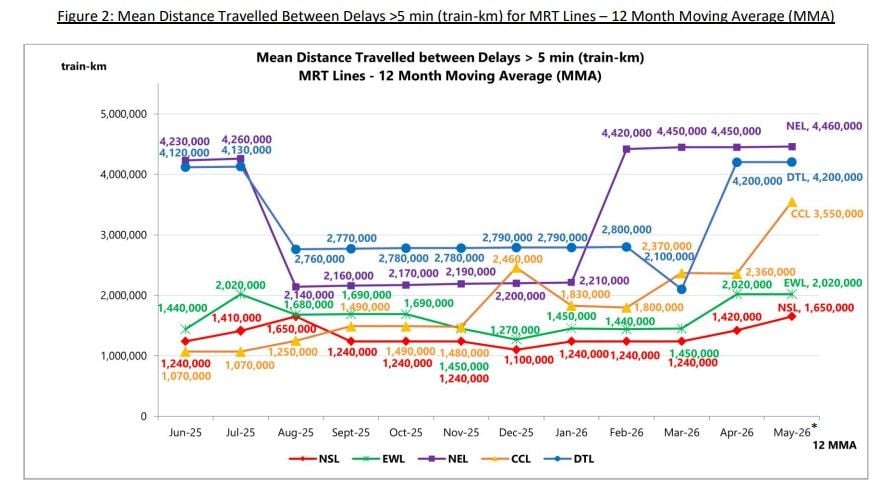
The TEL recorded an MKBF of 355,000 train-km in May, slightly down from 356,000 train-km in April, and registered one delay exceeding 30 minutes.
LTA said the line is still undergoing construction and extension works, with TEL Stage 5 yet to be completed.
The authority and operator are working with original equipment manufacturers to address signalling-related teething issues and prepare for future stages.
LTA expects TEL reliability to improve after the line is fully opened and operations stabilise.
Mixed results for service delivery and punctuality
Beyond MKBF, LTA tracks train service delivery and train punctuality as supplementary indicators of rail reliability.
Train service delivery measures the proportion of scheduled train mileage that was actually operated. At the network level, service delivery slipped slightly to 99.82 per cent in May from 99.90 per cent in April.
The decline was largely driven by lower performance on the Circle Line, which fell to 99.21 per cent from 99.67 per cent. The East-West Line and Downtown Line also posted slight declines, while the North-South Line and North-East Line improved.
LTA said the Circle Line’s performance was affected by ongoing system integration testing ahead of the opening of Circle Line 6 (CCL6), which caused minor perturbations on the existing network.
“Both indicators are expected to return to more typical levels after the opening of CCL6,” the authority said.
Train punctuality also declined across most lines. Overall MRT punctuality fell to 99.10 per cent in May from 99.48 per cent in April. All lines except the North-South Line recorded lower punctuality figures.
Greater transparency through monthly reporting
LTA began publishing monthly rail reliability updates in August 2025 following a series of service disruptions that heightened public scrutiny of Singapore’s rail network.
Previously, reliability updates were issued on a quarterly basis.
The authority said the move to monthly reporting was intended to provide commuters with greater visibility into rail performance and allow closer tracking of reliability trends across the network.
The latest report also showed Singapore’s MRT network compares favourably with many overseas systems.
Based on LTA’s conversion of reliability data into car-km, Singapore’s MRT network achieved an MKBF of 12.08 million car-km over the 12 months to May 2026, higher than Hong Kong’s MTR at 9.859 million car-km, though below Taipei Metro’s 23 million car-km.
For train service delivery, Singapore’s MRT network recorded 99.82 per cent, outperforming London Underground’s 92.6 per cent and New York City Subway’s 94.2 per cent based on the latest publicly available figures cited by LTA.