Coffee shop operators seek government grants to upgrade toilets amid hygiene enforcement
Singaporean coffee shop owners are increasingly turning to government subsidies to modernise facilities following stricter enforcement of hygiene standards.

- The National Environment Agency has received 175 applications for two S$5 million grants designed to co-fund up to 95 per cent of toilet renovation and deep cleaning costs.
- Coffee shop owners cite heavy usage, aging infrastructure, and the risk of demerit points or business suspensions from the Singapore Food Agency as primary motivations for upgrades.
- Critics, including Associate Professor Jack Sim, have labelled the grants a misuse of public funds, arguing that wealthy operators should bear the responsibility for basic hygiene compliance.

Singaporean coffee shop operators have begun utilising a S$10 million government fund to overhaul toilet facilities as authorities intensify pressure on public hygiene standards.
The initiative follows the endorsement of recommendations by the Public Toilets Task Force to improve cleanliness in high-traffic communal eating houses.
The National Environment Agency (NEA) reported that as of 31 January 2026, it had received 175 applications across two separate schemes: the Coffeeshop Toilet Renovation Grant and the Coffeeshop Toilet Deep Cleaning Grant.
Both programmes offer to cover up to 95 per cent of costs, with caps set at S$50,000 for renovations and S$25,000 for professional cleaning contracts.
According to a report by CNA, Ben Leem, the owner of Coffee Sense in Ang Mo Kio, became the first operator to complete a full renovation under the scheme.
Leem spent S$49,000 to install sensor taps and new fixtures after previously being fined and issued demerit points by the Singapore Food Agency (SFA) for cleanliness lapses.
Leem stated that the upgrade has led to a significant reduction in odours and a 20 per cent increase in business. He noted that while he previously washed the facilities twice daily, the decade-old infrastructure could no longer withstand heavy usage, leading to stained tiles that inspectors often mistook for mould.
The SFA operates a Points Demerit System where operators can face fines and suspensions. Accumulating 12 demerit points within a 12-month period can result in a mandatory business closure of up to three days.
Kenneth Lee, owner of Hai Fong coffee shop, noted that even short suspensions cause significant loss of income for both owners and stallholders.
Despite the high subsidies, some operators remain hesitant. Wong Kee Mee, owner of Keng Wah Sung cafe, cited space constraints in his pre-war premises and the potential for business disruption as reasons for not applying.
Other owners expressed concerns regarding cash flow, as the grant requires upfront payment to contractors followed by a reimbursement period of several months.
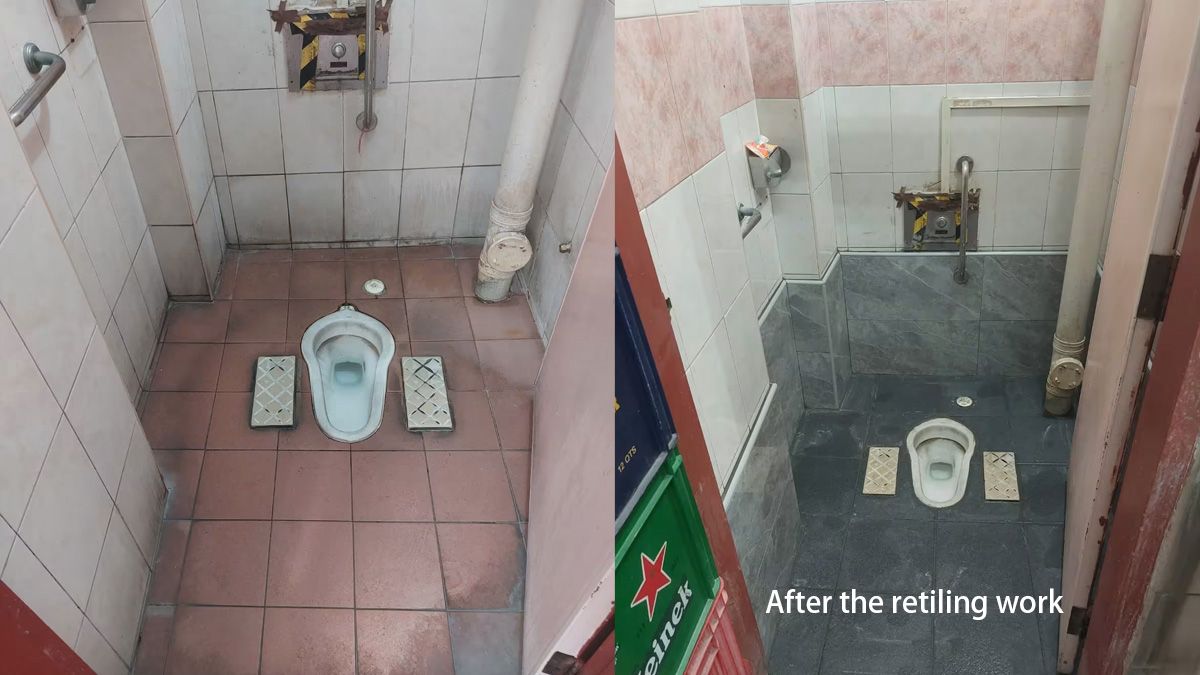
Instead of applying for the grant, Wong opted for a self-funded approach to maintain his business schedule.
According to CNA, he spent S$2,500 of his own money to retile the floors and walls over a single weekend to avoid closing the shop.
The grants have also faced public opposition. Associate Professor Jack Sim, a sanitation advocate, described the initiative as a "grave mistake" in a series of public statements.
Sim argued that the Ministry of Sustainability and the Environment (MSE) is unfairly subsidising private businesses, some of which are owned by wealthy entities.
Sim suggested that instead of providing public funding, the government should implement stricter enforcement, including surprise inspections and a public grading system similar to food hygiene ratings. He claimed that 60 per cent of coffee shop toilets remain dirty and argued that higher fines would be more effective than subsidies.
In response to such criticisms, the government has defended the grants as a necessary intervention for public health. Senior Parliamentary Secretary for Sustainability and the Environment Baey Yam Keng previously stated that coffee shops serve as vital social hubs, particularly for the elderly, and require support due to high footfall and limited cleaning manpower.
The Restroom Association of Singapore (RAS) continues to encourage owners of aging facilities to adopt the scheme.
RAS President Ho Chee Kit noted that while convincing some owners of the business value of clean toilets remains challenging, outreach efforts are slowly shifting mindsets through programmes like the Happy Toilet certification.