Singapore awaits Israeli response over reports of nationals serving in IDF
Singapore's government has confirmed it sought information from Israel over reports that two Singaporeans served in the Israel Defense Forces during the 2025 Gaza conflict, with no response received as of 5 March 2026.
- Singapore has asked Israel about alleged Singaporeans serving in the IDF but received no reply.
- Participation in foreign conflicts may result in detention or prosecution.
- Government says current laws, including the ISA, are sufficient.

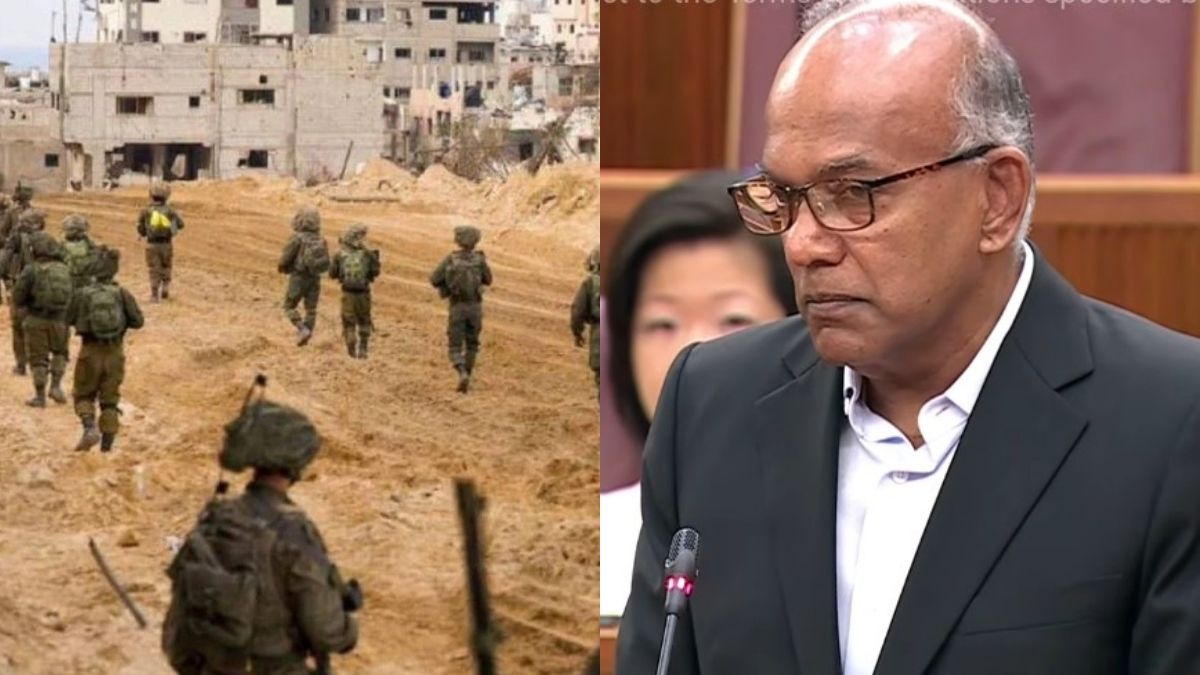
Singapore's government has formally requested information from Israel following reports that two Singaporean nationals may have served in the Israel Defense Forces (IDF) during the 2025 conflict in Gaza. As of 5 March 2026, no response had been received.
Coordinating Minister for National Security and Minister for Home Affairs K Shanmugam disclosed this during a parliamentary sitting, responding to questions from three Members of Parliament.
He reiterated that Singapore maintains zero tolerance for its citizens participating in foreign armed conflicts.
Reports of Singaporeans in the IDF
The matter was first brought to public attention on 11 February 2026, when British investigative outlet Declassified UK published a report drawing on data obtained from the IDF.
The data was secured through a freedom of information request submitted under Israel's Freedom of Information Law by Elad Man, a lawyer associated with Israeli non-governmental organisation Hatzlacha.
The IDF figures indicated that more than 50,000 soldiers holding Israeli nationality alongside at least one other citizenship had participated in the conflict.
Within that dataset, Declassified UK identified two Singapore passport holders.
One was recorded as an Israeli citizen with Singapore nationality; the other was recorded as holding multiple nationalities, including Singaporean and Israeli citizenship.
The report did not identify either individual, specify their roles, or state the period of their service or deployment. This limits what conclusions can be drawn from the figures alone.
MHA seeking clarification on Singaporeans serving in IDF
Shanmugam told Parliament that the Ministry of Home Affairs (MHA) is aware of the Declassified UK report but stressed that the ministry has no substantiated information confirming that any Singaporean has served or is currently serving in the IDF.
The questions were raised by Workers' Party Members of Parliament Dennis Tan and Fadli Fawzi, and by East Coast GRC Member of Parliament Hazlina Abdul Rahim.
The MPs sought clarification on whether the government had verified the claims, whether investigations had been initiated, and whether laws such as Section 125 of the Penal Code 1871 had been breached.
They also asked about possible prosecution, implications for dual citizens, and measures to monitor and deter unauthorised foreign military involvement.
No response from Israel
Responding to a supplementary question from Dennis Tan on whether Singapore would seek clarification from its Israeli counterparts, Shanmugam confirmed that a formal request had already been made.
"The government has asked the Israeli government; we have not received a response," he told Parliament.
Shanmugam acknowledged that foreign governments may face practical and legal obstacles in complying with such requests.
He noted that serving in a foreign military may not constitute an offence under Israeli law, even though it is a breach of Singapore law. In some jurisdictions, dual citizens are not legally required to disclose their additional nationalities to military authorities.
"Other governments may not even know that these people hold dual citizenship," he said, adding that such disclosure is not always mandatory.
He observed that Singapore has made similar requests of various governments over the years. "Sometimes we get answers; sometimes we don't get answers," he said.
Zero tolerance and legal consequences
Shanmugam reiterated that Singapore's stance has been long established and publicly communicated.
"Singaporeans should not participate in any foreign armed conflict not involving Singapore," he said.
"Our loyalties, as Singaporeans, should only be to Singapore, and we should only ever engage in military action in defence of Singapore."
He warned that those found to have participated, or even planned to participate, in foreign armed conflicts would be subject to Singapore law.
Enforcement options include criminal prosecution and detention under the Internal Security Act (ISA) for those deemed a threat to national security.
Shanmugam noted that many individuals had been detained on such grounds in the past, and that these cases had been publicised.
Individuals found to hold multiple citizenships may also be deprived of their Singapore citizenship, he added.
On the question of nationality obligations and preventive measures, Shanmugam said Singapore would seek to engage foreign counterparts to secure an individual's return if credible evidence emerged.
"If they are within Singapore, there is no issue; we will deal with them as we have dealt with in the past," he said.
Asked about clarifying existing guidelines, his response was direct: "The simple answer is don't do it, and there is zero tolerance for it."
Legal framework and Section 125 of the Penal Code
Fadli Fawzi asked whether Section 125 of the Penal Code 1871 is applicable to Singapore citizens serving in foreign militaries, and whether amendments to the law are necessary.
Section 125 criminalises waging war, attempting to wage war, or abetting the waging of war against any foreign power that is in alliance or at peace with Singapore.
Shanmugam did not directly address whether the provision applies to citizens serving in foreign armed forces. He said applicability would depend on the specific facts of each case and would require investigation, stopping short of confirming or ruling out its use.
He noted that in past cases, authorities had more often relied on the ISA rather than the Penal Code, suggesting that Section 125 has not been the primary enforcement tool in such matters.
On whether amendments are needed, Shanmugam said the existing legal framework is sufficient. "In our view, given the positions we have stated, the current legal framework, including the Internal Security Act, is adequate," he said.
He stressed that enforcement would apply regardless of which foreign force an individual was found to be serving with, and that Singapore would act upon receiving credible information.
Dual citizenship context
Singapore generally does not permit dual citizenship.
Under the Constitution, individuals below 21 years of age may hold more than one citizenship, but are required to renounce all but one thereafter.
The presence of Singapore passport holders in IDF data raises questions about whether those individuals had properly renounced prior citizenships, or whether their circumstances fall within the constitutional provision for those under 21
Shanmugam said Singapore would act upon receiving credible information, regardless of the theatre of conflict involved.