Singapore balances ties with China and Japan amid rising regional tensions, says PM Wong
Prime Minister Lawrence Wong says Singapore can remain friends with both China and Japan despite rising tensions, as the city-state deepens ties with Tokyo while maintaining strong links with Beijing.

- Singapore rejects “zero-sum” diplomacy, maintaining ties with China, Japan, and the US
- Bilateral relations with Japan upgraded to Strategic Partnership
- Wong highlights need for dialogue, ASEAN centrality, and managing historical sensitivities

Singapore has reiterated its commitment to maintaining strong relations with both China and Japan, even as tensions between the two East Asian powers remain elevated.
Prime Minister Lawrence Wong said the city-state does not see its diplomatic ties as a “zero-sum affair”, stressing that it is possible to cultivate meaningful partnerships with multiple major powers simultaneously.
“Having good relations with one does not come at the expense of another. We can be friends with both China and Japan and America, for that matter. We want to maintain as many good friends as possible,” Wong said.
His remarks came during his first official visit to Japan as prime minister, which began on 17 March 2026.
Strategic Partnership with Japan strengthened
Singapore and Japan announced an upgrade of their bilateral ties to a Strategic Partnership on 18 March, signalling deeper cooperation across multiple sectors.
Wong described the relationship as long-standing and mutually beneficial, noting that the new framework would enable both countries to expand collaboration further.
“The relationship we have with Japan is long-standing. It's mutually beneficial, and the cooperation is wide-ranging,” he said.
The partnership will focus on areas such as artificial intelligence, quantum technology, cybersecurity, and economic cooperation.
Both countries are also aligned in supporting free and open trade, as well as a rules-based international order.
Wong added that Japan’s strategic priorities closely match Singapore’s own development goals, providing a strong basis for deeper engagement.
Navigating a complex geopolitical environment
Wong acknowledged that maintaining balanced relations has become more challenging amid intensifying global rivalry.
He noted that Singapore’s actions are increasingly scrutinised by major powers, particularly in the context of shifting alliances and regional tensions.
“When I am in one country, the other country may take notice. This time it is Japan. Next week will be China,” he said.
Despite this, he emphasised the importance of preserving strategic flexibility.
“As far as a small country is concerned, it is helpful to have maximum strategic space for us to operate,” Wong said.
He added that Singapore’s approach is to engage as many partners as possible while safeguarding its national interests.
China, he noted, was aware of his visit to Japan and had continued to invite him to the Boao Forum in Hainan, where he is scheduled to deliver a keynote speech.
Call for dialogue between China and Japan
Addressing the strained relationship between China and Japan, Wong expressed hope that both sides would continue engaging in dialogue.
While acknowledging the challenges, he said differences should not prevent cooperation.
“Our focus in Singapore has always been to find the common ground, to focus on the areas where we have good opportunities to work together,” he said.
He reiterated that disagreements between countries need not hinder bilateral ties or partnerships.
Relations between China and Japan have deteriorated in early 2026, driven by territorial disputes, economic pressures, and tensions over Taiwan.
Recent remarks by Japanese PM Sanae Takaichi regarding potential military responses in a Taiwan conflict have further heightened tensions with Beijing.
Historical sensitivities acknowledged
Wong said historical issues were discussed during his meeting with Takaichi, particularly the legacy of World War II.
He emphasised that Singapore continues to remember the impact of the Japanese Occupation, describing it as a “dark, painful period”.
“We will never forget what happened,” he said.
Singapore commemorates Total Defence Day annually to mark the anniversary of the British surrender in 1942.
However, Wong stressed that remembering history should not prevent forward-looking cooperation.
“Remembering the past does not mean we cannot move forward to forge a mutually beneficial relationship with Japan,” he said.
He referenced Singapore’s longstanding approach since 1967, when founding prime minister Lee Kuan Yew opened the Civilian War Memorial as a symbol of remembrance without fostering hostility.
ASEAN centrality and regional stability
Wong reiterated that Singapore’s foreign policy is rooted in ensuring a peaceful and stable regional environment.
He said this goal cannot be achieved alone, highlighting the importance of partnerships and multilateral cooperation.
“We need to do this with partners, and that is why we have long advocated for an open and inclusive region with ASEAN at the centre,” he said.
Japan, he added, plays a crucial role in supporting ASEAN through investment, infrastructure development, and economic cooperation.
However, Wong noted that some ASEAN countries still hold concerns over unresolved historical issues involving Japan.
“Singapore's position is, we hope Japan can more clearly articulate its position on these issues,” he said.
He added that resolving such concerns could enable Japan to take on a larger role in regional security and diplomacy.
Wong said Singapore’s strategy is to build a secure and resilient nation by maintaining strong relationships with multiple partners.
He stressed that this approach reflects both pragmatism and principle in navigating an increasingly uncertain global landscape.
The emphasis, he said, remains on cooperation, dialogue, and mutual benefit, even amid rising geopolitical tensions.
Sim Ann earlier highlighted historical legacy and path forward with Japan
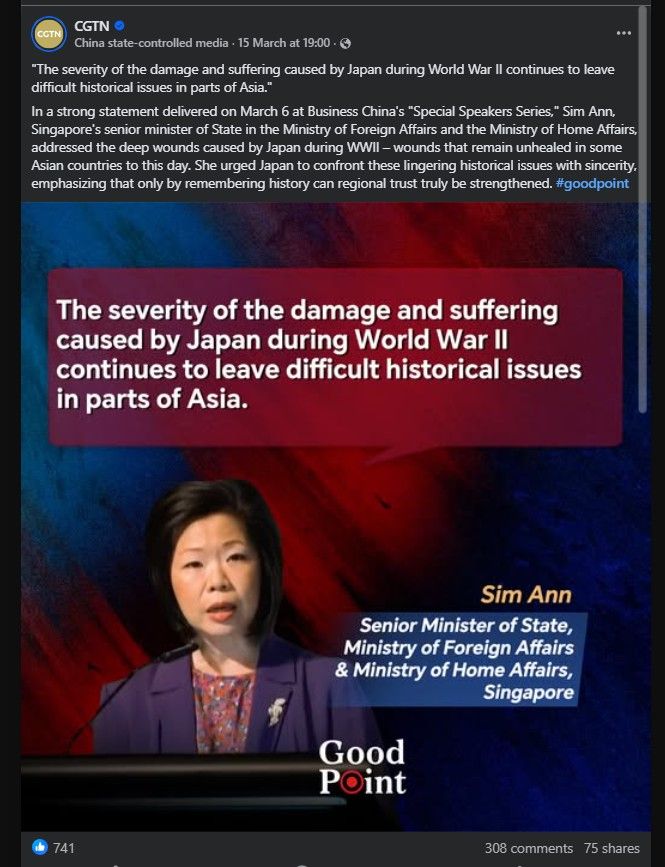
Notably, speaking at the Business China Special Speakers Series earlier on 6 March, Senior Minister of State for Foreign Affairs Sim Ann also reflected on Singapore’s long and complex history with Japan, spanning early economic ties to the trauma of the World War II.
She noted that while the Japanese Occupation remains the darkest chapter, its lessons continue to shape Singapore’s emphasis on resilience and self-reliance.
Sim stressed that remembrance is not intended to reopen old wounds, but to ensure future generations understand the consequences of conflict.
She also highlighted how post-independence cooperation, including reparations and investment, enabled Japan to play a significant role in Singapore’s economic development.
“At the same time, we recognise that the severity of the damage and suffering caused by Japan during the Second World War continues to create difficult historical issues in parts of Asia,” she said.
She added that such issues must be handled sensitively, expressing hope that Japan can consider how to resolve these longstanding concerns to strengthen regional trust and cooperation.
China state media outlet CGTN subsequently spotlighted her remarks, particularly her reference to the enduring impact of wartime suffering.
According to CGTN, her comments underscored the “deep wounds” left by Japan’s actions during the war, which remain unresolved in parts of Asia, framing her remarks as a call for Japan to address these historical issues with sincerity, noting her emphasis that remembering history is essential to building lasting regional trust.