Netizens challenge PM Wong's fertility comments, citing affordability and work-life pressures
Singaporeans have responded to Prime Minister Lawrence Wong's remarks on declining birth rates by calling for broader structural reforms, arguing that housing costs, childcare expenses, work-life balance and job insecurity remain key barriers to starting families.
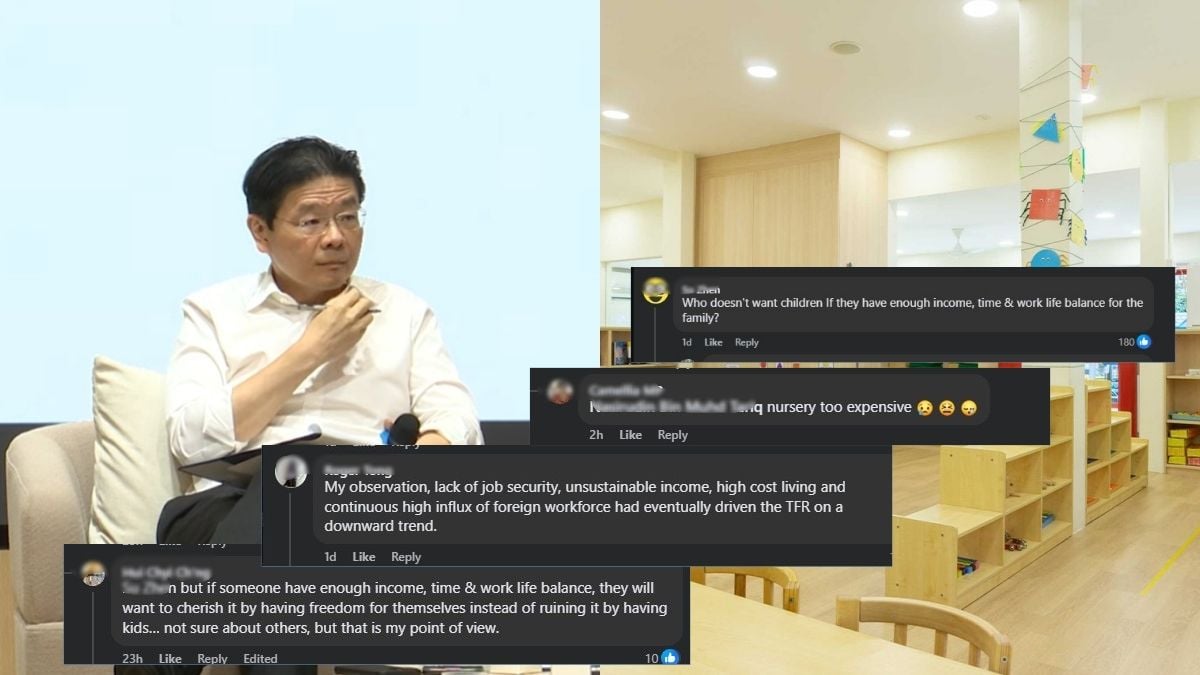
- Singaporeans say housing, childcare and work-life balance are bigger concerns than baby bonuses.
- Lawrence Wong described declining fertility as a global challenge affecting both developed and developing countries.
- Online discussions called for structural reforms to better support marriage, parenthood and family life.

Singaporeans have pushed back against Prime Minister Lawrence Wong's remarks that declining birth rates are a global challenge with no clear solution, with many arguing that couples are already struggling to support themselves, let alone raise children.
Online discussions point to housing costs, childcare expenses, job insecurity, long working hours and poor work-life balance as key reasons behind Singapore's persistently low fertility rate.
Many also argued that one-off incentives such as baby bonuses are insufficient, calling instead for broader structural reforms including more affordable housing, subsidised childcare and education, flexible work arrangements and stronger support for working parents.
PM Wong: Declining fertility as a global challenge with no ready solution
Speaking during the Singapore Press Club's Eminent Speaker Series at the SPH Media news centre auditorium in Toa Payoh on 8 June 2026, Wong said declining birth rates have become a global demographic challenge affecting countries across different stages of development.
"It's a global challenge. It's happening everywhere in the world. No one has the answers for now," he said.
Wong said earlier assumptions that low fertility rates were primarily a problem in wealthy economies no longer reflected reality.
"But nowadays you look around the world, even developing countries are having declining birth rates below replacement levels," he said.
He added that governments worldwide have invested significant resources in pro-marriage and pro-parenthood measures but have yet to achieve lasting success.
"Countries have put in a lot of resources to try and stop the decline and to encourage marriage and parenthood, but there has been no enduring success," Wong said.
Singapore's total fertility rate fell to a record low of 0.87 in 2025.
Focus on creating a family-friendly environment
Despite the challenges, Wong said Singapore would continue efforts to support families through the Marriage and Parenthood Reset Workgroup led by Minister in the Prime Minister's Office Indranee Rajah.
"The objective is to think about the issue less as a procreation incentive, less of a baby bonus," he said.
Instead, he said the Government was looking at creating a more family-friendly environment through improvements in areas such as housing, childcare and education.
Immigration remains necessary
Wong also rejected suggestions that Singapore was aiming for a population of 10 million.
"How do we get to 10 million when the TFR is so low?" he said.
He added that there were no plans to establish a new long-term population target and noted that the earlier projection of 6.9 million residents remained some distance away.
On immigration, Wong said inflows would continue to be carefully managed despite demographic pressures.
"We should then have some of them who share our values and way of life to become Singaporeans," he said.
"The aim is not to raise the population to a very high figure at all."
Netizens urge deeper structural reforms
Wong’s remarks were followed by extensive discussion on social media, with more than 1,200 comments recorded on CNA’s Facebook page alone.
The debate also extended to The Straits Times and CNA’s YouTube channels, as well as online forums such as Reddit.
Many netizens questioned whether policymakers fully understand the everyday pressures shaping family formation decisions, with repeated calls for greater emphasis on long-term structural costs rather than short-term incentives.


Concerns over cost of raising children
A dominant theme in the discussion was the affordability of raising children in Singapore.
Many commenters argued that financial incentives such as baby bonuses do not sufficiently offset long-term expenses, particularly childcare, housing, and education.


One widely echoed view was that while financial support at birth may provide initial relief, it does little to address the ongoing costs of raising a child. As one commenter noted,
“Those help in the early years, but they don’t cover the ongoing costs of raising a child.”
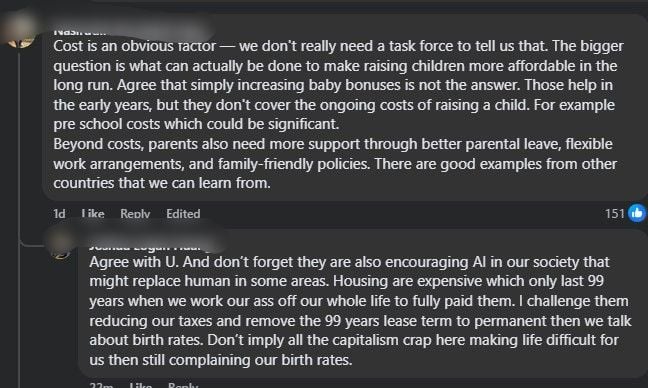
Others stressed that affordability remains the key barrier, with one user stating that “nursery too expensive,” while another argued that if childcare and education were more affordable or free, more couples might consider having children.

Some commenters also called for structural reforms, including expanded parental leave, flexible work arrangements, and stronger workplace protections for families, arguing that these measures are as important as direct financial subsidies.

Differing views on policy priorities
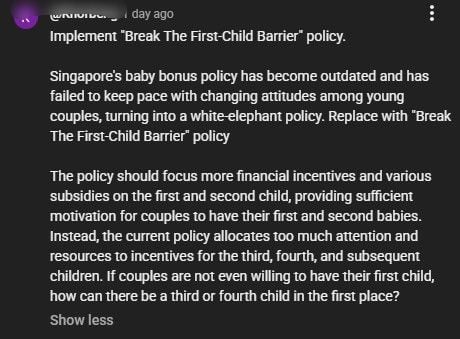
There were also contrasting opinions on how resources should be allocated. Some users argued that incentives should focus on encouraging the first and second child rather than later births, with one suggestion calling for a “Break The First-Child Barrier” approach.
This view held that if couples are not having their first child, incentives for third or fourth children are less meaningful. “If couples are not even willing to have their first child, how can there be a third or fourth child in the first place?” one comment stated.
Others countered that policy effectiveness is not determined solely by incentives, but also by broader societal conditions.
They argued that decisions on family size are more strongly shaped by long-term financial security, housing access, and employment stability than by subsidies alone.
Views on broader structural conditions
A number of commenters pointed to wider systemic issues such as housing affordability, cost of living, and job security. Some argued that young couples are delaying family formation as they first seek to stabilise careers and finances.
One comment stated that in the current environment, “how are courting couples able to start families when rents are high and housing is expensive?”

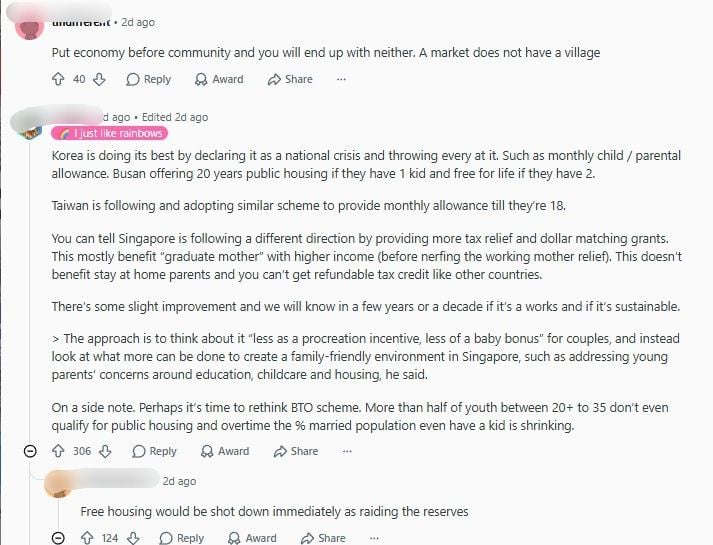
Others highlighted international comparisons, pointing to countries with extensive childcare support, housing benefits, or education subsidies as examples worth studying.
At the same time, some users disagreed on the extent of state responsibility, arguing that long-term fiscal sustainability and avoiding over-reliance on public support must also be considered.
Debate on population growth and immigration
The discussion also extended to Singapore’s broader demographic outlook and immigration policy.
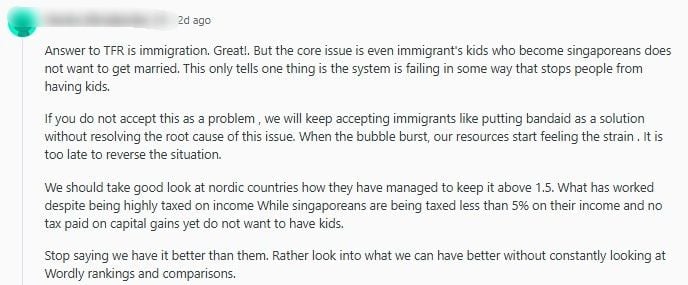
Some commenters questioned whether population growth targets remain relevant, while others argued that continued inflows of migrants are already shaping demographic trends.
One view expressed scepticism about long-term population projections, while another stated that “despite low fertility, the population is still growing rapidly,” suggesting that immigration continues to play a significant role.
Others argued that immigration policy must balance economic needs with social cohesion, with emphasis on carefully managing inflows while maintaining stability.

Concerns over national identity and long-term sustainability
Some commenters raised concerns about long-term demographic composition and integration, while others focused on economic sustainability and labour force needs.
A segment of users expressed unease about increasing reliance on foreign labour, while others viewed it as necessary to offset declining birth rates.
There were also broader reflections on whether current policy directions adequately address the underlying causes of low fertility, with calls for more comprehensive, long-term planning rather than incremental adjustments.

Divergent expectations of government role
Opinions varied on the extent to which the government should intervene in addressing fertility decline.
Some urged stronger intervention through subsidies and structural reforms, while others argued that family formation remains a personal decision that cannot be engineered through policy alone.
As one comment summarised, “What the government should do is make life easier for those who want children, instead of trying to persuade people into having them.”