A historic first: The POFMA direction against The Online Citizen and what it means
On 23 March 2026, TOC received what we believe is the most escalated use of POFMA since it came into force in 2019 — the first direction to name an individual journalist by full legal name, the first to require a newspaper advertisement, and the 19th direction against TOC, more than any other entity in POFMA's history.
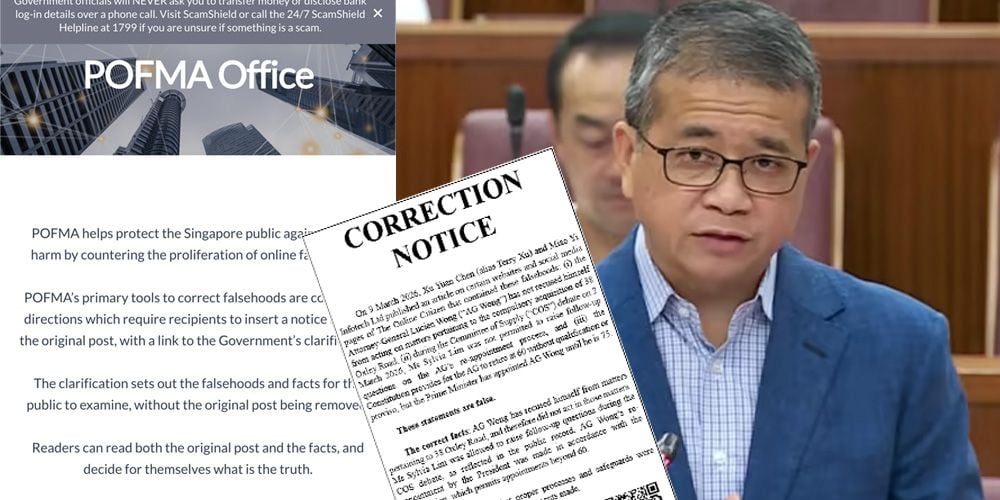

On 23 March 2026, The Online Citizen received what we believe to be the most escalated use of the Protection from Online Falsehoods and Manipulation Act (POFMA) since it came into force in 2019.
The Correction Direction — reference POFMA-DC-2026-03-03 — was issued by Minister for Law Edwin Tong against Xu Yuan Chen (Terry Xu) personally and Miao Yi Infotech Ltd, the Taiwan-registered entity through which TOC operates.
The direction concerns an article published on 9 March 2026 titled "The Chair Was Empty, The Question Wasn't", which examined three questions: whether 72-year-old Attorney-General Lucien Wong had renewed his recusal from matters pertaining to 38 Oxley Road following his fourth consecutive reappointment in January 2026; whether Workers' Party MP Sylvia Lim was permitted adequate follow-up during the Committee of Supply debate on 2 March 2026; and whether the Prime Minister's role in the AG's reappointment was accurately characterised.
We comply with the direction because the law requires it. We do not comply because we accept the government's characterisation of our reporting.
The Personal Naming: A Documented First
TOC has received POFMA directions on multiple occasions since the Act came into force in 2019. According to records compiled from official POFMA Office data, The Online Citizen has received 19 Correction Directions to date — more than any other entity or individual in POFMA's history. The progression of how those directions were addressed is documented in the directions themselves.
In January 2020, the direction was addressed to "Mr Terry Xu, Editor, The Online Citizen" — identifying Terry in his editorial capacity. In October 2022, the direction was addressed to "The Online Citizen" — the publication entity alone, with Terry not named. In February 2025, a direction was issued over a piece authored by Terry personally about matters directly concerning a minister who is simultaneously pursuing personal defamation proceedings against him. That direction was addressed entirely to "The Online Citizen." Terry was not named personally despite being the author and despite the Taiwan-based operating structure already being in place.
In March 2026, for the first time across all 19 directions spanning six years, the direction names "Xu Yuan Chen (alias Terry Xu)" by full legal name as a primary respondent alongside the publishing entity.
The February 2025 direction demonstrates that the personal naming in this direction was a deliberate choice, not an administrative default. Every circumstance that might justify personal naming was present in February 2025 — the piece was Terry's work, the subject was a minister in direct legal dispute with him, the Taiwan operating structure was already in place. The personal naming did not occur then. It occurred on a piece questioning the Attorney-General's recusal from proceedings involving the founding prime minister's family.
The Heidoh Question
The direction lists https://heidoh.com as one of the online locations where the subject statements are communicated, and requires correction notices to be published on Heidoh's main page.
Heidoh is an AI-driven news aggregation platform. The article published on 9 March 2026 was not posted on Heidoh as original content. What appeared on Heidoh was a link to the article on theonlinecitizen.com, accompanied by a title and excerpt automatically generated by the platform's aggregation function. The full article resided on and was published by theonlinecitizen.com.
The direction treats the automated aggregation of a link and excerpt as equivalent to the communication of the subject statements themselves. If that standard is applied consistently, every platform that aggregated, linked to, or excerpted the article — including news aggregators, social media link previews, and third-party platforms — would be equally subject to direction for communicating the same subject statements.
We note that certain platforms are exempted from POFMA directions under the Act's provisions. The question of whether automated aggregation of a link and excerpt constitutes communication of a false statement of fact — and why that standard was applied to Heidoh but not to other platforms that carried the same link and excerpt — is one we consider relevant to the direction's basis and proportionality.
The Three Subject Statements and Our Response
The direction identifies three statements as false statements of fact. We address each in turn.
On Subject Statement 1, the direction asserts that AG Wong has recused himself from matters pertaining to the compulsory acquisition of 38 Oxley Road. The government's rebuttal in Annex A points solely to parliamentary statements made in July 2017 — when the circumstances were materially different. At that time, the Oxley Road matter was a private family dispute managed outside government.
By January 2026, the government had gazetted 38 Oxley Road as a national monument, commenced compulsory acquisition proceedings under the Land Acquisition Act, and initiated compensation proceedings against Lee Hsien Yang — the brother of the man who appointed Lucien Wong to his position three times.
Our article did not say the 2017 recusal never existed. It said no public confirmation of renewal has been produced for these materially different 2026 proceedings. The government's rebuttal does not produce one. It points to 2017 and declares the matter settled.
On Subject Statement 2, the direction states that Sylvia Lim was in fact permitted to raise follow-up questions during the COS debate. We acknowledge that Lim subsequently asked two questions after Minister Tong's initial response.
Our parliamentary report on the same debate — published on the same day as the opinion piece — contained the substantive claim that the Speaker did not call on Lim to respond after Tong concluded his remarks. That report was not subject to any direction. The direction was applied to the opinion piece while an identical factual claim in the parliamentary report was left untouched. The question of why the same claim attracts a direction in one publication but not another has not been addressed by the government.
On Subject Statement 3, the direction asserts that the President, not the Prime Minister, makes the appointment. The article itself stated precisely this — that the AG's appointment is "a constitutional appointment made on the Prime Minister's advice."
The direction corrected a compressed formulation in one part of the piece while ignoring the article's own correct statement of the constitutional position elsewhere in the same piece. The article's actual argument — that Lawrence Wong, as the person whose advice determines the appointment, should have defended that decision personally — was not addressed by the direction at all. Neither was Sylvia Lim's direct question about whether other candidates were shortlisted, which Minister Tong explicitly declined to answer on the parliamentary record.
What the Parliamentary Record of 2019 Says
During the Second Reading of the Protection from Online Falsehoods and Manipulation Bill on 7 May 2019, then-Senior Minister of State for Law Edwin Tong told Parliament that the large majority of the Bill's toolkit was designed for platforms and coordinated bad actors, not individual publishers.
He described how falsehoods amplified by bots and fake accounts could reach hundreds of thousands within hours and mobilise real-world consequences before any correction could take hold.
Then-Law Minister K Shanmugam described the Bill's primary targets as foreign state actors using information warfare, profit-driven disinformation operations, and coordinated fake account networks operating at industrial scale.
Minister Tong is the signatory of this Direction.
The Contrast That Speaks For Itself
In the same period this Direction was issued, the government declined to invoke POFMA against a coordinated campaign of nearly 300 AI-generated YouTube videos targeting Prime Minister Lawrence Wong, accumulating millions of views, fabricating narratives about his resignation and dismissal.
Minister for Digital Development and Information Josephine Teo explained in Parliament that POFMA directions were unnecessary because YouTube had independently removed most offending accounts. The government instead relied on platform enforcement and public discernment.
This was precisely the threat profile that then-Senior Minister of State Edwin Tong described to Parliament on 7 May 2019 when making the case for the law — coordinated inauthentic behaviour, AI-generated content, fake accounts operating at industrial scale. The government declined to use the instrument against that campaign, with Minister for Digital Development and Information Josephine Teo explaining that YouTube's independent removal of most offending accounts made formal directions unnecessary. The same instrument was used instead against a single opinion piece by an independent journalist questioning the Attorney-General's recusal — a direction signed by Edwin Tong, now Law Minister, the same minister who described the law's purpose to Parliament in 2019.
The 2019 parliamentary record and the 2026 enforcement record now sit side by side. We leave readers to draw their own conclusions.
What This Direction Represents
Beyond the three subject statements, this direction is notable for what it does structurally.
It is the first direction in POFMA's history to name an individual journalist by full legal name as a personal respondent. It is the first direction to invoke Section 11(3)(b) — requiring publication of a correction notice in a newspaper at the subject's expense, at a cost of SGD $10,400.
It was served on a Taiwan-based individual with no Singapore bank account, with a payment demand from SPH Media arriving less than 24 hours after the direction itself.
The direction was issued following a year in which no directions were issued against TOC at all — a year during which we published substantive analytical work on national service allowances, AI displacement, and Singapore's demographic strategy, none of which attracted any direction.
The one piece that broke that silence was a piece asking whether the Attorney-General has renewed his recusal from proceedings involving the family of the man who "appointed" him — or, as the government now insists, whose advice determined his appointment.
The Newspaper Advertisement
Section 11(3)(b) of the Act, invoked here for what we believe is the first time since POFMA came into force in 2019, requires us to publish a correction notice on page 2 or 3 of The Straits Times main section at a cost of SGD $10,400, which we are required to bear.
The Straits Times audience did not read our original article. The correction notice does not reach the audience that allegedly encountered the subject statements. It reaches an entirely different audience who had no prior exposure to either version of events.
We are complying. We are also taking legal advice on our options.
The Full Direction
The complete Correction Direction, including the government's stated basis for each finding in Annex A, is published below in full. We invite readers to assess for themselves whether the government's characterisation of our reporting withstands scrutiny.
- PayNow | Payable to: Leong Sze Hian | Mobile: 96804908
- Buy Me a Coffee | https://buymeacoffee.com/theonlinecitizen
- PayPal: [email protected]
- Patreon (for ongoing support) | https://www.patreon.com/c/CitizenMediaFund