Chinese marketing firm embedded pro-Beijing narratives in Taiwan lifestyle pages, RSF finds
An investigation by Reporters Without Borders has exposed how Wubianjie Group, a China-based digital marketing company, covertly injected pro-Beijing political messaging into Taiwanese lifestyle Facebook pages reaching tens of millions of users — a pattern corroborated by earlier Taiwanese government and academic research.

- RSF's 2026 investigation identifies Wubianjie Group as the operator of a covert pro-Beijing influence network embedded in Taiwanese lifestyle Facebook pages.
- The company's activities were first documented by academic researchers and Taiwan's National Security Bureau in 2024, establishing a sustained pattern across multiple election cycles.
- Wubianjie has registered a front company in New Taipei City and is actively recruiting multilingual staff, signalling plans to expand operations.

A Chinese digital marketing company has spent years covertly embedding pro-Beijing political narratives into Facebook pages targeting Taiwanese users, according to a new investigation by Reporters Without Borders (RSF) published in April 2026.
The company, Wubianjie Group, is headquartered in Qinhuangdao, a port city in Hebei province. It operates hundreds of pages nominally devoted to health advice, celebrity content, inspirational quotes and everyday lifestyle topics.
At politically significant moments, these pages are used to inject narratives aligned with Beijing's official positions before reverting to ordinary content — a strategy designed to maximise audience reach while minimising the risk of detection.
The RSF findings are corroborated by earlier investigations. In June 2024, academic researcher Wang Horng-en and Taiwan's own government authorities had independently identified Wubianjie as the force behind a coordinated attempt to influence public opinion during Taiwan's 2024 presidential election. Together, the two bodies of reporting establish a sustained pattern of interference spanning multiple election cycles and extending well beyond Taiwan's borders.
Wubianjie did not respond to requests for comment from RSF.
How the operation works
The operational logic of Wubianjie's influence campaigns rests on deliberate concealment. Pages build large, politically disengaged audiences through routine lifestyle content over extended periods. At moments of political significance — elections, international crises, policy flashpoints — they are activated to inject targeted messaging before returning to normal posting.
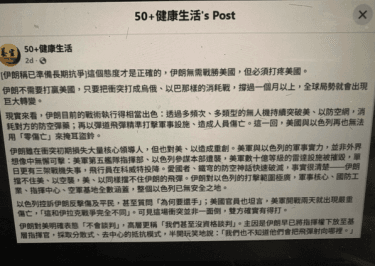
RSF documented a concrete instance of this method. The Facebook page "50 Plus Healthy Life," which presents as a wellness resource for older Taiwanese readers written in traditional Chinese, published a lengthy post in March 2026 shortly after the United States joined Israel in military action against Iran.
The post argued that Tehran did not need to defeat Washington militarily but needed only to impose sufficient costs to weaken American resolve — framing that closely mirrors Chinese state media narratives. The post was subsequently deleted, though a screenshot obtained during the investigation preserved its content.
According to a 2025 report by Taiwan's National Security Bureau (NSB), Wubianjie operates accounts on Facebook, Threads and X that focus on non-political or soft topics before intermittently introducing political messaging. The NSB identified this phased approach as a deliberate method of first building audience reach before attempting to shift public perception.
Arnaud Froger, head of RSF investigations, described the strategy as representative of a new generation of influence operations. "These social media lifestyle accounts, which look harmless and apolitical, are actually managed — and, at times, mobilised — by a private actor close to the Chinese state," Froger said.
"Less overt than operations conducted through state institutions, these decentralised campaigns that insert ideological content in sudden bursts are also harder to detect."
Scale of the network
According to a self-introduction published on the website of Yanshan University, where Wubianjie's chief executive studied, the company employs 163 editorial staff, operates 761 Facebook pages with a combined following of 61 million users and manages 460 partner pages reaching an additional 46 million users. It runs pages in Japanese, Mandarin and English.
Facebook had approximately 17.3 million users in Taiwan as of late 2025, out of a total population of 23 million, according to DataReportal, a global digital activity tracking project.
On its own website, Wubianjie presents itself as a news organisation and, in materials directed at advertisers, claims to operate a global media network generating genuine audience engagement and real-world impact.
Beyond political messaging, the company uses its Facebook infrastructure to embed links directing users toward content farm websites, web novel platforms and commercial advertising pages, including for erectile dysfunction medication.
The 2024 election and the Laixiu Media connection
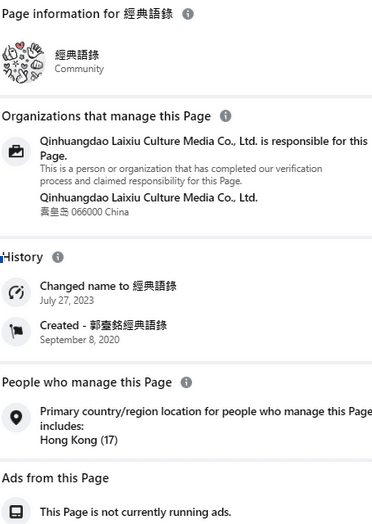
The RSF findings build on earlier academic research. In June 2024, Wang Horng-en, then an assistant professor of political science at the University of Nevada, Las Vegas, published research documenting how the Facebook page "Classic Quotes" — originally devoted to life philosophy — abruptly shifted during Taiwan's 2024 presidential campaign to posting large volumes of politically directed content inconsistent with its prior history.
Wang's research team traced the page's management accounts to IP addresses in Hebei province, contradicting the page's listed residence of Hong Kong. The company funding the operation was identified as Qinhuangdao Laixiu Culture Media Co. (秦皇島萊秀文化傳媒有限公司).
Subsequent investigation by Taiwanese government authorities confirmed that Laixiu Media's registered address is identical to that of Wubianjie Group — a finding RSF independently corroborated in 2026, also noting the two companies share an identical website.
The "Classic Quotes" page had been renamed "Terry Guo's Classic Quotes" in July 2023, when Terry Guo — a China-friendly technology billionaire and founder of Foxconn, which manufactures components for Apple's iPhone — was preparing a presidential candidacy. RSF assessed the page was likely used as a vehicle for disseminating pro-China narratives during the pre-election period, though it does not appear to have been directly affiliated with Guo's campaign.
Laixiu Media also operated a content farm called Huanxiang (歡享網), previously exposed by Taiwanese media for distributing politically divisive articles intended to influence Taiwanese public opinion.
A front company in New Taipei City
Among the more significant findings documented in the 2024 CNA investigation was the establishment of a corporate entity on Taiwanese soil. Wubianjie's legal representative, Kang Lei (康雷), registered a company called Wubianjie Co., Ltd. (無邊界有限公司) in New Taipei City in 2023.
The registration deliberately obscured the company's actual activities, listing its primary business as the wholesale of everyday goods and kitchen furniture rather than digital media or information technology.
Taiwanese government sources assessed this misrepresentation as consistent with an advance effort to establish a local operational foothold for cognitive warfare — reducing the likelihood of regulatory scrutiny while laying groundwork for expanded activity.
RSF's 2026 investigation separately confirmed that the address corresponds to a business centre rather than an active operational office.
Ties to the Chinese state
Multiple documented interactions connect Wubianjie to Chinese state structures. In June 2020, the state-run Qinhuangdao Radio and Television network announced a formal strategic partnership with the company — described by investigators as an uncommon arrangement between a municipal state broadcaster and a private digital firm. Four months later, officials from Hebei province's propaganda department and cyberspace administration conducted an official visit to Wubianjie's offices.
Dr. Austin Horng-en Wang, by 2026 affiliated with the RAND Corporation, which provides geopolitical analysis to the United States armed forces, told RSF that it would be highly unusual for a Chinese company operating across political content and commercial advertising sectors to do so without some form of government connection.
"At a minimum, I believe the company has some form of tacit understanding with the authorities," Wang said.
Wang also traced a widely circulated September 2025 post on Threads — which falsely claimed to show a child collapsing on Taipei's metro system while bystanders failed to respond — back to a Wubianjie-linked account. Authorities subsequently confirmed the footage had been filmed in Hangzhou, China.
Since its founding in 2014, Wubianjie has grown from a startup with initial capitalisation of 100,000 yuan (approximately 12,500 euros) to a group now capitalised at 10 million yuan (approximately 1.3 million euros), according to AiQicha, a Chinese corporate data platform.
Operations beyond Taiwan
Wubianjie's influence activities have not been confined to Taiwan. The Japanese website Seiji Chishin (政治知新) reported in June 2021 that a Twitter account with more than 10,000 followers had been approached by staff from Wuwei Network Technology Co., a Wubianjie subsidiary, with an offer to purchase the account at 2,000 yen per day. In January 2023, Wubianjie was also documented acquiring accounts on X through its own blog to direct click traffic.
Taiwanese government sources told CNA that Wubianjie's overarching objective in acquiring foreign accounts is to gain simultaneous control over multiple overseas presences, post unrelated content over extended periods to evade tracking, and activate the accounts at politically significant moments to inject targeted messaging at scale.
The company continues to recruit aggressively. Recent advertisements seek multilingual staff including German and Portuguese speakers — assessed by government sources and researchers as preparation for expanding cognitive warfare operations into new information environments. Current recruitment also targets social media managers and video editing personnel.
Broader context
Wubianjie operates within a wider documented ecosystem of Chinese information operations. In a report published in March 2026, Meta said it had dismantled a separate network of accounts promoting pro-Beijing narratives and seeking to undermine Taiwan's ruling party in what the company described as an apparent effort to foster domestic discord.
That network spent approximately US$15,000 on Facebook and Instagram advertising despite originating in China and using Taiwanese proxy accounts and fabricated personas to mask its source.
Wang Hsing-huan, chairperson of the Taiwan Statebuilding Party, called for more aggressive government action against China's online manipulation campaigns. "China doesn't even need to convey a specific message, as the disinformation campaign is primarily aimed at creating confusion. Its ultimate goal is to make everyone lose trust in the government and media outlets," Wang Hsing-huan said.
A senior Taiwanese cybersecurity policymaker, speaking on condition of anonymity, warned RSF that the campaigns had already succeeded in sowing divisions within Taiwanese society. More concerning, the official said, was that the disinformation effort had cultivated a perception that democracy equates to chaos, leading some in Taiwan to view authoritarian governance as an acceptable alternative.
Taiwanese government sources, cited in the earlier 2024 CNA investigation, drew a parallel conclusion: China was using private commercial companies as cover, relying on account acquisition, account cultivation and soft-topic content injection to reduce local awareness and lower the risk of exposure, while retaining the capacity to intervene in the public discourse of democratic countries at moments of its choosing.