‘Take MRT as last resort?’ Faishal Ibrahim’s train post draws criticism over ‘rare event’ perception
A post by Associate Professor Faishal Ibrahim showing him taking the MRT has triggered backlash online, with many questioning its authenticity and calling it staged. Critics say public transport is a daily reality for ordinary commuters, not a “special event”, while others defend his character and intentions.

- Faishal Ibrahim’s MRT post sparked debate over authenticity and political image-making.
- Critics said public transport use was portrayed as a rare or staged event.
- Supporters defended his character, calling him sincere and community-focused.

SINGAPORE: Acting Minister-in-charge of Muslim Affairs and Senior Minister of State for Home Affairs, Associate Professor Muhammad Faishal Ibrahim, drew mixed reactions online after posting photographs of himself taking the MRT to an official event, with many netizens questioning the authenticity and intent behind the images.
On 25 April 2026, Faishal shared photos of himself dressed in a traditional baju kurung while commuting by train to the reopening of the refreshed Malay Heritage Centre the previous day.
In his post, he explained that heavy traffic following an earlier engagement in the city had delayed his journey, prompting him to switch to the MRT in order to arrive on time.
“Roads were jammed, but thankfully our train system runs smoother than my morning kopi,” he wrote.
The post quickly attracted scrutiny, with many online commenters questioning why the act of taking public transport was presented as noteworthy.
Several users pointed out that the images appeared staged, suggesting that the so-called “candid” shots were deliberately arranged.
Others asked who had taken the photographs, speculating that a photographer or media aide had been involved.
A recurring criticism was that using the MRT appeared to be treated as a rare occurrence or last resort, rather than a routine part of daily life.
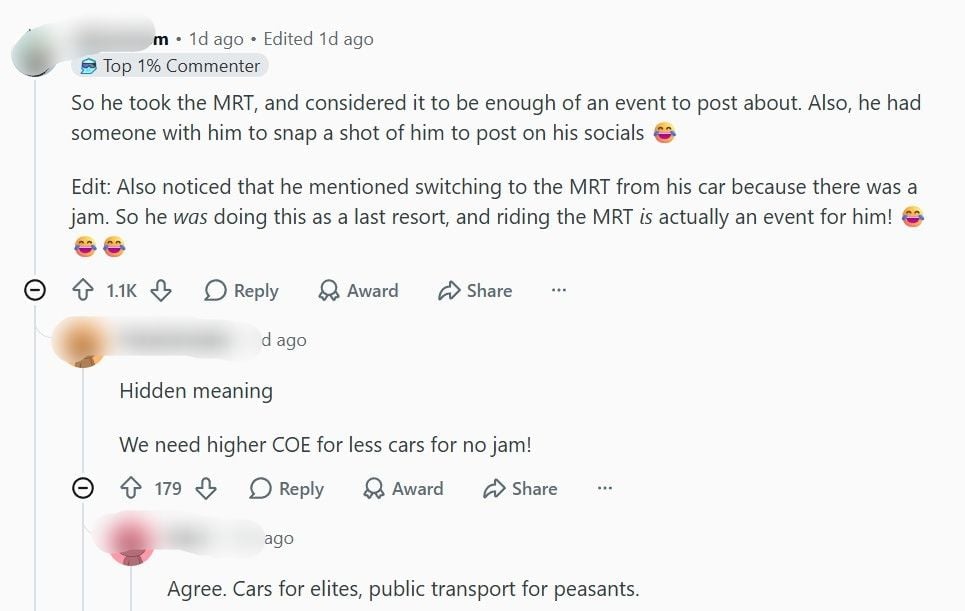
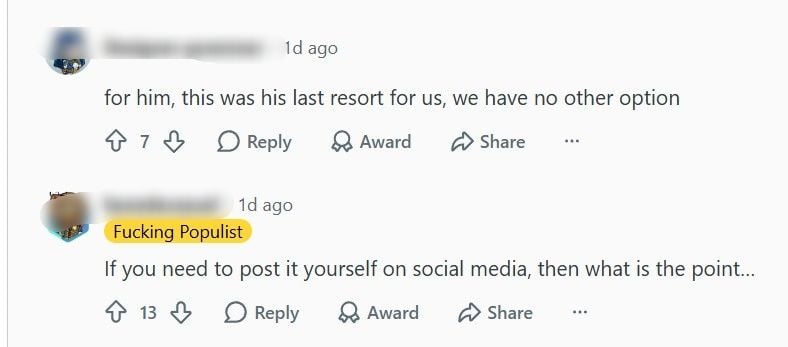
Some commenters remarked that ordinary commuters rely on public transport every day without documenting it, contrasting this with what they perceived as a curated moment.

Mockery and scepticism online
A number of responses adopted a sarcastic tone, questioning whether Faishal regularly uses public transport in his daily routine.
One commenter wrote that they also take the MRT but do not take photographs to publicise it.
Others joked about the logistics behind the journey, including whether a chauffeur or official vehicle had been left behind.
The caption accompanying the post also drew light-hearted criticism, with some netizens poking fun at the comparison between the train system and “morning kopi”.
Underlying many of the remarks was a broader scepticism about political messaging, with some users suggesting that such posts were designed to project relatability.
Perceptions of political optics
Critics argued that the post reflected a pattern of leaders attempting to align themselves with everyday experiences after encouraging the public to use public transport.
Some suggested that such gestures appeared performative, particularly when framed as unusual or noteworthy.
Others questioned whether similar actions would be repeated regularly, including during peak commuting hours.
A common sentiment expressed online was that public transport use by political leaders often occurs “once in a blue moon” or only under specific circumstances such as heavy traffic.
This perception contributed to accusations of elitism, with commenters implying that officials typically rely on private transport and only use trains for public visibility.
Calls for leading by example
Amid the criticism, some users emphasised that leaders should demonstrate the behaviours they advocate.
These commenters argued that using public transport more consistently, without excessive publicity, would be a more credible way of setting an example.
Others suggested that normalising public transport use among public officials could help reinforce broader policy messages, provided it is not perceived as staged.
Supporters defend Faishal
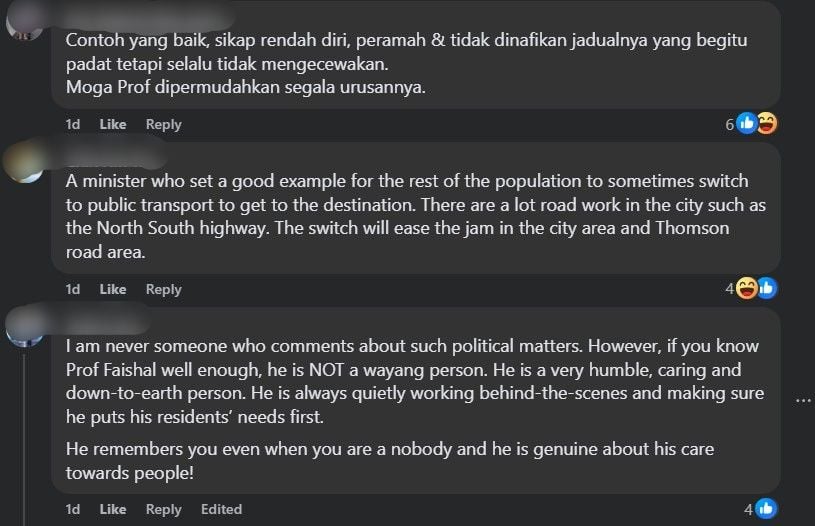
Despite the criticism, a segment of commenters defended Faishal, describing him as a sincere and grounded individual.
Supporters characterised him as someone who works quietly behind the scenes and prioritises the needs of residents.
They rejected the suggestion that the post was purely performative, arguing that it did not reflect his overall approach to public service.
Context of earlier public transport debate
The reaction to Faishal’s post comes amid a wider discussion about public transport use by political leaders earlier in April.
On 10 April 2026, Deputy Prime Minister Gan Kim Yong posted a video of himself riding the Light Rail Transit through the Punggol East loop alongside other Members of Parliament.
The post highlighted ongoing upgrades to the network, including the rollout of new two-car Light Rail Vehicles across the Sengkang-Punggol system.
However, the video drew ridicule online, with some users describing the outing as orchestrated and contrasting it with a separate photograph of Workers’ Party leader Pritam Singh commuting alone on a train.
The image of Singh, which circulated on the same day, was widely perceived as spontaneous, with commenters describing it as an example of “actually commuting” without fanfare.
Save and take public transport
by u/LegitimateCow7472 in SingaporeRaw