Political salary review done; Govt defers decision over conflict impact: Chan Chun Sing
Singapore has completed its latest political salary review but will defer decisions until the economic impact of the Middle East conflict becomes clearer, according to Coordinating Minister Chan Chun Sing on 6 May 2026.

- Political salary review completed and submitted to Government in April 2026.
- Consideration deferred due to Middle East conflict and economic uncertainty.
- Report and Government response to be released together later.

Singapore’s Government has completed a review of its political salary framework but will defer decisions on its recommendations until the economic impact of the Middle East conflict becomes clearer.
Coordinating Minister for Public Services Chan Chun Sing confirmed in a written parliamentary reply on 6 May 2026 that the committee tasked with the review had submitted its findings in April.
“The Government recognises that the Middle East conflict is still ongoing, causing major economic uncertainties and clouding the outlook for Singapore,” Chan stated.
The reply was issued in response to a parliamentary question from Marsiling-Yew Tee GRC MP Alex Yam, who had asked about the status of the review amid recent global developments.
Release of report to be timed
Chan said the Government would release the committee’s report alongside its official response “at the appropriate time”.
Members of Parliament will be given the opportunity to review both documents together, allowing for what he described as “a more meaningful debate”.
The decision to defer reflects broader caution within the Government as geopolitical tensions continue to affect global economic stability.
Background of the current review
The latest review stems from a framework established in 2012, when the Government agreed that political salaries should be assessed every five years by an independent committee.
In January 2026, Chan informed Parliament that such a committee had been convened to examine the existing structure, which was first introduced in 2012.
That committee has now completed its work and submitted recommendations, marking the first formal review since earlier delays.
Previous reviews and deferrals
A prior review conducted in 2017 concluded that the salary framework remained sound. It recommended that political salaries continue to be adjusted annually in line with benchmark salary movements.
Despite that recommendation, the Government decided not to implement any changes following the 2017 review.
In 2023, the scheduled five-year review was deferred altogether. The Government cited an uncertain external environment and downside risks in the global economy at the time.
The deferment followed parliamentary queries, including one raised in January 2023 by Non-Constituency Member of Parliament Hazel Poa, who asked whether a review committee had been appointed.
Chan responded then that the Government would revisit the issue without committing to a timeline. It has since been confirmed that the review was formally postponed due to prevailing economic uncertainties.
Details from earlier salary benchmarks
The structure of political salaries in Singapore has long been tied to benchmark earnings.
In 2018, the Committee to Review Ministerial Salaries highlighted a 9 per cent increase in benchmark salaries and proposed that political salaries be adjusted annually in tandem with these movements.
At that time, the suggested annual salary for entry-level ministers was S$1.2 million. This included a 13th-month bonus, a three-month performance bonus, and a National Bonus linked to key performance indicators.
The committee also proposed raising allowances for Non-Constituency Members of Parliament from 15 per cent to 20 per cent of elected MPs’ pay, reflecting their full voting rights introduced in April 2017.
Speaking in Parliament in March 2018, then Deputy Prime Minister Teo Chee Hean said, “The government has decided that since the scheme remains valid and the economy is still in transition, we will not change anything now and will maintain the current salary structure and level.”
Political salary framework origins
The current framework originated from a 2012 White Paper introduced after significant public dissatisfaction with political salaries.
The move followed the 2011 General Election, where the ruling party recorded its lowest share of the vote and lost a Group Representation Constituency for the first time.
An independent committee chaired by Gerald Ee proposed revisions, including benchmarking an entry-level minister’s salary to the median income of the top 1,000 Singaporean earners, with a 40 per cent discount applied.
Despite these reductions, Singapore’s political office holders remain among the highest paid globally.
For example, according to World Population Review, Singapore’s top political leader earns approximately US$1.6 million annually, placing the country at the upper end of international benchmarks.
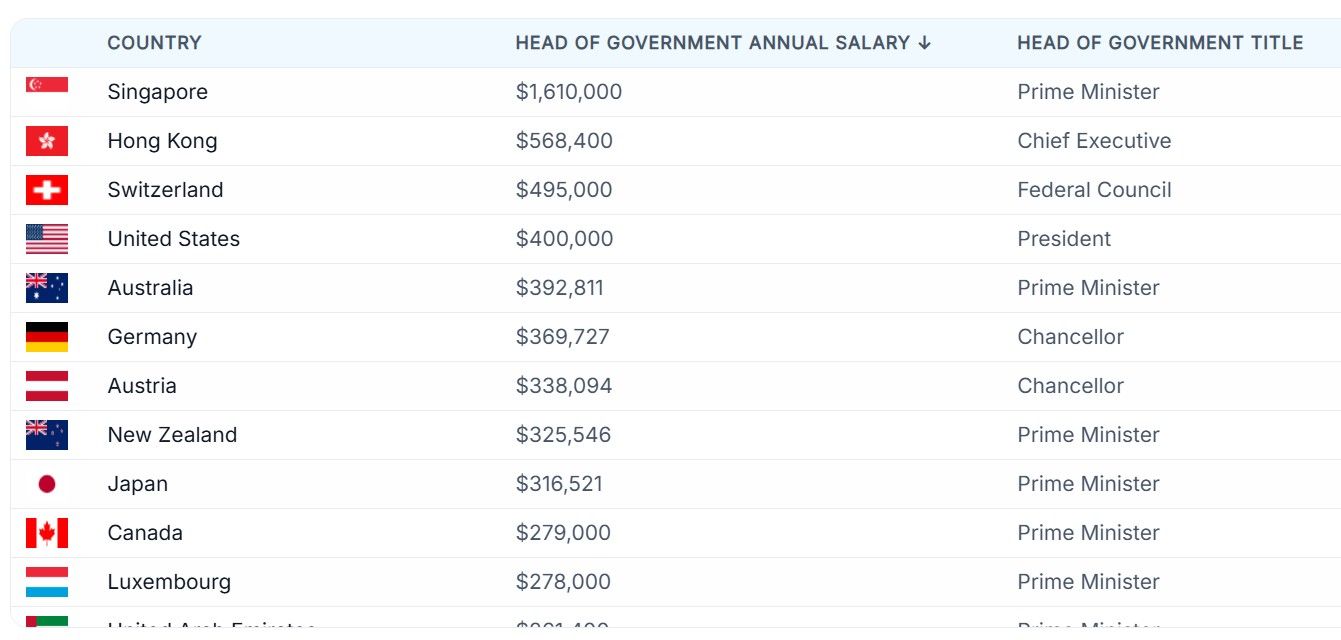
Even under the revised framework, ministers and senior civil servants in Singapore earn more than some heads of government in other developed countries.