Chan Chun Sing calls for flexible security partnerships and quality defence spending
Singapore's Defence Minister Chan Chun Sing told the 23rd Shangri-La Dialogue that modern conflicts require flexible coalitions and consistent defence investment, not simply higher spending.
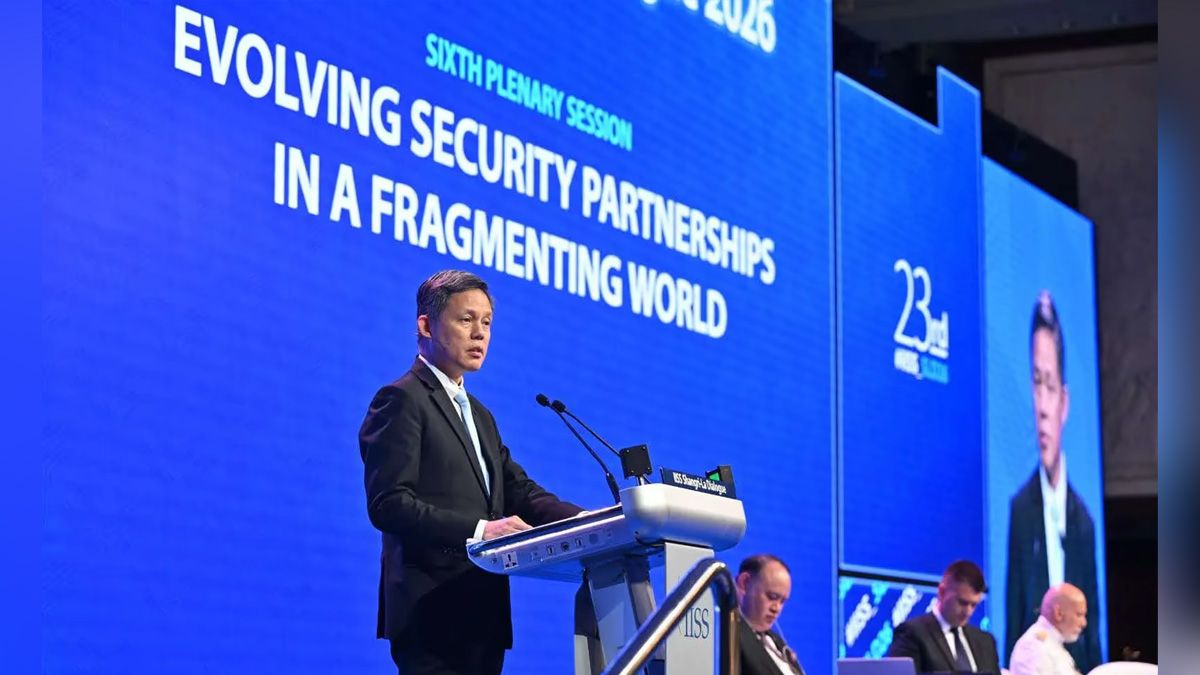
- Chan called for flexible coalitions of like-minded nations to address conflicts spanning geography, firepower, and time.
- Singapore and 16 nations launched GUIDE, a voluntary framework protecting critical underwater infrastructure from disruption.
- Chan argued consistent, innovative defence investment beats high spending that yields no commensurate capability.

Singapore's Defence Minister Chan Chun Sing used the 23rd Shangri-La Dialogue (SLD) on 31 May 2026 to call for flexible security partnerships and disciplined defence investment, warning against transactional global governance.
Chan spoke at the sixth plenary session, "Evolving Security Partnerships in a Fragmenting World," alongside NATO Chair of the Military Committee Admiral Giuseppe Cavo Dragone and Philippines Secretary of National Defense Gilberto Teodoro Jr.
The annual defence summit was held at the Shangri-La hotel in Singapore from 29 to 31 May 2026.
Conflicts have evolved across three dimensions, Chan told the plenary: beyond geography, beyond military firepower, and beyond the present moment.
In a hyperconnected world, he said, these conflicts carry cascading ramifications across military, economic, informational, and cyber domains.
Rules and norms under threat
Chan urged nations to preserve and refresh the rules-based international order underpinned by international law, warning that weak institutions and transactional relationships would leave all nations worse off.
"More beggar-thy-neighbour policies would make beggars of us all," he said. "For our nations and economies to thrive, we need stability and predictability, undergirded by rules and norms."
Sacrificing these foundations for short-term political gain, Chan added, would undermine long-term collective security.
Issue-based coalitions
Chan argued that flexible, issue-based partnerships should complement multilateral cooperation. He called for "coalitions of the able and willing" to bridge gaps, test ideas, and pathfind in new and uncharted territories.
He pointed to the security of critical underwater infrastructure (CUI) — including subsea energy cables and telecommunications networks — as a domain where such cooperation is especially necessary.
Such systems transcend geographic boundaries, Chan said, making them a shared vulnerability that no single country or region can address alone.
On 30 May, Singapore and 16 other countries launched the Guiding Principles for Underwater Infrastructure Defence Exchanges (GUIDE) to address this challenge.
The voluntary, non-legally binding and non-financially binding agreement is designed to facilitate information sharing and support early warning of security incidents.
Chan said the framework idea was first proposed at the 2025 edition of the dialogue, and described GUIDE as both a protective mechanism and a deterrent against actors seeking to disrupt subsea systems.
"Can you imagine Singapore being unable to access our essential supplies? This would have very serious implications for our lives and our livelihoods," Chan told reporters after the dialogue.
Chan also told the plenary that effective international cooperation requires domestic confidence.
Citing Emeritus Senior Minister Goh Chok Tong's description of Singapore as "a small speedboat in an open sea," he said Singapore cannot control the sea but can keep its boat seaworthy.
Quality over quantity in defence spending
Speaking to reporters at the close of the dialogue, Chan said the central question in defence is not how much countries spend, but how effectively that money is used.
He stressed there is no straight line between defence expenditure and capability. Innovation and efficiency — getting more "bang for the buck" — matter more than raw spending figures, he said.
"Some countries spend a lot, but they do not get commensurate capability," he said.
Chan highlighted human capital as the most critical dimension of consistent defence investment, noting that training pilots, sailors, and scientists takes years, as does building the scientific and technological capacity needed to translate spending into real capabilities.
"It takes years to train a pilot, a sailor and so forth. It takes even more years for us to build up the scientific community [and] the technological capabilities," he said.
Chan cautioned against "feast-or-famine" defence strategies, where spending surges only during crises. By the time trouble starts, he said, it is usually too late to build the required capabilities.
The issue of defence spending was a central theme of the dialogue for the second consecutive year.
Singapore's defence spending has hovered around 3 per cent of gross domestic product (GDP) in recent years.
Chan has previously indicated that the Singapore Armed Forces (SAF) has public and political support to raise expenditure to as high as 6 per cent of GDP.
US Secretary of War Pete Hegseth, speaking at the dialogue on 30 May, said the United States would prioritise working with "model allies" that had responded to calls for a more equitable sharing of the global security burden.
Hegseth praised Indo-Pacific partners for meeting the US expectation of spending 3.5 per cent of GDP on defence. At the 2025 edition, he had asked regional allies to raise that figure to 5 per cent.
China's absence
Asked about the absence of Chinese Defence Minister Dong Jun for the second year running, Chan said China would have its own considerations in deciding who to send.
He noted that the level of Chinese participation varies year by year, adding that the representatives at the 2026 dialogue "have made their presence felt in many of the plenary sessions."
China's delegation was led by Major-General Meng Xiangqing, a professor at the People's Liberation Army National Defense University (PLANDU).
During the dialogue, Chan also hosted a ministerial roundtable bringing together 10 visiting ministers and their representatives to discuss security challenges.
Discussions covered non-traditional and hybrid threats including misinformation, cyber risks, and threats to critical underwater infrastructure, alongside the role of emerging technologies in defence innovation.
Ministers also discussed how to build and sustain public support for consistent defence spending, and the value of a total defence approach to long-term security.