FATF gives Singapore top monitoring status but flags penalties and cross-border gaps
Singapore has been placed in "regular follow-up" by the Financial Action Task Force after its 2026 mutual evaluation, reflecting a robust anti-money laundering framework, though gaps in penalties, transparency, and proliferation financing remain.

- Singapore upgraded from enhanced to regular follow-up, its best-ever FATF monitoring result.
- Only 682 of 11,189 money laundering investigations resulted in prosecution, a rate below 10 per cent.
- No assets frozen under the UN Al-Qaeda and ISIS sanctions regime despite identified exposure.

Singapore has been upgraded from enhanced follow-up to regular follow-up by the Financial Action Task Force (FATF), the global body that sets standards for combating money laundering, terrorism financing and proliferation financing, following a comprehensive peer review published on 6 May 2026.
The upgrade is a material improvement. Following Singapore's previous evaluation in 2016, the country was placed in enhanced follow-up — the second-most serious monitoring tier — owing to deficiencies in both technical compliance and effectiveness. The move to regular follow-up in 2026 represents the best result Singapore has achieved under FATF's assessment framework.
The report was jointly published with the Asia/Pacific Group on Money Laundering (APG). It assessed Singapore's anti-money laundering (AML), counter-terrorism financing (CTF) and counter-proliferation financing (CPF) regime based on an on-site visit conducted from 1 to 18 July 2025, covering the reporting period from 2020 onwards. Singapore is among the first jurisdictions to undergo the fifth and most recent round of FATF mutual evaluations.
What is the FATF?
The FATF is a 40-member intergovernmental body that establishes rules to help national authorities pursue illicit funds linked to drug trafficking, arms dealing, cyberfraud and other serious crimes. Singapore has been a member since 1992.
Singaporean T Raja Kumar, currently serving as senior adviser at the Ministry of Home Affairs (MHA), served as the body's president from 2022 to 2024.
Member countries are periodically assessed through peer reviews known as Mutual Evaluations, to determine how well their systems measure up to FATF standards. Countries are assessed on two fronts: whether the required laws and regulations are in place, and how effectively they achieve outcomes across 11 areas, including risk management, supervision and enforcement.
Based on their results, countries are placed on one of three monitoring tracks. Regular follow-up is the default for those with strong systems. Enhanced follow-up applies where major improvements are needed. The most serious is the FATF International Cooperation Review Group (ICRG) process, reserved for countries requiring fundamental reform and direct FATF monitoring. It is this process that can lead to a country being greylisted or blacklisted by the body.
Findings affirmed by three agencies
The Monetary Authority of Singapore (MAS), MHA and the Ministry of Finance (MOF) issued a joint statement affirming that the result validated Singapore's robust and effective framework and process to tackle financial crime.
They noted the outcome represented an improvement over Singapore's fourth-round evaluation in 2016, even as FATF standards had been materially strengthened across several areas in the intervening period.
"Singapore remains firmly committed to complying with the FATF standards, and welcomes the FATF's recommendations," the three agencies said, adding that Singapore would study the recommendations and adopt them in a risk-proportionate manner while building on existing strengths.
Among the measures cited for expansion was COSMIC, an information-sharing initiative currently involving six major banks, which the agencies said would be extended further.
S$3 billion case as emblem of commitment
The FATF report described the high-profile S$3 billion money laundering case in 2023 as the clearest example of Singapore's active approach to combating misuse of its financial system. Foreign nationals had brought in billions derived from overseas remote gambling offences, in what became one of the world's largest money laundering crackdowns that year.
While the case illustrated Singapore's attractiveness to foreign criminals, the FATF said it equally demonstrated the quality of law enforcement and the government's political commitment to addressing financial crime.
In the wake of that case, an inter-ministerial committee was established to review and strengthen Singapore's AML/CTF/CPF approach, leading to legislative amendments and new information and data-sharing mechanisms.
Overall assessment
The report found that Singapore employs a dynamic approach to identifying money laundering and terrorism financing risks, underpinned by a whole-of-government structure involving high-level and working-level committees, interministerial bodies, and active engagement from supervisory authorities and industry associations.
The Anti-Money Laundering Case Coordination and Collaboration Network (AC3N) and the AML/CFT Industry Partnership (ACIP) were cited as key mechanisms facilitating inter-agency and public-private collaboration.
Singapore's AML/CTF regime and its policy and operational cooperation were described as likely among the best in the world.
Fraud was identified as Singapore's most prominent money laundering threat, particularly cyber-enabled scams orchestrated by syndicates typically located overseas. Other prevalent predicate offences identified include corruption, organised crime including illegal gambling, and tax crimes.
Effectiveness ratings
Under the FATF's framework, effectiveness is assessed across 11 immediate outcomes. Singapore received a rating of substantial effectiveness for seven: risks and coordination (IO1), international cooperation (IO2), supervision of financial institutions (IO3), preventive measures (IO4), financial intelligence (IO6), asset recovery (IO8), and terrorist financing investigations and disruptions (IO9).
Four outcomes were rated at only moderate effectiveness: beneficial ownership and transparency (IO5), money laundering investigations and prosecutions (IO7), terrorist financing prosecutions and sanctions (IO10), and proliferation financing (IO11).
No outcome received the highest rating of high effectiveness. The ratings span four tiers — high, substantial, moderate and low.
Technical compliance
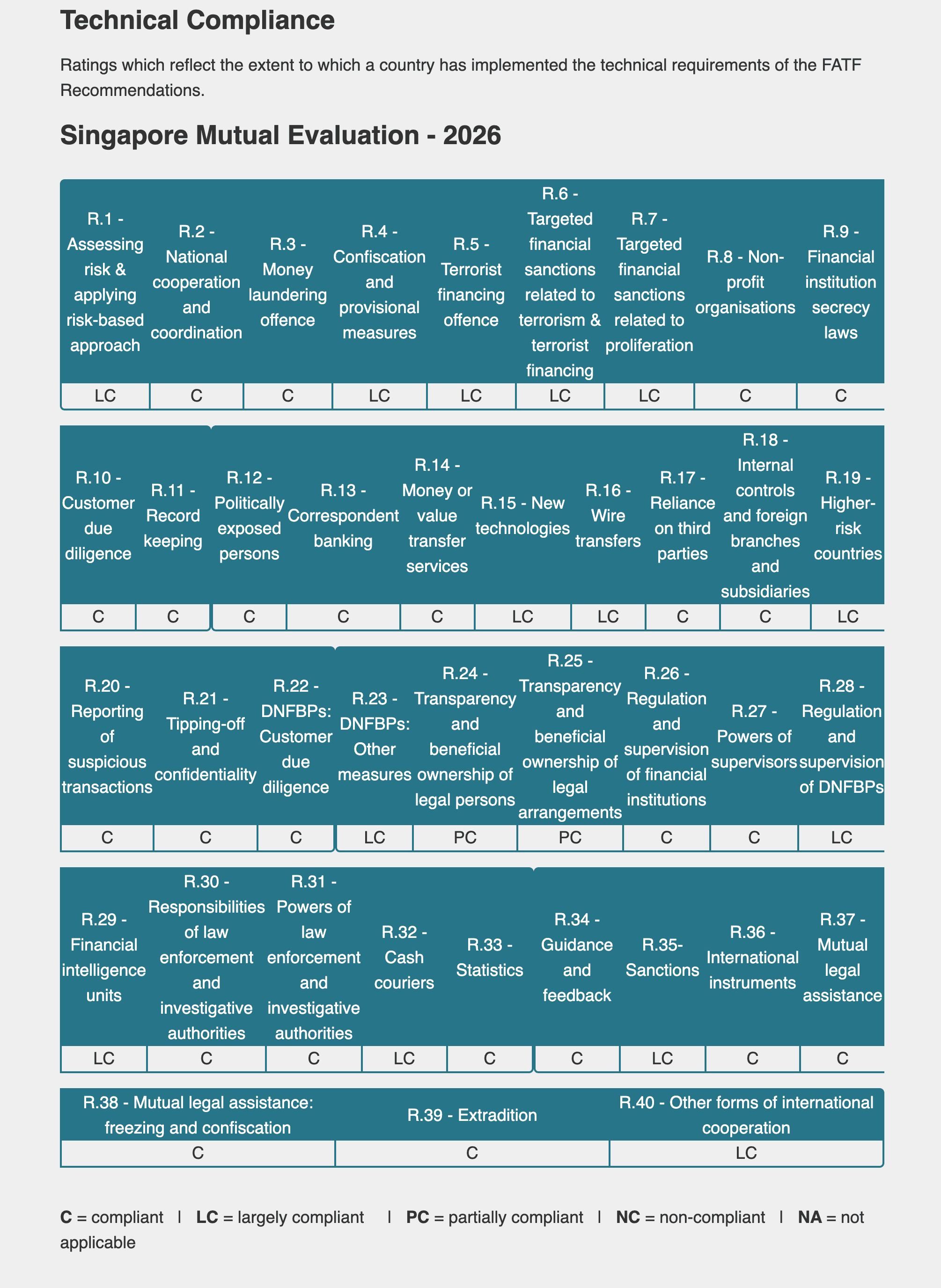
On technical compliance, the majority of Singapore's ratings across the FATF's 40 Recommendations were either compliant or largely compliant.
Two Recommendations — R.24 on transparency and beneficial ownership of legal persons, and R.25 on transparency and beneficial ownership of legal arrangements — were rated as only partially compliant, pointing to structural gaps in how beneficial ownership information is collected and verified.
Since its 2016 evaluation, Singapore achieved four technical compliance re-ratings: one upgrade from partially compliant to compliant, two from partially compliant to largely compliant, and one from largely compliant to compliant.
Investigations and a damaging prosecution gap
Law enforcement agencies opened 11,189 money laundering investigations during the five-year assessment period. More than 80 per cent were initiated from victims' complaints relating to cyber-enabled fraud.
Of those 11,189 investigations, 7,594 were referred to the Attorney-General's Chambers (AGC) for prosecution. However, only 682 natural persons were actually prosecuted during the review period — a conversion rate of below 10 per cent.
Once cases do reach prosecution, Singapore achieves an 82 per cent conviction rate including in complex cases. However, the FATF flagged that the majority of convictions result from guilty pleas, which the report said undermines the overall deterrence value of sanctions.
The majority of sanctions were imposed against low-level money mules rather than professional syndicates, professional intermediaries or legal persons. The FATF found significantly fewer investigations into higher-risk areas such as tax crimes, corruption and trade-based money laundering.
Singapore has introduced new legislation to address these gaps, including a new money mule offence under Section 55A(1) of the Corruption, Drug Trafficking and Other Serious Crimes Act. However, the report noted these changes were too recent to assess for effectiveness.
As a direct recommended action, the FATF called on Singapore to pursue investigations and prosecutions of local directors and professional intermediaries who are facilitating money laundering activity within Singapore's borders, and to develop tailored sentencing guidelines for money laundering offences.
Penalties
Money laundering penalties in Singapore were assessed as low and potentially insufficient to deter offenders. The FATF said this undermines dissuasiveness, contrasting with terrorism financing penalties which were assessed as more appropriate.
Asset recovery
Asset recovery was identified as a high-level political priority, supported by the National Asset Recovery Strategy (NARS). Law enforcement agencies seized approximately S$6 billion (approximately US$4.4 billion) over the assessment period, though the FATF noted results were largely driven by a small number of high-value cases, with about one-third of money laundering investigations leading to seizures.
Between 2020 and 2024, S$3.9 billion (approximately US$2.9 billion) was confiscated, reflecting a seizure-to-confiscation rate of 61 per cent.
The FATF identified a notable gap: Singapore does not seek enforcement of its own confiscation orders abroad, which the report described as especially concerning given the volume of predicate offences and money laundering investigations with a foreign nexus.
Financial intelligence
Singapore's Financial Intelligence Unit, the Suspicious Transaction Reporting Office (STRO), is well resourced and leverages sophisticated systems. Of all suspicious transaction reports (STRs) received, 30,918 — representing 11 per cent — were disseminated as financial intelligence reports. During 2023 and 2024, STRO issued 469 financial intelligence packages, mostly to law enforcement agencies. Of those packages, 26 per cent initiated an investigation and 14 per cent supported ongoing investigations.
The FATF found that financial intelligence was well deployed for fraud-related offences but underutilised for higher-risk offences including tax crime, corruption and trade-based money laundering.
Terrorist financing and a notable sanctions gap
Singapore opened 126 terrorism financing investigations into 213 individuals and legal persons over five years, resulting in six prosecutions, all of which resulted in convictions. Five involved guilty pleas and one proceeded to full trial.
All six prosecutions followed the same typology — individuals sending small salary amounts overseas to support global terrorist activities — which the FATF said was broadly in line with Singapore's risk profile.
However, the report identified a significant gap: no assets have been identified or frozen under the UNSCR 1267 sanctions regime, which covers Al-Qaeda and ISIS-related entities. Singapore did freeze a net value of S$1.3 million under its domestic terrorism financing sanctions regime, with approximately S$3.97 million currently frozen overall. The complete absence of action under the 1267 regime is notable given Singapore's own identification of funds transiting through its banking sector and digital payment token service providers as among its highest terrorism financing risks.
The FATF also found that multiple intermediaries exist between United Nations Security Council alerts on listing changes and dissemination to reporting entities in Singapore, creating potential points of failure and causing delays in implementation.
Proliferation financing: prosecutions but no TFS action
The FATF identified Singapore as one of the jurisdictions globally most vulnerable to proliferation financing, given its geographical position and its role as a hub for trade, transport, maritime activity and virtual assets.
During the assessment period, Singapore's Attorney-General's Chambers prosecuted 22 individuals and eight legal persons for breaches of the UN (Sanctions — DPRK) Regulations and related export control regulations. However, no individual or legal person has been prosecuted specifically for breaches of proliferation financing targeted financial sanctions. One case resulted in S$22.3 million (approximately US$16.2 million) being frozen.
Reporting entities filed approximately 1,900 STRs related to proliferation financing during the assessment period, of which 732 were related to the Democratic People's Republic of Korea (DPRK). Only five financial intelligence packages related to DPRK sanctions were disseminated to competent authorities.
Representation offices of foreign flag states operating in Singapore were found to have negligible awareness of their obligations under proliferation financing targeted financial sanctions rules.
Beneficial ownership and transparency gaps
The Accounting and Corporate Regulatory Authority (ACRA) has implemented a central beneficial ownership registry for most legal persons, though Variable Capital Companies and unregistered foreign companies are excluded. The registry is not publicly accessible.
The FATF found limited mechanisms to ensure the accuracy of registry information beyond basic validation checks. Singapore does not verify beneficial ownership information at the point of filing; it instead relies on corporate service providers conducting proper customer due diligence.
Singapore was found to have a reasonably good understanding of how domestically incorporated companies can be misused, but a more limited understanding of risks tied to legal arrangements, unregistered foreign companies and complex multi-entity structures.
The report noted that enforcement against beneficial ownership transparency breaches is more nascent than enforcement of basic company information requirements, and that recently enacted increased penalties have not yet had time to demonstrate a deterrent effect.
Virtual assets hub
Since its last evaluation, Singapore has developed into one of the most significant virtual asset service provider hubs in the world. The FATF found that Singapore has a robust licensing framework to prevent criminals from holding beneficial ownership or controlling interests in financial institutions and virtual asset service providers.
International cooperation and MLA gaps
Singapore received 988 mutual legal assistance (MLA) requests during the assessment period. Of these, 34 per cent remain pending or partially addressed, and 8 per cent remain entirely unaddressed. Singapore makes four times fewer MLA requests than it receives, despite its own acknowledgement that its primary risks originate abroad.
Formal and informal cooperation was found to be sought almost exclusively for fraud and money laundering cases, with fewer requests made in respect of other higher-risk areas such as tax crime, corruption and trade-based money laundering.
Cross-border cash enforcement
The report found that while Singapore has a solid legal framework for cross-border cash reporting, enforcement is weak in practice. Of 439 cases involving failure to file or false declarations, authorities were only able to link one offender to broader criminality. The FATF flagged this as an issue with follow-up investigations and the use of the cash declaration system as an asset recovery tool.
Key recommended actions
Following the evaluation, the FATF issued a formal roadmap of key recommended actions to be completed within three years, adopted at the FATF Plenary in February 2026. Priority measures include enhancing beneficial ownership verification mechanisms, refining the prioritisation of money laundering investigations toward complex and high-value cases, introducing dissuasive sentencing guidelines, streamlining terrorism financing sanctions communications, identifying assets subject to UNSCR 1267, and deepening proliferation financing engagement with maritime-sector entities.
Singapore will report back to the FATF and APG on its progress in implementing these measures.