SGMHM survey: Most Singaporeans would see a GP for mental health. Nearly half don't trust them to help
A new public consultation by SG Mental Health Matters surveyed 525 Singaporeans on their lived experience of Singapore's National Mental Health and Well-Being Strategy. While 65-68% said they were willing to seek mental health support at a GP or polyclinic, only 57.1% trusted GPs to actually provide appropriate care — a gap that sits uneasily against the government's Healthier SG push.


Most Singaporeans say they are willing to seek mental health help at a General Practitioner (GP) or polyclinic. Less than six in ten trust their GP to actually provide it.
That gap — between willingness and confidence — is one of the central findings of a new independent public consultation released by SG Mental Health Matters (SGMHM) on 12 May 2026, which surveyed 525 Singaporeans on their awareness and lived experience of Singapore's National Mental Health and Well-Being Strategy (NMHWS) nearly three years after its launch.
The nationally benchmarked survey was conducted in March 2026 in partnership with independent research company OPPi, and included a supplementary subpanel of 23 higher-engagement respondents comprising people with lived experience of mental health conditions, caregivers, mental health practitioners and LGBTQ+ individuals, whose qualitative responses inform much of the findings cited in this report.
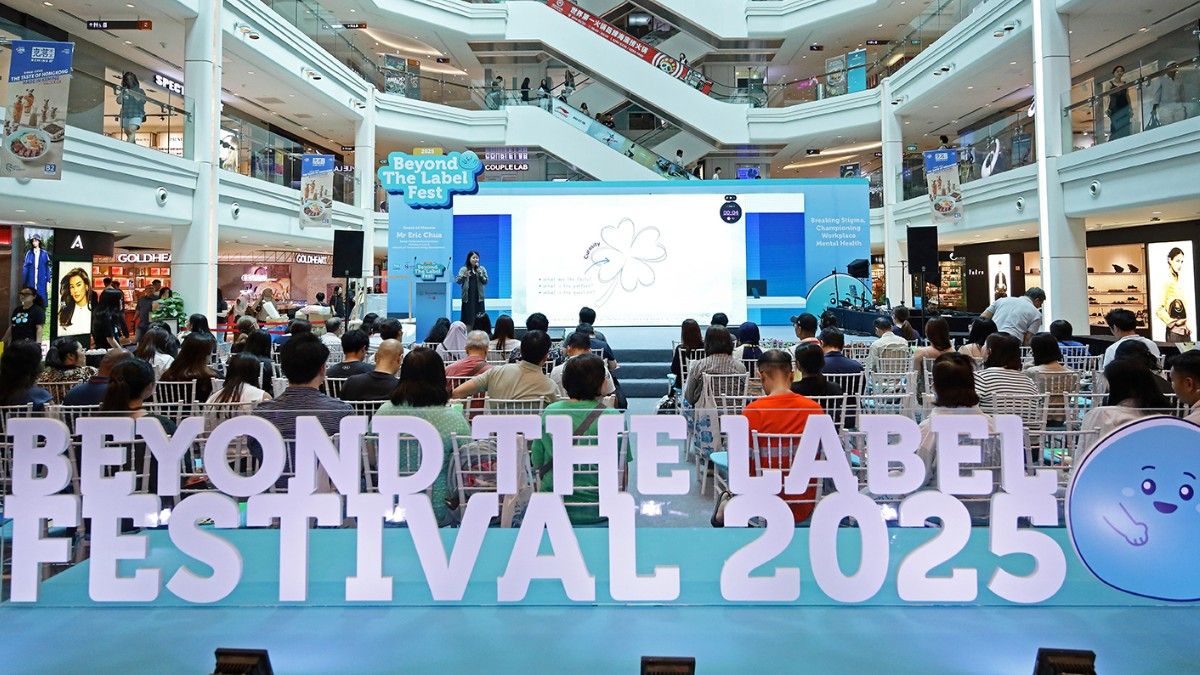
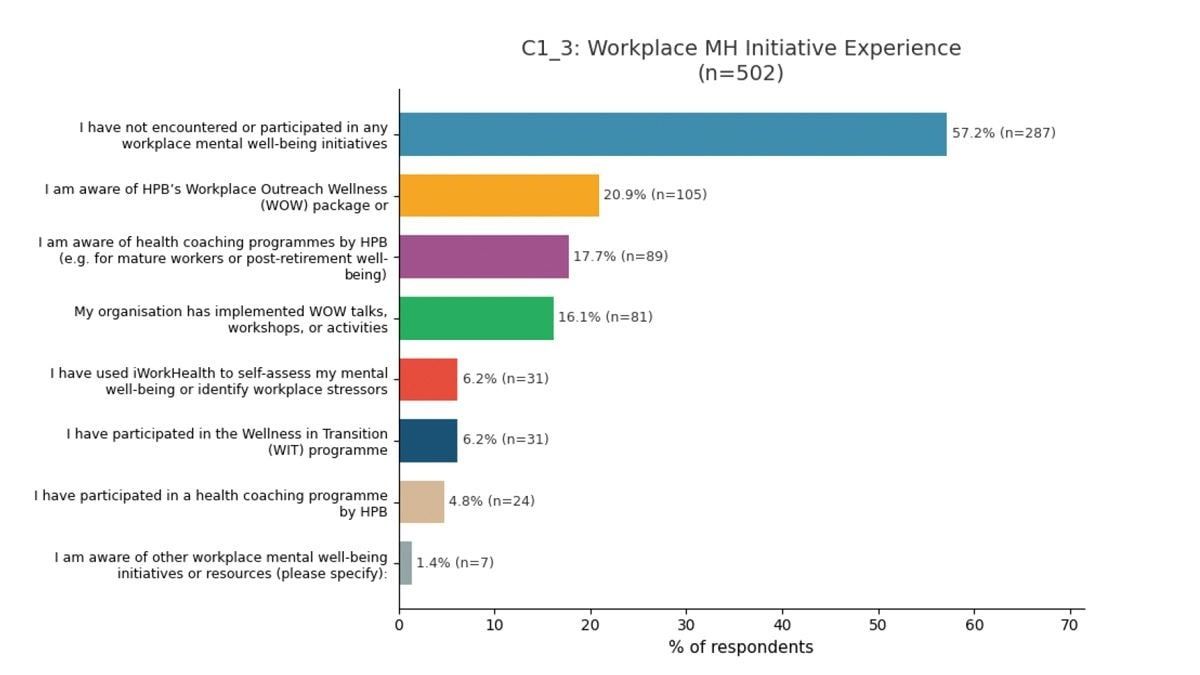
The survey also found that more than half of working Singaporeans — 57.2% — have never encountered or participated in any workplace mental wellbeing programme, and that Singapore's flagship anti-stigma campaign Beyond the Label remains unrecognised by more than four in five respondents.
Together, the findings paint a detailed picture of a strategy whose reach and impact on the ground remains uneven.
Awareness remains shallow
Awareness of the Strategy itself stood at just 47.4% — the lowest-scoring awareness item in the entire survey. Awareness of the National Mental Health Office, established in 2024 to coordinate the Strategy's implementation, was only marginally higher at 53.0%.
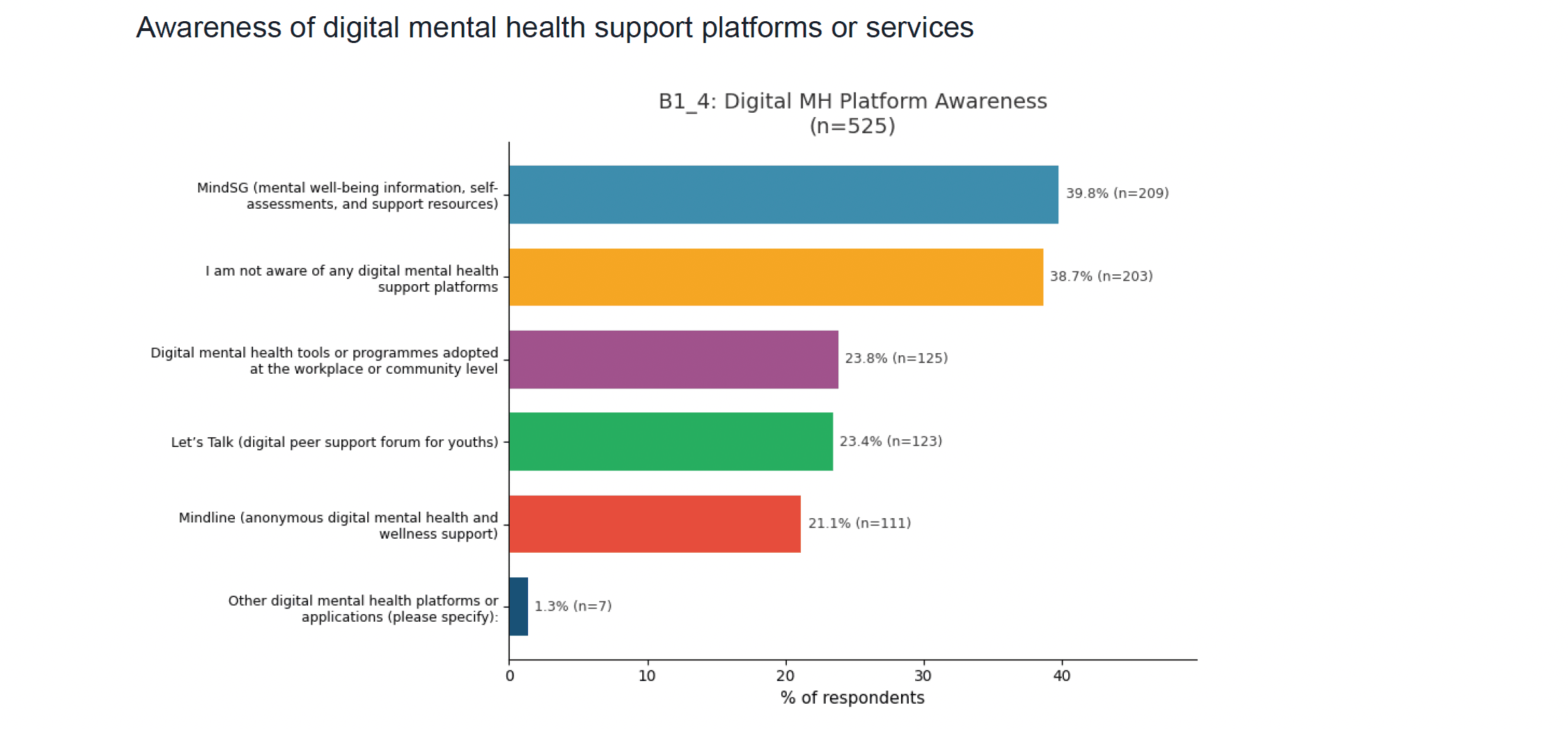
Digital mental health platforms fared little better. MindSG, the government's flagship mental health portal, was recognised by 39.8% of respondents — barely ahead of the 38.7% who said they were unaware of any digital mental health platform at all.
Anti-stigma campaign awareness was similarly thin. Beyond the Label, launched in 2018 and relaunched in 2022, was recognised by only 15.2% of respondents. World Mental Health Day, which requires no local campaign infrastructure, scored 53.9%.
Critically, exposure did not reliably translate into impact. Among respondents who recognised at least one anti-stigma initiative, only 57.7% said it changed how they thought about mental health conditions.
By contrast, those who had directly participated in community wellbeing initiatives reported substantially stronger outcomes — between 72% and 75% found them contextually relevant, and 73.9% said they had practical takeaways applicable to their real lives.
One respondent observed: "While there have been more community and online initiatives, the level of mental health literacy may still be low in our families and local communities, pending each constituency's focus and priorities."
(Chart from the SGMHM Technical Report on Singapore's National Mental Health and Well-Being Strategy Public Consultation, 2026)
Attitudes shifting, but unevenly
Across seven attitudinal measures, Singaporeans reported broadly positive shifts since 2024, with agreement ranging from 66.5% to 73.1%. The strongest shift was reduced negativity toward people with mental health challenges, at 73.1%. The weakest was personal comfort discussing one's own mental health, at 66.5% — the lowest-scoring attitudinal item in the survey.
Where mental health conversations are happening is telling. Among respondents who described more open discussions, social media led at 18.2%, followed by general societal shifts toward reduced stigma at 15.1%, and workplaces at 12.0%. Formal institutional channels — digital health platforms, professional services, helplines, government campaigns, traditional media — collectively accounted for just 15.4% of responses.
The pattern suggests that whatever openness is emerging is being driven by informal and peer-led spaces rather than the institutional settings where the government's strategy is primarily being implemented.
As one respondent with lived experience noted: "I naturally am more accepting and empathetic to persons with mental illness as I grew up with family with mental illness. However, it is unclear which campaigns are superficially anti-stigma."
Another was more direct: "As an individual with mental health issues, I'm already fighting stigma so these don't change my views."
Workplace programmes present, but not felt
Among those who had encountered workplace wellbeing initiatives, 72.1% said the programmes improved their experience at work — suggesting quality is not the issue. The problem is reach.
Of those who had been reached, however, psychological safety remained the weakest dimension. Only 45.6% felt it had become easier to discuss mental health challenges at work without fear of consequences. Only 45.8% felt more empowered to raise workload or wellbeing concerns with supervisors.
Financial support from employers was the least visible area of change. Nearly a quarter — 23.3% — actively disagreed that their employer had increased mental health-related financial support since 2024, with a further 42.4% unsure or unaware of any change. Yet 71.1% said they believed employers should subsidise mental health treatment, similar to physical health benefits.
(Chart from the SGMHM Technical Report on Singapore's National Mental Health and Well-Being Strategy Public Consultation, 2026)
The qualitative responses were pointed. "Positive wellbeing engagement does not negate work stressors and demands," one respondent said.
Another described the structural bind many workers face: "Most workers are not like civil servants. We are judged not by how many hours we log in the office but by our actual outputs. So if we take a mental health break or reduce our workload, our bonuses and promotion will be affected because we have less deliverables to show."
A third went further: "Workplace wellbeing strategy should be mandated before any community strategy as many of our concerns starts and ends in workplaces. Many workplaces are not championing wellbeing at full speed — HR do not prioritise it until it's at crisis, and wellbeing is only 10% of their KPI."
Help-seeking willingness outpaces trust
Willingness to seek help was generally moderate to high across pathways. The national mental health hotline recorded the highest willingness at 71.4%, followed by polyclinics at 68.4%, GPs at 65.5% and social service agencies at 65.0%. Hospital admission for mental health treatment was the lowest at 53.9%.
But a significant confidence gap emerged in primary care. While 65.5% to 68.4% said they were willing to seek help at a GP or polyclinic, only 57.1% said they trusted GPs to actually provide appropriate mental health care — a gap that sits directly against the government's Healthier SG strategy of routing more mental health support through primary care.
Willingness to use insurance coverage for mental health treatment was among the highest-scoring items at 69.5%, as was willingness to be trained as a basic emotional supporter at 68.6% — pointing to strong public receptivity to financial enablement and peer support models that the current strategy has not fully activated.
One respondent captured what is needed: "Help-seeking barriers are psychological, not informational. Referral pathways must be seamless. The approach should be whole of society and not tweaking parts of the networks."
Another pointed to cost as a concrete barrier: "Make counselling accessible in terms of cost. It should be means tested to about $50 a subsidised visit and co-located with community health services."
Vision unclear, civic channels underused
Just over half of respondents — 54.7% — said they had a clear sense of the Strategy's long-term vision. Nearly a third, 29.1%, were unsure, with 12.6% actively disagreeing they understood where the Strategy was headed.
Civic engagement was even weaker. Only 46.9% said they would feel comfortable raising mental health concerns with their Member of Parliament —"the lowest-rated item in the civic engagement section. A further 20.2% actively disagreed and 28.6% were ambivalent, suggesting formal political channels are not widely seen as accessible avenues for mental health advocacy.
"Indicators of success should be articulated and accounted for," one respondent said. Another put it more plainly: "To co-design initiatives with the people, not just for them."
Who is being left behind
The survey identified several groups whose experiences diverge sharply from the general population.
Non-working respondents — caregivers, the unemployed, retirees — scored lower than working respondents across all 20 survey items. Three gaps reached statistical significance: willingness to approach social services, normalisation of mental health discussions, and self-care knowledge, each favouring working respondents by 21 to 23 percentage points.
A counterintuitive age finding also emerged. Older respondents aged 55 and above led on early help-seeking at 72.9%, against just 57.3% among those aged 25 to 34 — the reverse of the pattern seen across virtually every other attitudinal measure, where younger adults consistently scored highest.
Gig workers and caregivers were highlighted as groups for whom standard wellness interventions are structurally inaccessible. "How is a Grab driver supposed to take a mental health break without losing his income?" one respondent asked. "Provide real material support. Nobody needs to talk to an emotional support buddy. ChatGPT also does that."
LGBTQ+ individuals remain effectively invisible in the Strategy's framing. The main survey did not capture sexual orientation as a demographic variable — an acknowledged gap in the report itself. A subpanel respondent was direct: "No mention of LGBTQ+ or queer in the national wellbeing report. Why are queer people actively written out of national policy?"
SGMHM has shared that it has presented the reports to the Government.
The consultation's next phase — qualitative focus group discussions and in-depth interviews — is scheduled for the second and third quarters of 2026.