The man who told the truth the world already knew — still waiting for freedom
Mordechai Vanunu took 57 photographs of Israel's secret nuclear arsenal in 1986. He gave them to a newspaper. The story has never been seriously challenged. He spent 18 years in prison, 11 in solitary. He still cannot leave Israel. In July 2024, he said he'd only post again from freedom. The account is gone.

On the first day of every month, a man posted the same message: "One more year without freedom since 1986. Now I am waiting for my freedom, freedom to leave Israel. I will continue to wait until my freedom comes. Born to be free. See you in freedom."
His name is Mordechai Vanunu. Most people have never heard of him.
That is not an accident.
The Man and the Photographs
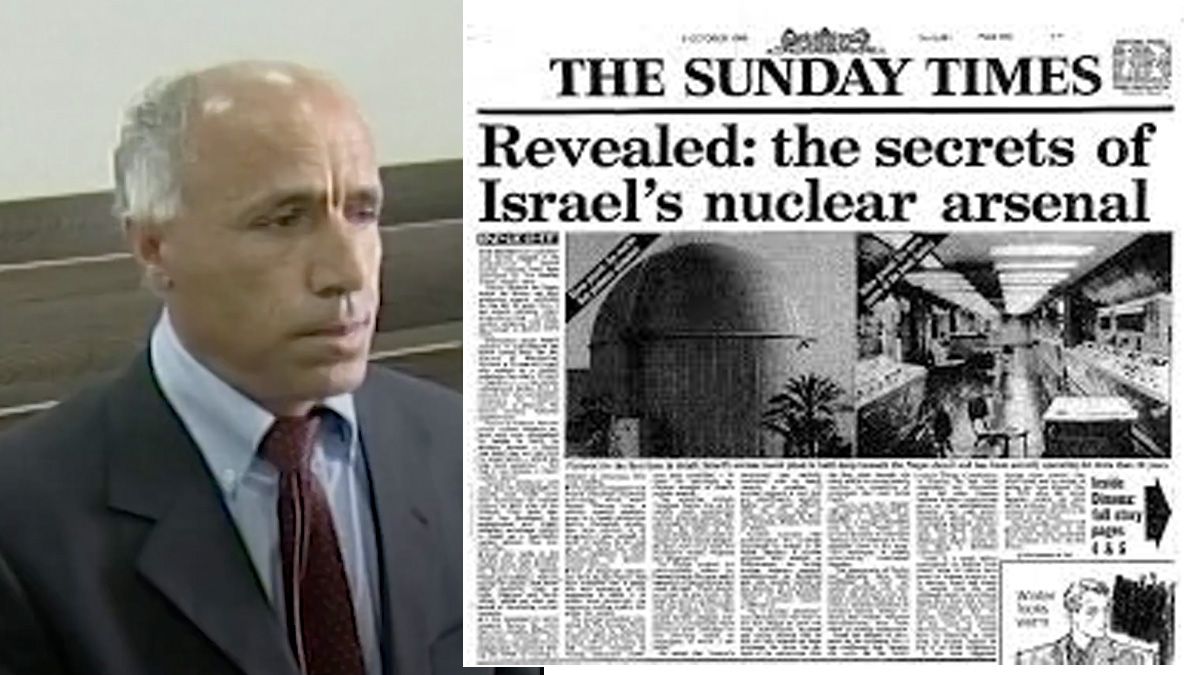
In 1986, Vanunu was a nuclear technician at Israel's Negev Nuclear Research Centre in Dimona. Before leaving his job, he did something unremarkable in principle and extraordinary in consequence: he photographed what he saw, and took those photographs to The Sunday Times of London.
What the photographs showed was that Israel had been secretly constructing nuclear weapons — not merely enriching uranium, but manufacturing warheads, developing thermonuclear capability, and building an arsenal that analysts would later estimate at between 90 and 200 weapons, with fissile material stockpiles sufficient for potentially 300 more.
The Sunday Times spent weeks verifying the material before publishing. The story has never been seriously challenged.
Before the article even appeared, Vanunu had vanished. He had been lured from his London hotel to Rome by a Mossad honeytrap operation — an agent posing as an American tourist — drugged, bundled onto a cargo ship, and returned to Israel.
His trial was conducted in complete secrecy. He was convicted of espionage and treason, sentenced to 18 years imprisonment, and spent more than 11 of those years in solitary confinement in a cell measuring roughly three metres by two.
He was released in 2004. He has never been allowed to leave Israel. He cannot speak freely to foreign journalists. His movements remain restricted. Israeli courts continue renewing these conditions annually. His most recent restrictions were renewed in July 2024 — 38 years after the fact.
Daniel Ellsberg, the American whistleblower who leaked the Pentagon Papers, called Vanunu "the preeminent hero of the nuclear era." He was awarded the Right Livelihood Award in 1987 for his courage. None of this has moved the Israeli state one degree.
The question worth asking is not why Israel punished Vanunu. States routinely punish people who expose their secrets. The question is: what, exactly, was the secret?
A Secret Built Behind Closed Gates
Israel's nuclear programme was not always an open secret. It was a genuine concealment operation — one that survived direct pressure from the highest levels of American government.
In the early 1960s, President John F. Kennedy wrote directly to Israeli Prime Minister David Ben-Gurion demanding inspection access to the Dimona facility. Ben-Gurion stalled, offered limited visits with advance notice, and provided explanations — a textile plant, a research reactor — that American officials found increasingly implausible.
Kennedy pressed. Israel evaded. Kennedy was assassinated in 1963. Under Lyndon Johnson, the pressure dissipated. The programme continued.
By the time Vanunu photographed the underground weapons complex in the mid-1980s, the arsenal was mature and the ambiguity had hardened into official policy — known in Hebrew as amimut. Not a genuine state of uncertainty, but a performance: carefully maintained, institutionally enforced, and serving a very specific legal function.
That function is this: keeping American aid money flowing.
The Symington-Glenn Architecture
Two amendments to the United States Foreign Assistance Act — the Symington Amendment (1976) and the Glenn Amendment (1977) — explicitly prohibit the United States from providing economic or military assistance to any country that acquires nuclear enrichment or weapons reprocessing technology outside international safeguards.
The language is not ambiguous. If the United States government formally acknowledged what virtually every serious intelligence analyst already knows — that Israel possesses a substantial nuclear arsenal developed entirely outside the Non-Proliferation Treaty framework, without IAEA oversight, without inspection, and without any international accountability mechanism — it would be legally required to cut off the billions of dollars in annual military and economic aid that forms the backbone of the relationship.
Israel does not belong to the NPT. It has never submitted to IAEA inspection of Dimona. It operates entirely outside the international nuclear accountability framework that every other nuclear state, declared or suspected, is expected to engage with.
The "ambiguity" policy exists for one primary reason: to give Washington legal cover to maintain aid flows that would otherwise be prohibited by its own domestic law.
Both governments understand this perfectly. The performance is maintained by mutual consent. It has never been seriously litigated in the United States Congress. It has never been challenged through American courts.
Vanunu's crime was not espionage in any operational sense — the information he revealed did not endanger Israeli soldiers or compromise active operations. His crime was making the fiction harder to maintain. He forced the world to look directly at what everyone was already choosing not to see, and in doing so, he threatened the legal architecture that kept the money flowing.
That is why the punishment has lasted 38 years, and why it continues today.
Iran and the Mirror
This would be troubling enough as a standalone story of institutional hypocrisy. But there is a mirror held up to it that makes the double standard impossible to ignore.
That mirror is Iran.
Iran is an NPT signatory, subject to IAEA inspection, with no confirmed nuclear weapons. It signed the JCPOA in 2015 — a multilateral agreement that placed strict limits on its nuclear activities in exchange for sanctions relief. The IAEA repeatedly certified its compliance. The United States unilaterally withdrew in 2018, collapsed the Iranian economy, and drove renewed enrichment. Iran returned to negotiations anyway.
Then came the Israeli strikes.
On 27 February 2026, Omani Foreign Minister Badr Albusaidi stated publicly that a peace deal was within reach — Iran had agreed to irreversible stockpile conversion, zero accumulation, and full IAEA verification. Technical talks were scheduled for Vienna on 2 March. Eight days later, the bombs fell.
A country that was days away from signing the most constrained nuclear agreement in the world now faces an active war. The consequences — Hormuz disruption, oil above US$100 a barrel, insurance premium spikes across Asia-Pacific shipping — are being absorbed not in Tel Aviv or Tehran but in the everyday cost of living of billions of people who had no vote in any of this.
And the foundational architecture of this conflict rests on an asymmetry that mainstream discourse rarely names directly.
The Question No One Is Permitted To Ask
Iran, an NPT signatory, under IAEA monitoring, with no confirmed weapons, engaged in diplomatic process: faces war, sanctions, and existential pressure.
Israel, an NPT non-signatory, with no IAEA access to Dimona, with a confirmed arsenal by any credible assessment, and with what strategic analysts have long termed the "Samson Option" — an inferred last-resort nuclear posture implying overwhelming retaliation even at civilisational cost — embedded in its deterrence logic: faces no scrutiny, no sanctions, continued military aid, and automatic diplomatic protection at the United Nations Security Council.
The term "Samson Option," popularised by journalist Seymour Hersh and extensively analysed in nuclear deterrence literature, refers to Israel's presumed willingness to employ nuclear force if facing existential destruction — named after the Biblical figure who pulled the temple down on himself and his enemies.
Israel has never formally published this as doctrine. It has never needed to. The deterrence value lies precisely in the ambiguity — which is the same structural logic that governs its entire nuclear posture. What is never officially acknowledged cannot be officially constrained.
What does Israel have that leaves it effectively insulated from the enforcement mechanisms of international law? The answer is structural, not theological: a US Security Council veto that has blocked dozens of resolutions; an aid-fiction architecture that requires nuclear ambiguity to be maintained under American domestic law; a narrative framework in which criticism of Israeli state policy is systematically conflated with antisemitism, making scrutiny politically costly regardless of its factual basis; and an actual nuclear arsenal that provides the hard deterrence no sanctions regime will challenge.
The rules-based international order — invoked constantly by Western governments as the foundation of legitimate state conduct — is not merely being applied selectively. It is being actively gamed by the very states that claim to uphold it. The Symington-Glenn amendments are not being violated; they are being circumvented through a performance of wilful ignorance, maintained by both parties, year after year.
The People Who Said No
Vanunu is not alone. He belongs to a lineage of individuals who, at great personal cost, placed the interests of the broader human collective above the demands of the state that claimed authority over them.
Daniel Ellsberg leaked the Pentagon Papers in 1971 — not troop positions, but proof that four successive US administrations had known the Vietnam War was unwinnable and lied to continue it. The government sought 115 years in prison. The case collapsed due to the government's own illegal conduct in persecuting him. He died in 2023 having never expressed regret.
Thomas Drake, a senior NSA executive, discovered the agency was wasting billions on a dysfunctional surveillance programme while suppressing a cheaper, constitutional alternative. He raised concerns internally, went to the inspector general, cooperated with congressional investigators — followed every proper channel. The government indicted him anyway, raided his home, and destroyed his career. He ended up working at an Apple Store. His case is the definitive answer to anyone who says whistleblowers should work within the system.
Katharine Gun, a GCHQ translator, leaked a classified NSA memo in January 2003 revealing that the US and UK were bugging UN Security Council delegates — the diplomats whose votes were needed to authorise the Iraq invasion. They were not building a legal case. They were rigging the vote that would provide legal cover. Charges against her were dropped — reportedly because a trial would have forced the government to defend the legality of the war in open court.
Peter Buxtun went to the Associated Press in 1972 with a story the medical establishment already knew: since 1932, the US government had been running a study on 399 Black men with syphilis in Alabama, watching the disease progress through their bodies for decades, never telling them their diagnosis, never offering treatment even after penicillin became standard. He had raised it internally in 1966 and again in 1968. He was reassigned and pushed out both times. His disclosure ended the study and produced the Belmont Report — the foundational document of modern bioethics.
Li Wenliang sent a message to colleagues in December 2019 warning of a SARS-like illness in Wuhan. Chinese authorities forced him to sign a statement recanting. He contracted the disease. He died in February 2020, aged 33. The weeks lost to official suppression of his warning are measured in lives.
Chelsea Manning, Edward Snowden, and Julian Assange each disclosed what governments had decided the public should not see — war crimes, mass surveillance, diplomatic duplicity. Manning was sentenced to 35 years. Snowden has lived in exile since 2013. Assange spent over a decade in legal limbo — years in the Ecuadorian embassy in London, years in Belmarsh prison — before reaching a plea deal with the US Department of Justice in 2024 that finally allowed him to return to Australia. The information was true. That was the problem.
Why Following the Law Is Not Always the Legitimate Choice
The instinct to defer to law is understandable. Rules create predictability. Order enables cooperation. Most of the time, legal compliance is both the sensible and the ethical course.
But that calculus depends entirely on one condition: that the law applies equally.
When it does not — when the same conduct that attracts war and sanctions for one state is protected by diplomatic veto for another; when the same disclosure that would earn a whistleblower in Tehran a death sentence earns one in Tel Aviv merely 38 years of house arrest within his own country; when an NPT signatory under inspection is bombed while a non-signatory with a confirmed arsenal collects aid checks — the law is no longer functioning as a normative system. It is functioning as a power instrument. And compliance with a power instrument, dressed in the language of rules, is not a virtue. It is a choice to ratify the asymmetry.
Vanunu's photographs did not create Israel's nuclear weapons programme. Manning's cables did not create the killing in Baghdad. Snowden's disclosures did not create the surveillance architecture. Li Wenliang's message did not create the virus. What each of them did was make visible something that power had decided the public should not see — because visibility would create pressure for accountability. That is the function the law, in these cases, was being used to prevent.
That is not a security policy. It is a protection racket operating at civilisational scale, maintained by the performance of legal compliance from all parties except the ones the law is supposed to constrain.
Ellsberg photocopied documents. Drake filed inspector general reports and was destroyed anyway. Gun read a memo and understood what it meant. Buxtun raised his hand in a room where no one wanted him to. Li Wenliang sent a message. Vanunu took photographs.
None of them were following orders. All of them were following something older, harder, and more durable than the authority of the state that claimed dominion over them.
What Vanunu Actually Did
He took 57 photographs. He gave them to a newspaper. The newspaper verified them exhaustively and published. The information has not been seriously challenged in nearly four decades.
The truth he told did not start a war. It did not compromise a military operation. It did not get anyone killed. It embarrassed a legal fiction — and it has cost him the better part of his life.
For years, on the first day of every month, he posted that he was still waiting for freedom. In July 2024, he posted that his restrictions had been renewed once again — and said he would only write his next post from freedom. The account subsequently disappeared from X. No further post has been recorded. His whereabouts are not publicly known.
And across the world, in quiet corners of the internet and in the work of researchers, journalists, and peace activists who have never met him, people are still calling for that freedom — still thanking a man who gave up decades of his life to tell a truth that powerful governments needed the world not to know.
The account is gone. The gratitude is not.