Public response to MHA's OCHA action on anti-Indian content centres on immigration and employment concerns
The Ministry of Home Affairs ordered 14 posts disabled under the Online Criminal Harms Act on 6 June 2026, assessing them as likely constituting an offence under Section 298A of the Penal Code for promoting enmity between racial groups. The government's framing of the action as a defence of racial harmony drew an immediate and substantial public response across mainstream media platforms — with thousands of commenters presenting their concerns primarily through the lens of immigration and employment policy.
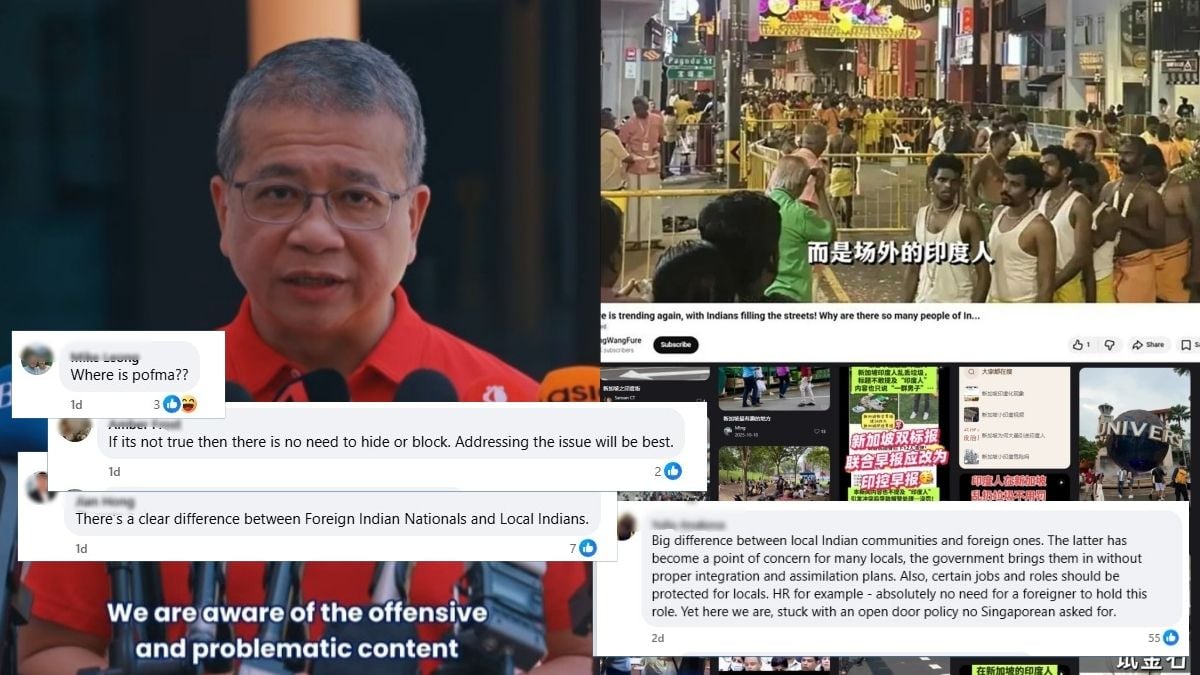

The Ministry of Home Affairs (MHA) announced on 6 June 2026 that the Singapore Police Force (SPF) had issued Disabling Directions under the Online Criminal Harms Act 2023 (OCHA) to Google, Meta and X, requiring the platforms to disable access by Singapore users to 14 posts assessed as carrying inflammatory narratives about the Indian community.
MHA stated that the posts were assessed as likely constituting an offence under Section 298A of the Penal Code 1871, which prohibits knowingly promoting feelings of enmity, hatred or ill-will between different groups on grounds of race.
According to MHA, the content originated from a China-based platform before spreading to YouTube, Facebook and X.
MHA stated the narratives framed Singapore as displaying anxiety over its cultural identity and ethnic politics, before escalating into explicit inflammatory claims — including allegations that Singapore's multiracial policy is a facade, that ethnic Indian politicians would act in favour of Indian immigrants, and that Singapore's culture is fundamentally Chinese.
MHA noted the posts used selectively chosen images of crowded streets in Little India — assessed as likely filmed on weekends when migrant workers spend their days off — and footage of religious festivals, to support claims that Singapore was being overrun by Indians. The posts also used derogatory language including comparisons to a concentration of curry.
No evidence currently pointing to state coordination
Law and Second Minister for Home Affairs Edwin Tong, speaking to reporters on 6 June 2026, said there was currently no evidence to suggest the content formed part of a coordinated campaign by any foreign government.
"Based on our investigations, the content originates from the infospace — they are likely generated organically by various foreign netizens," Tong said.
Tong said investigations had nonetheless identified deliberate efforts to spread the content within Singapore's local information space, characterising these as malicious efforts to sow discord by inciting ill-will against the Indian community. He said the government would not hesitate to take further measures if similar content continued to proliferate.
Minister for Digital Development and Information Josephine Teo also denounced the content on the same day, stating the posts did not reflect the views of Singaporeans and warning that targeting one community today would be followed by other communities tomorrow.
Why OCHA and not POFMA
The government's choice of legal instrument drew attention from several commenters across social media platforms.
OCHA allows the SPF to direct platforms to disable access to content assessed as likely constituting a criminal offence, without requiring the government to publish a statement specifying which claims in the content are false and what the correct facts are.
POFMA — the Protection from Online Falsehoods and Manipulation Act — operates differently.
A POFMA correction direction requires the issuing minister to specify the false statement of fact and to state what the accurate version is, with that correction published alongside or appended to the original content. Invoking POFMA would require the government to identify the false statements of fact relied upon and publish a correction setting out the government's position.
The government's use of OCHA rather than POFMA means no such public specification has been required. Several commenters noted this distinction directly, with one asking "Why not POFMA them? Is it because it's not a falsehood?" and another writing "If it is not true then there is no need to hide or block. Addressing the issue will be best."
Public response: immigration and employment concerns
The announcement generated a substantial public response across social media posts published by CNA, The Straits Times, and Mothership reporting on the MHA action, with thousands of comments posted within hours.
While some commenters supported the government's action fully and others condemned the foreign interference dimension, a recurring pattern observed across the substantive public response was not disagreement with the takedowns themselves but with the government's framing of the concern as primarily racial in nature.
A consistent distinction emerged across a large number of comments between Singaporean Indians — described repeatedly as valued members of Singapore's social fabric — and CECA foreign nationals or Indian migrant workers, with many commenters framing their concerns around immigration and employment policy.
"Dear minister Singaporeans have no problems with Singapore Indians. It is CECA and PRC they dislike. The issue is not race but immigration and immigrants," one commenter wrote.
"Local Indians and India Indians very different," wrote another.
"There's a clear difference between Foreign Indian Nationals and Local Indians. The latter has become a point of concern for many locals, the government brings them in without proper integration and assimilation plans," a commenter stated, adding that certain roles should be protected for locals.
Several commenters named what they characterised as the underlying policy failure. "Rather than blocking, Edwin and the cabinet should address it. Why do we have a dominance of certain people in Changi Business Park and some condos in the East? It's been decades. You can block social media but you cannot block perceptions on the ground," one wrote.
Another drew a direct line to parliamentary debate: "Even our own PSP raised it in parliament. It's been brewing but never properly addressed."
Commenters also questioned the selective application of the government's response. "Why only blocked online posts targeting Indian, looks like there is no online posts targeting other races," one wrote. Another asked: "Then why didn't the gov order them to block content targeting the Chinese and Malay community?"
Lianhe Zaobao readers: immigration policy, not racism
A parallel and largely Chinese-language conversation unfolded in the comment section of Lianhe Zaobao's coverage of the same announcement — a readership drawn predominantly from Singapore's Chinese-speaking community and diaspora readers across the region.
The dominant register in that thread differed markedly in tone from the English-language commentary, but the substantive argument converged on the same distinction: the target of public frustration was immigration policy, not Singapore's local Indian community.
Many commenters focused on the CECA framework specifically. "不是针对土生土长的印度人是对外来的印度人不满" ("It's not about local-born Indians, it's dissatisfaction with foreign Indians"), one wrote — a formulation that appeared in varied forms across dozens of comments. Another framed the policy critique directly: "问题在于政策" ("The problem lies in the policy"), before listing what they described as a series of economically questionable decisions, including the CECA agreement and aviation partnerships with Indian carriers.
A number of readers questioned whether the government's intervention addressed the underlying grievance or merely suppressed its expression. "越制止,反弹越大" ("The more you try to stop it, the bigger the backlash"), one commenter wrote. Another argued: "不找原因为何出现这种情况,用政治力量去压制,这是鸵鸟心态" ("Not looking for the cause of this situation and using political force to suppress it — this is the ostrich mentality"). A third put it more bluntly: "不让看就可以当作没这回事了吗" ("Just because you don't let people see it, does that make it not exist?").
Concerns about the long-term demographic trajectory of Singapore surfaced repeatedly. Several commenters pointed to differential fertility rates between ethnic groups as a structural issue the government had not publicly addressed. "一想到20年后新加坡的人口结构,我心里就沉甸甸的" ("When I think about Singapore's population composition in 20 years, my heart feels heavy"), one wrote, expressing anxiety about the sustainability of the country's multiracial balance as Chinese Singaporean birth rates continued to decline.
Another noted that without transparency about naturalisation data, citizens had no independent means of assessing the pace or direction of demographic change: "政府应该让新加坡人都知道,而不是保持静静" ("The government should let Singaporeans know, rather than staying silent").
A recurring theme in the Zaobao thread was the distinction between foreign-origin provocation and genuine domestic concern. Several commenters rejected the framing that the videos were being circulated primarily by malicious foreign actors, arguing that the sentiments expressed reflected observations rooted in everyday experience. "本地人看到的不是种族问题,是移民政策问题" ("What locals see is not a racial issue, it's an immigration policy issue"), one wrote.
Another rejected the government's framing more sharply: "讲的是不是真的,你没有证明给我们看,只是用嘴巴跟我们讲不是真的" ("Whether it's true or not — you haven't shown us proof, you're just telling us with your mouth that it's not true").
Some commenters acknowledged the foreign interference dimension while maintaining that it did not invalidate the underlying concern. "有人意图分化新加坡人,但这不等于国人的担忧是没有道理的" ("Some people are trying to divide Singaporeans, but that doesn't mean citizens' concerns are without basis"), one observed.
A number pointed out that similar commentary about Chinese nationals in Singapore had circulated online for years without equivalent government action, questioning whether the response was being applied evenhandedly across communities.
The employment dimension drew substantial comment. Several readers described first-hand workplace observations — the concentration of foreign Indian nationals in technology and financial services companies, and what they characterised as a pattern of internal hiring that disadvantaged local workers. "新加坡大学不是说世界排名前20,难道新加坡人没有能力胜任这些工作吗" ("Isn't NUS ranked in the world's top 20 — are Singaporeans not capable of doing these jobs?"), one wrote.
Another called for the government to investigate hiring patterns rather than treating public concern as evidence of racial hostility: "政府应该重视,而不是打压掩盖" ("The government should take this seriously, not suppress and cover it up").
Not all responses were critical of the government's position. A minority of commenters supported the MHA action, describing the videos as part of a deliberate effort by PRC-based actors to destabilise Singapore's social cohesion. "中国共产党正在有系统地制作假视频来煽动种族对立" ("The Chinese Communist Party is systematically producing fake videos to incite racial conflict"), one wrote.
Another expressed concern that the comment section itself had been infiltrated: "看看内政部长来自印度,但我更担心这里的评论充满了境外势力的渗透" ("What worries me more is that this comment section is full of foreign infiltration"). Several commenters warned their fellow readers to be discerning and not allow outside actors to exploit legitimate policy grievances as a vehicle for destabilisation.
What is CECA
The term CECA — which appears repeatedly in the public commentary — refers to the Comprehensive Economic Cooperation Agreement, a free-trade and economic pact between Singapore and India signed in 2005. The agreement was intended to boost bilateral trade, investment, and the movement of professionals between the two countries.
Over time CECA became a contested shorthand in public discourse, used by critics to refer to the employment pass framework that allows Indian nationals with professional qualifications to work in Singapore, and to broader concerns about the concentration of Indian foreign nationals in specific sectors — particularly the technology, banking, and financial services industries. Critics argue the framework has led to hiring practices that disadvantage local workers. The government has consistently rejected claims that the agreement grants special immigration privileges, noting that employment passes are subject to fair consideration frameworks regardless of nationality.
The demographic data gap
The persistence of the public debate about immigration and demographic change is partly explained by a structural opacity in Singapore's official data.
The government has declined since at least 2013 to provide a breakdown of new citizens by country of origin, citing sensitivities. In a written parliamentary reply on 14 March 2016, then-Minister for Home Affairs and Law K Shanmugam reaffirmed that position, quoting then-Deputy Prime Minister Teo Chee Hean's 2013 explanation that providing detailed breakdowns "may have implications on specific groups of persons or create sensitivities in the countries of origin."
The citizen-level data that is published presents a picture that is stable but incomplete. Population in Brief 2021 records the Indian citizen population at approximately 259,000 as at June 2021 — representing around 7.4 percent of the citizen population, a proportion that has remained broadly stable for over a decade. By June 2025, that figure had grown to approximately 278,300, or 7.6 percent of the citizen population. The Chinese citizen population stood at approximately 2,654,500 in 2021, rising to 2,763,900 by 2025.
These figures, however, capture only one layer of a considerably larger picture. On 6 July 2021, then-Minister of State for Manpower Dr Tan See Leng disclosed in a ministerial statement that the proportion of Indian nationals among Employment Pass holders had risen from 14 percent in 2005 to 25 percent in 2020.
Applied to MOM's figure of 177,100 EP holders as at December 2020, that proportion implies approximately 44,000 Indian nationals holding Employment Passes at that point — a figure equivalent to roughly 17 percent of the entire Indian citizen population, from a single work pass category. Dr Tan did not disclose corresponding figures for S Pass holders.
That 6 July disclosure remains among the few instances where nationality-disaggregated work pass data has entered the public record, and it did so only because a ministerial statement compelled partial transparency. The written parliamentary questions filed on 2 August 2021 — the sitting that followed — illuminate how comprehensively the remaining data is withheld.
Former Progress Singapore Party NCMP Hazel Poa asked for the total number of work passes issued to foreign nationals belonging to any of the 127 professions listed under Annex 9A of the CECA. The ministry declined, stating that it does not track or report employment data by that occupational grouping because "there is no such route" under the agreement.
Former PSP NCMP Leong Mun Wai asked a related but distinct question: from 2005 to 2020, how many intra-corporate transferees, foreign professionals, and dependants who had initially entered Singapore through the Movement of Natural Persons provisions in various free trade agreements had subsequently become citizens, become permanent residents, or re-entered the workforce through another visa type.
The ministry's answer was that records prior to 2014 "do not distinguish" between applications invoking WTO GATS or FTA provisions, making the full 2005–2020 picture irrecoverable from official data. For the 2014–2020 period, the ministry said an average of approximately 30 persons per year had acquired permanent residency or citizenship through that route, and approximately 140 per year had subsequently obtained another work pass — characterised as "a negligible share" of overall EP approvals, without providing the underlying denominator that would allow independent verification of that characterisation.
The result is that a question covering fifteen years of policy — how many people entered Singapore under FTA professional mobility provisions and then transitioned to permanent residency or citizenship — was answered with seven years of partial data, framed in terms designed to minimise rather than illuminate.
The contrast with other jurisdictions is instructive. Taiwan's Ministry of Labour publishes monthly tables disaggregating its foreign worker population by nationality, source country, and sector as a matter of administrative routine. Singapore's equivalent data, to the extent it exists internally, is not released in comparable form.
The resident total fertility rate for Chinese Singaporeans stood at 0.83 in 2024 — well below the replacement level of 2.1, and significantly lower than the Malay TFR of 1.58 and Indian TFR of 0.91. Despite these differential birth rates, Singapore's reported ethnic composition among citizens has remained broadly stable for decades. How births, deaths, emigration, and naturalisation each contribute to that stability — and from which countries new citizens are drawn — cannot be independently examined because the government does not publish country-of-origin naturalisation data.
The result is a public debate conducted largely without official figures. The sentiments documented across the Lianhe Zaobao and English-language comment threads — whatever their origin or intent — are in part a product of that gap: when governments decline to publish data, publics fill the absence with observation, inference, and anxiety.
Impact on local Indian Singaporeans
The discussion also drew responses from Singaporean Indians who described the impact of the conflation on their own experience. Several noted that the CECA term was being used as a proxy that affected local Indians regardless of origin.
"Singaporean Indians and people from India regularly hear jokes about their skin colour, their smell, eating with hands, or being criminals and deviant since school. We've always had the problem of property websites allowing agents to put 'no Indians' on property listings," one Reddit commenter wrote. "Anti-Indian sentiment is not a fringe issue in Singapore. It is frankly more normalised than we'd like to imagine."
Another wrote: "For the rest of you thinking people using CECA in vain doesn't affect local Indians — it absolutely does, it already did. Some of them can't even tell the difference between locals and immigrants."
A third described the personal toll: "Singapore is the only home I have. Three generations deep and I still have to prove that I belong. I have to deliberately distance myself from foreign Indians so that I don't get lumped into whatever stereotypes surround them."
The foreign interference dimension
On Reddit, several commenters identified the foreign interference dimension as the primary issue, expressing concern about Chinese influence operations targeting Singapore's social cohesion independently of the immigration debate.
"Guys the key thing is these are foreign origin posts. This is not an organic expression of displeasure by Singaporeans — it's a fifth column attempt by a foreign nation to threaten Singapore's national security," one wrote, adding that this did not make it acceptable to be racist against Indians in any context.
Another noted that China-based platforms had been running similar operations against Singapore for some time: "Haha now then they block, China has been conducting this sort of psyops for years."
Several commenters also pointed to what they described as inconsistency in how the foreign influence concern was being framed, questioning why TikTok, Douyin, and Xiaohongshu were not named alongside YouTube, Facebook and X in the disabling directions.
MHA has urged Singaporeans to reject all attempts to divide society and to be discerning when disseminating information online.