Chinese investors warn Prabowo over Indonesia policies hurting investment confidence
Chinese business operators in Indonesia have urged President Prabowo Subianto to address regulatory uncertainty, rising costs, and alleged over-enforcement, warning the measures could undermine investment confidence and disrupt the country’s nickel industry.

- Chinese investors warned Indonesian policies are undermining business certainty and long-term investment confidence.
- The coalition criticised mining quotas, export proceeds rules, tax audits, and forestry enforcement actions.
- Indonesian officials defended regulatory enforcement while domestic businesses echoed concerns about policy unpredictability.

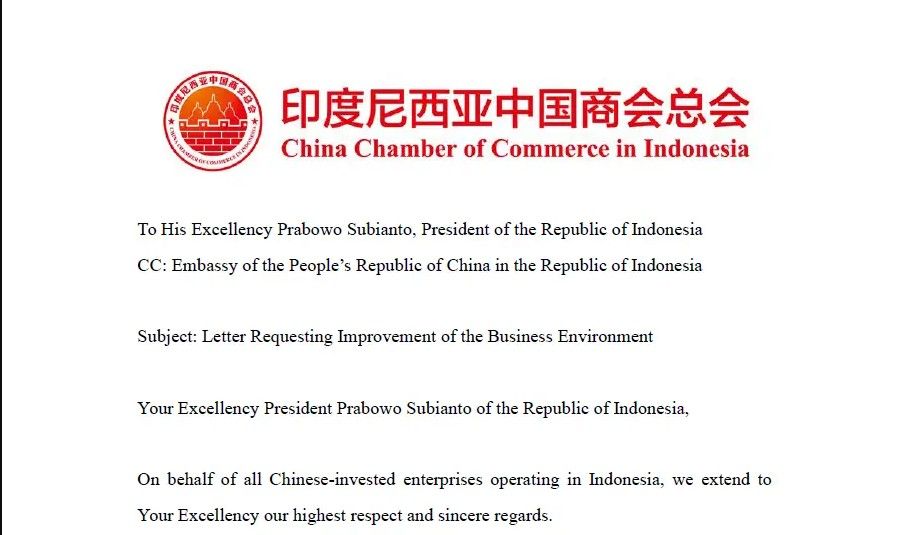
A coalition of Chinese business operators in Indonesia has reportedly submitted a formal letter to President Prabowo Subianto expressing concern over a series of Indonesian government policies that they claim are affecting business certainty and investment confidence.
According to excerpts from the document circulated on Thursday, the investors criticised measures including proposed increases in mining royalties, stricter rules on retaining export proceeds domestically, reductions in nickel ore mining quotas, and what they described as excessive law enforcement practices that allegedly created opportunities for corruption and extortion.
The letter, reportedly issued through the China Chamber of Commerce in Indonesia, stated that Chinese companies had consistently supported Indonesian government policies and complied with prevailing regulations while contributing to economic growth, employment, industrial downstream development, and corporate social responsibility programmes.
However, the investors argued that the business environment had deteriorated significantly in recent periods.
“Over the past period, companies operating in Indonesia have generally faced serious problems, including excessively strict regulations, over-enforcement of the law, and even corruption and extortion by the relevant authorities,” the letter stated.
The coalition said such conditions had disrupted business operations, weakened long-term investment confidence, and raised broader concerns among Chinese companies regarding Indonesia’s future investment climate.
Concerns over taxation and export proceeds rules
One of the principal complaints concerned repeated increases in taxes and levies, including mineral resource royalties. The investors also criticised increasingly intensive tax inspections accompanied by threats of substantial financial penalties.
“Taxes and fees, including mineral resource royalties, have been raised repeatedly, accompanied by increasingly intensive tax inspections and even enormous fines amounting to tens of millions of US dollars, creating panic among companies,” the letter said.
The investors also objected to proposed rules requiring companies to retain a portion of foreign exchange earnings from natural resource exports in Indonesian state-owned banks for at least one year.
Under the proposed policy, companies would be required to place 50 per cent of export proceeds domestically. The investors argued that such a requirement would disrupt liquidity and affect long-term operations.
Nickel industry complaints
The letter placed particular emphasis on Indonesia’s nickel sector, where Chinese companies are among the largest investors and operators.
The investors complained about significant reductions in nickel ore mining quotas since the beginning of 2026. According to the letter, quotas for major mining operations had been cut by more than 70 per cent, equivalent to approximately 30 million tonnes.
The coalition argued that the reductions were disrupting downstream industries, including electric vehicle battery production and stainless steel manufacturing.
The investors also criticised recent adjustments to Indonesia’s Mineral Benchmark Price (HPM) policy. According to the letter, the Ministry of Energy and Mineral Resources had revised the pricing formula to include cobalt, iron, and other associated minerals, resulting in what the investors described as a sharp rise in production costs.
The coalition claimed the changes had increased the comprehensive cost of nickel ore by up to 200 per cent.
“As the largest investors and operators in Indonesia’s nickel industry, Chinese investment companies are now facing a sharp increase in production costs, widening operational losses, and imbalances within the industrial supply chain,” the letter stated.
The investors warned that the situation could affect future investment, exports, and employment across the nickel industrial chain, which they said involved more than 400,000 workers.
They also argued that the measures risked undermining international investor confidence in Indonesia’s nickel industry.
Forestry enforcement and project suspensions
The investors additionally raised concerns regarding enforcement actions in the forestry sector.
According to the letter, Indonesia’s Forest Area Enforcement Task Force had imposed fines of up to US$180 million on several Chinese investment companies in relation to permits for borrowing and utilising forest areas.
The coalition further claimed that several large-scale projects had been halted by the government, including hydroelectric power developments accused of damaging forest areas and contributing to flooding.
“The government ordered work to stop and imposed sanctions,” the letter said.
Issues relating to work permits for foreign employees were also highlighted. The investors stated that visa approval processes had become increasingly complicated and costly, while location-specific work regulations had limited the mobility of technical and managerial personnel.
In addition, the coalition expressed concern regarding several proposed policies, including additional export duties on certain products, the removal of electric vehicle incentives, and reductions in tax facilities in special economic zones.
Call for policy stability
Despite the criticism, the investors reaffirmed their commitment to economic cooperation between Indonesia and China.
“Chinese investment companies in Indonesia are major participants in and drivers of China–Indonesia economic and trade cooperation,” the letter stated.
The coalition said it remained optimistic about Indonesia’s long-term development prospects and was prepared to continue supporting industrial upgrading and national economic growth.
Nevertheless, the investors argued that government policies lacked consistency and predictability.
“Law enforcement standards in taxation, environmental protection, forestry, and other sectors are not transparent and grant excessive discretionary authority,” the letter continued.
The coalition also complained that official complaint channels were ineffective, alleging that some issues could only be resolved through intermediaries charging substantial fees.
Through the letter, the investors urged President Prabowo to maintain a stable, fair, transparent, and predictable business climate, while improving communication mechanisms between the government and the private sector.
“We are confident that with the attention and facilitation of His Excellency the President, China–Indonesia economic and trade cooperation will continue to develop steadily and healthily,” the letter stated.
The chamber also indicated that it was prepared to provide a direct explanation to the President if required.
Indonesian business community responds
Members of Indonesia’s domestic business community said the letter reflected longstanding concerns among investors regarding regulatory consistency and bureaucratic efficiency.
Indonesian Employers Association Expert Council member Danang Girindrawardana said the letter represented a serious signal regarding Indonesia’s investment climate.
“The letter came from a coalition of Chinese business operators in Indonesia addressed to President Prabowo. It reflects their concern regarding Indonesian bureaucratic services,” Danang said on Thursday.
According to him, many of the concerns outlined in the letter had also been experienced by Indonesian businesses, including tax audits, sudden policy changes, export proceeds retention requirements, and allegations of corruption and extortion by rogue officials.
“It is only natural that Chinese business circles complain about several Indonesian public service issues mentioned in the letter,” he said.
Danang stated that investors required assurances that government policies would not change abruptly and that bureaucratic processes would remain transparent, efficient, and legally certain.
He added that Indonesian business groups had repeatedly conveyed similar concerns to the government through formal meetings and correspondence, but many proposals had allegedly received limited response.
“A great many letters from the business community have been ignored by the authorities,” he said.
Apindo urged the government to improve bureaucratic services, simplify regulations, and strengthen legal certainty in order to maintain foreign investor confidence.
Government response
Indonesian government officials responded by stressing that foreign companies operating legally in Indonesia should not be concerned by regulatory enforcement.
Senior Finance Ministry official Purbaya Yudhi Sadewa said the government welcomed foreign investment provided companies complied with Indonesian law.
“As long as they conduct legal business, there is no problem. If it is illegal, then they must pay to become legal. They must fulfil all of their obligations,” Purbaya said in Jakarta on Wednesday.
According to him, companies should not fear actions taken by the Forest Area Enforcement Task Force or tax authorities if their activities complied with regulations.
“If they conduct business legally, there is no issue. Therefore, they should not be afraid,” he said.
Purbaya also referred to allegations involving around 40 Chinese steel companies accused of regulatory violations. He said Indonesia’s tax authorities had communicated with those companies to encourage compliance with prevailing regulations.
“The tax office has already spoken with them. Naturally, they are expected to move towards legality. But we shall see what happens next. If there is no further action from them, we will pursue them again,” he said.
Regarding proposed increases in mining royalties and levies, Purbaya said the government would continue prioritising national interests in managing natural resources.
“There is nothing wrong with minerals — they belong to us,” he said.
However, he added that the proposed royalty increases remained under discussion and had not yet been implemented.
“Nothing has been imposed yet; it is still only a proposal,” he said.
Meanwhile, Indonesian Energy and Mineral Resources Minister Bahlil Lahadalia said he had not directly received the letter addressed to President Prabowo but confirmed that discussions with investors and the Chinese Ambassador had taken place.
“Several parties have already communicated with me. The Ambassador has also spoken with me, and I have provided a proper explanation,” Bahlil said at the Attorney General’s Office in Jakarta.
According to Bahlil, adjustments to mining sector policies, including Work Plan and Budget (RKAB) arrangements, would continue while maintaining business certainty.
“Yes, RKAB adjustments are being made, and there is no problem,” he said.
Purbaya also stated that Indonesian authorities had raised concerns with Chinese counterparts regarding allegations that some Chinese companies operating in Indonesia had not fully complied with local regulations.
“I have also complained to them that many Chinese business operators here are conducting illegal business activities. I asked for improvements, and they promised to issue warnings,” he said.
He added that Indonesia–China investment relations should be viewed as reciprocal and based on mutual respect for each country’s legal framework.
“It goes both ways, actually. There is no problem,” Purbaya said.