My response to the Chief Justice's point about truth decay
Chief Justice Sundaresh Menon marked the judiciary's bicentennial with a concern about truth decay — shallow public engagement with court judgments, headlines launching conclusions. Here is my response to his question about why.
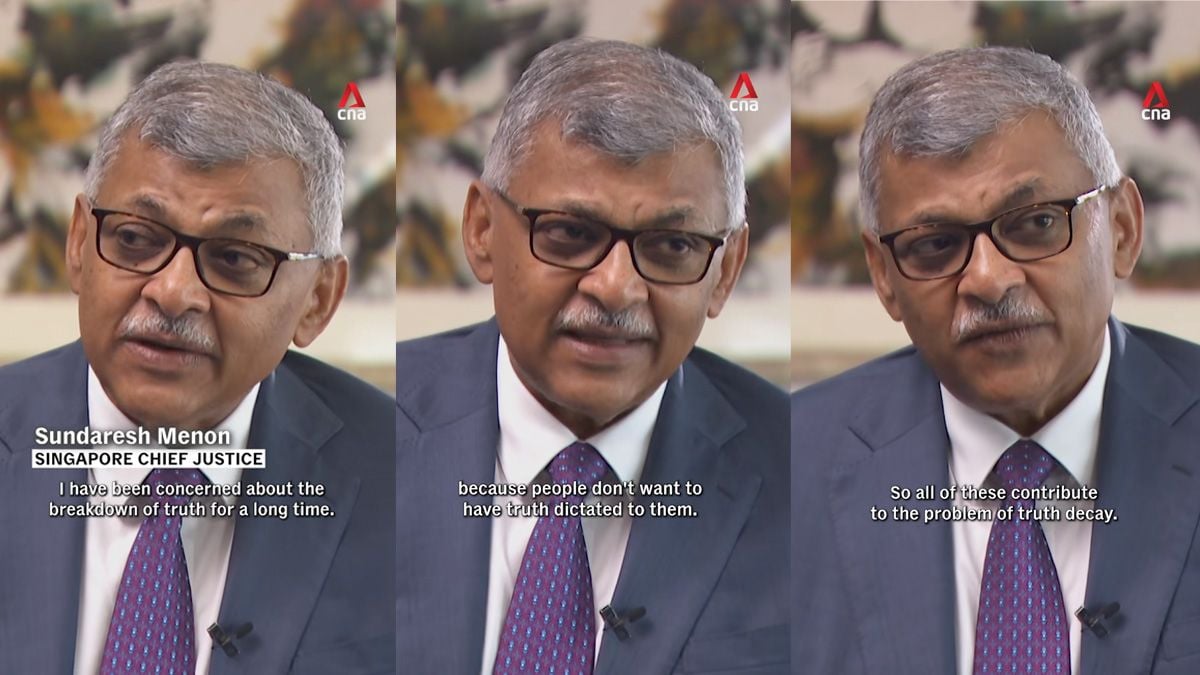

Chief Justice Sundaresh Menon, speaking to local media to mark the judiciary's bicentennial — 200 years since the Second Charter of Justice 1826 established Singapore's modern legal system — said that when he looks at social media, he finds people commenting on court verdicts without having read even the case summaries the courts produce.
Headlines launch conclusions. He described this as part of a broader "truth decay" — the erosion of shared facts in an age where anyone with mass reach can propose their own version of events.
If enough people come to believe that courts decide cases for reasons other than what the evidence shows, he warned, the consequences go beyond comment threads. "You have a huge breakdown, a breakdown of confidence in the courts, breakdown of order in society."
As TOC reported, he is genuinely concerned. So am I.
I wrote my response. Here it is:
47a3c40f9f9c45d73ebda4071b0de668fd81af6036c73ad045fbf1c67fccc7c4
For those unfamiliar with how this works: the string above is a SHA-256 cryptographic hash — a one-way digital fingerprint of the opinion I wrote. You cannot read the opinion from the hash. Nobody can. Running the original text through SHA-256 always produces the same string, which means the hash verifies the text without revealing it.
I cannot publish it now. In 2023, I was fined S$18,000 for republishing an open letter written by an Australian citizen that questioned whether certain individuals had been prosecuted for political reasons by the Attorney-General's Chambers rather than legal ones, and was ordered to pay a further S$12,000 in costs to the AGC.
My argument in those proceedings — recorded in the judgment at paragraph 49 — was that I understood the open letter as a criticism of prosecutorial decisions, of the AGC, and not as an attack on judicial integrity. The court acknowledged that reading was available. It then found, at paragraph 50, that questioning whether prosecutions were politically motivated may be read as implicating the broader system of justice, which includes the courts.
I am not disputing that finding here. I am noting its practical consequence: under that interpretation, questioning whether a prosecution was politically motivated may be read as implicating the judiciary — and carry contempt risk on that basis.
The hash is not proof that the unpublished opinion is correct. It is proof only that I wrote it, and chose not to publish it, and that the legal environment in which I made that choice is the same legal environment the Chief Justice is describing when he wonders why substantive public engagement with the courts is so thin.
If the law changes to the point where I can say what I think without that risk, I will publish it. Until then, this is what my contribution to the Chief Justice's concern looks like.
From the Judgment: Attorney-General v Xu Yuan Chen (alias Terry Xu) [2023] SGHC 87
49 Mr Xu argues that he understood the Letter "to be a criticism of the [AGC] in the way prosecutions are handled in Singapore" and "not… as an attack on the integrity of the Singapore Judiciary or an attempt to scandalise it". In illustrating this, Mr Xu refers to two sentences which say, "[Mr Li] and [Mrs Lee] were not prosecuted but persecuted due to a family feud due to a family feud [sic] between the Prime Minister and his siblings", and "Were those involved in prosecuting Parti Liyani, [Mr Li] and [Mrs Lee] doing so out of out of [sic] a fear of the political elites or as a favour to them?". Mr Xu argues that these sentences suggest that the author is criticising the AGC, and not the Judiciary, for its role in prosecuting those individuals.
50. I see no merit in this argument. As I have explained at [47] above, the attacks were targeted at Singapore's "system of justice" which necessarily includes the Judiciary. Just because the Article criticises the way prosecutions were handled in these cases does not mean that it cannot also be a simultaneous attack on the Judiciary. This is especially when there are direct attacks on the Judiciary in the earlier parts of the Article, ie, that Singapore's legal system favours those who have connections with the judges, that judges are not selected for their courage to seek or determine the truth, and that the courts are undermining the administration of justice in Singapore. Reading the Letter as a whole, it is clear that while there was criticism of the way prosecutions are handled in Singapore, there was also an attack on the Judiciary's integrity, propriety, and impartiality. This brings the Letter (and consequently, the Article which reproduced the Letter) within the ambit of s 3(1)(a)(i) of the AJPA.