Power-washing artist’s Mountbatten heart artwork removed after complaint; MP says SMRT staff cleaned it off
A power-washing artwork outside Mountbatten MRT Station was removed a day after it was created following a public complaint and police involvement. Mountbatten MP Gho Sze Kee clarified that the pavement falls under SMRT’s jurisdiction and that SMRT staff, not the town council, cleaned the artwork.
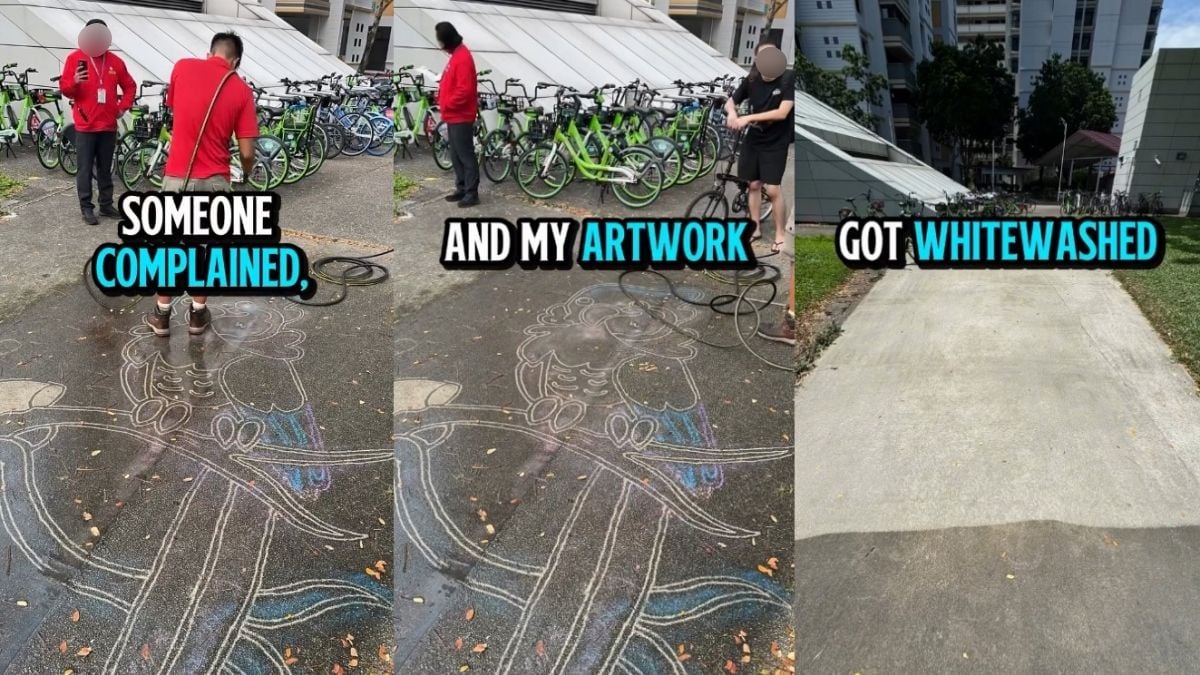
- A public complaint led to intervention while Marcus Pang was creating artwork outside Mountbatten MRT Station.
- The artwork was removed the following day by SMRT staff, according to MP Gho Sze Kee.
- The incident sparked widespread discussion about public art, regulations and shared community spaces.

SINGAPORE: A pavement artwork created by Singapore power-washing artist Marcus Pang outside Mountbatten MRT Station was removed within a day after a member of the public allegedly complained to station staff, triggering police involvement and sparking a broader debate over public art in shared spaces.
Pang, 24, said he spent approximately five hours on 31 May 2026 creating a large heart-shaped artwork titled Heart of Mountbatten on a pavement outside the station before being approached by SMRT staff.
According to Pang, station personnel informed him that a complaint had been lodged alleging that he was spraying chemicals onto nearby grass while carrying out the work.
In an Instagram post published on 5 June, Pang said he explained that he was using collected rainwater to power wash dirty concrete surfaces and that the substance mistaken for chemicals was likely petrol used by his equipment.
“Five hours in, I was stopped by the train station staff as someone had complained about me spraying chemicals onto the grass,” Pang wrote.
He added: “Unfortunately, the staff detained me as I had no permit to do such artwork, which I replied I did not require one.”
Police called to scene
Pang said police officers subsequently attended the scene and recorded his statement.
According to his account, officers informed him that no offence had been committed and that he could continue creating the artwork. However, they encouraged him to seek a letter of endorsement from the area's Member of Parliament.
The following day, Pang returned to the site and discovered that the section of pavement containing the artwork had been thoroughly cleaned.
Video footage shared online showed a noticeably lighter section of pavement where the artwork had previously been visible, effectively removing the design.
Reacting to the removal, Pang questioned why a single complaint appeared to have led to the artwork's disappearance.
“Why do we let one bad apple have power over something where the majority would appreciate?” he wrote.
He also questioned why station staff had not communicated their intentions before cleaning the area.
“We could have negotiated something that benefits both the community and train station,” he said.
Mission to create artwork across Singapore
In the caption accompanying his post, Pang reiterated his ambition to create heart-shaped power-washing artworks across Singapore.
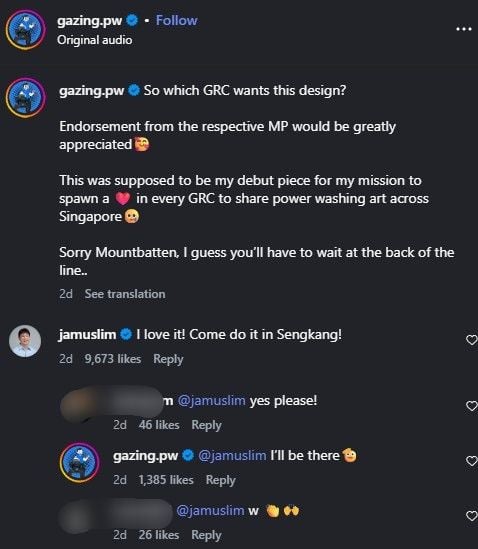
“So which GRC wants this design?” he wrote.
He added that endorsement from elected representatives would be appreciated as he pursued what he described as a mission to create a heart artwork in every Group Representation Constituency.
“This was supposed to be my debut piece for my mission to spawn a heart in every GRC to share power washing art across Singapore,” Pang said.
“Sorry Mountbatten, I guess you'll have to wait at the back of the line.”
The post rapidly gained attention online, attracting more than 78,600 likes and over 2,200 comments within two days.
View this post on Instagram
MPs and netizens weigh in
The incident quickly drew responses from politicians and members of the public.
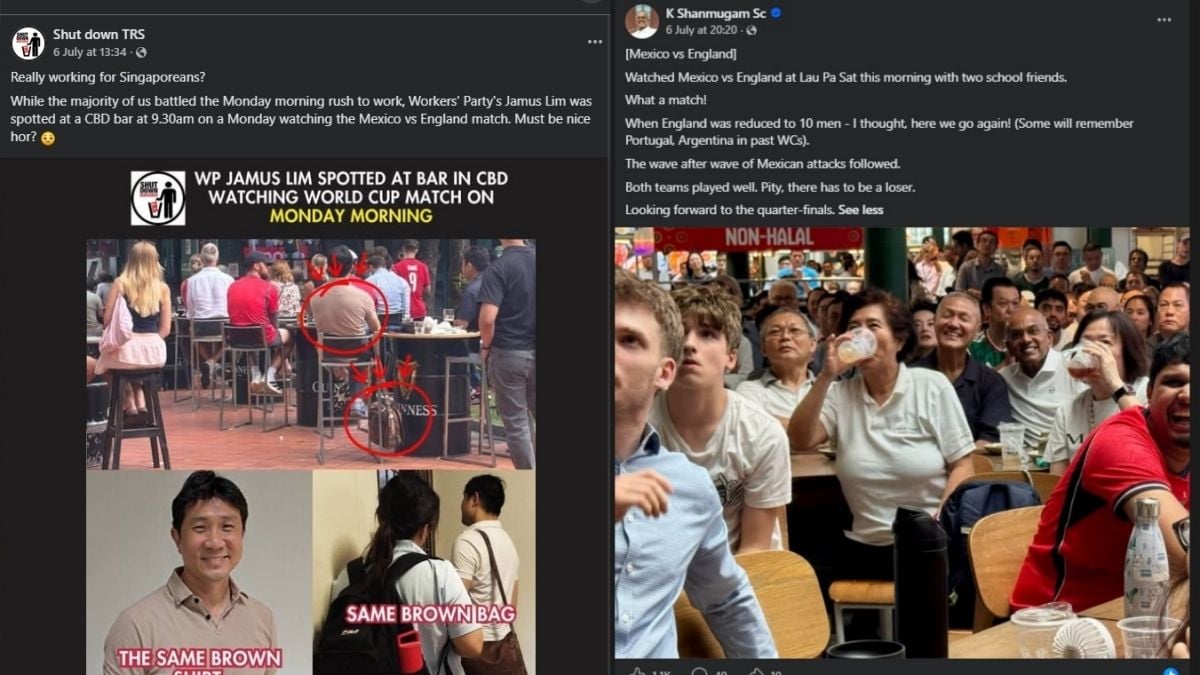
Associate Professor Jamus Lim, Member of Parliament for Sengkang GRC, publicly invited Pang to bring his artwork to the constituency.
“I love it! Come do it in Sengkang!” Lim commented on the Instagram post.
The comment itself attracted more than 9,600 likes.
Shawn Loh, MP for Whampoa-Boon Keng within Jalan Besar GRC, also expressed interest in the artwork online.
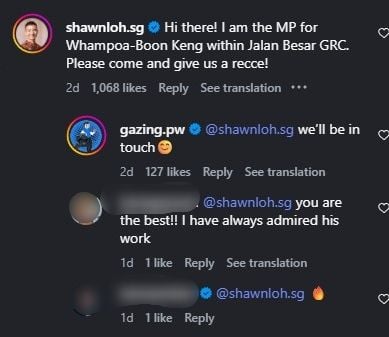
Many social media users questioned why a temporary and non-destructive artwork had been removed while other parts of the pavement remained visibly uncleaned.
Several commenters argued that the response reflected excessive bureaucracy and a lack of support for community-driven public art initiatives.
Others questioned whether police involvement and the removal of the artwork were necessary given that the work was temporary and did not cause permanent damage.
A minority of commenters, however, maintained that permits and regulations should apply consistently regardless of artistic intent.
SMRT responds publicly
As online discussion intensified, SMRT also responded directly in the comments section of Pang's Instagram post.
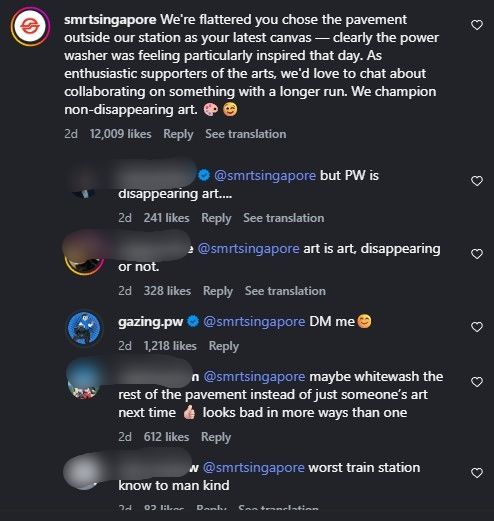
“We're flattered you chose the pavement outside our station as your latest canvas — clearly the power washer was feeling particularly inspired that day,” the operator wrote.
“As enthusiastic supporters of the arts, we'd love to chat about collaborating on something with a longer run. We champion non-disappearing art.”
However, the transport operator did not address why Pang's artwork had been removed.
Mountbatten MP clarifies responsibility
Mountbatten MP Gho Sze Kee addressed the issue in a Facebook post published on 7 June 2026.
Gho said she had intentionally waited to engage relevant agencies before commenting publicly.
“I thought the right thing to do was for me to engage with LTA/SMRT and the police first to get the facts of the engagement before I talk about this,” she wrote.
She added that it was for SMRT and the police to clarify the circumstances surrounding the incident.
Gho also disclosed that she had been familiar with Pang's work before the controversy emerged.
“I have seen Marcus' work around for some time now,” she wrote.
“Personally, I thought they were a nice touch to the neighbourhood.”
Jurisdiction clarified
A central point of Gho's statement was clarification over responsibility for the site where the artwork was created.
“That area around the station falls under the control of SMRT. It is not under the town council's purview. And the work was not cleaned off by the town council but by SMRT staff.”
Gho noted that overlapping jurisdictions in neighbourhood spaces are often not widely understood by residents.
She also revealed that she had already instructed the chairman of Mountbatten's arts interest group to reach out to Pang on 5 June 2026.
Broader questions about public spaces
Beyond the immediate incident, Gho said the controversy raised wider questions about balancing creativity and public regulations.
“There will always be tension between artistic creativity, free expression and the rules that hold our shared spaces together,” she wrote.
“We all live on a small island together, and the rules exist for reasons, even when the reasons can sometimes feel heavy handed.”
She posed a series of questions about how society should balance competing interests in shared public spaces.
“How much room do we make for spontaneous beauty?” she asked.
“How should we weigh between those who are delighted against those who are not?”
“In this instance, between those who see art and those who see graffiti?”
Gho also noted that the original feedback submitted regarding Pang's work concerned the chemicals allegedly being used during the power-washing process.
She argued that public spaces belong to everyone and that differing views should be considered carefully.
Encouraging collaboration
While acknowledging the complexity of the issue, Gho suggested collaboration as a practical path forward.
“I think the best way for now, is to work with us. Collaborate with us, let us manage the space for you,” she wrote.
She also invited other artists with ideas for community projects to approach her directly.
“For the budding artists out there, if you too, have an idea for art in our neighbourhood, please do feel free to reach out to me.”