When asking a simple question gets a clear answer — Just not from Singapore
Tokyo Metro cited a specific regulation. Taipei Metro confirmed a standard procedure. Both answered the same question The Online Citizen asked: what happens when a parent needs to hand a child across a fare gate? Singapore's LTA and SMRT, whose own fare gate dispute sparked the question, have yet to give a straight answer.

On 9 June 2026, Daniel Chow published an open letter on Instagram describing a recurring dispute at an MRT fare gate: he had been handing his toddler across to his mother-in-law on Saturday mornings while he continued to work, with station staff opening the side gate for him — until one station manager refused, citing security reasons, and required him to tap out, pay a fare, hand the child over, and tap back in.
The story generated hundreds of comments, a public Facebook statement from the Land Transport Authority (LTA), and considerable public debate about whether Chow was entitled, whether the rule made sense, and whether it had anything to do with Singapore's record-low fertility rate.
What it did not generate was a straight answer to a straight question.
Over a week ago, on 11 June and 12 June, The Online Citizen sent formal media queries to both SMRT and LTA asking, in plain terms: is a commuter required to tap out when passing a child to a waiting family member across the fare gate, or not?
We asked SMRT to provide the relevant policy text or standard operating procedure.
We asked LTA to confirm, on record, one of two positions: either the practice is permitted and the gate-opening is a sanctioned standard accommodation, or it is not permitted and any staff who did it were acting outside the rules.
Neither query has received a substantive response addressing the specific question asked.
In the same period, The Online Citizen sent identical queries — framed around the same scenario — to Tokyo Metro and Taipei Metro (TRTC).
Both responded. Both answered the question directly.
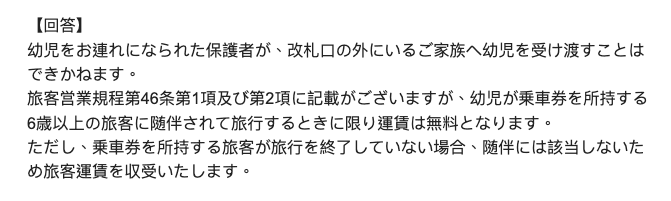
Tokyo Metro cited Passenger Business Regulations Article 46, Paragraphs 1 and 2, and stated clearly that the handover cannot happen without the parent exiting the gate.
Under Tokyo Metro's rules, a child travels free only when accompanied by a fare-paying passenger completing the same journey — if the accompanying passenger remains inside the paid zone while the child crosses to the unpaid zone, the child is no longer considered "accompanied" and a fare applies. You may agree or disagree with that rule. But Tokyo Metro told us what it is, and where it is written.
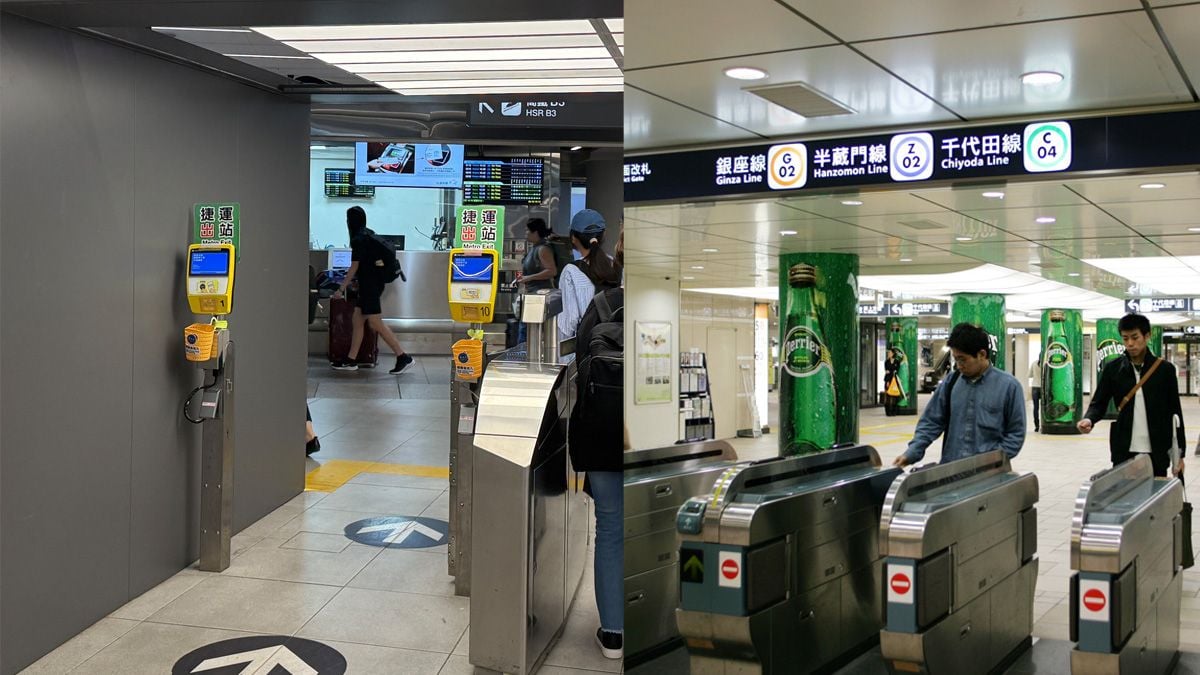
Taipei Metro stated equally clearly that if a passenger is not exiting the station and simply needs to hand a child over at the gate, station staff will open the service gate to facilitate the handover, and the passenger can continue their journey.
Normal tap-in/tap-out procedures apply only if the passenger actually needs to exit. TRTC confirmed that the service gate opening for this purpose is a standard, acknowledged accommodation — not an informal staff favour subject to withdrawal at individual discretion.
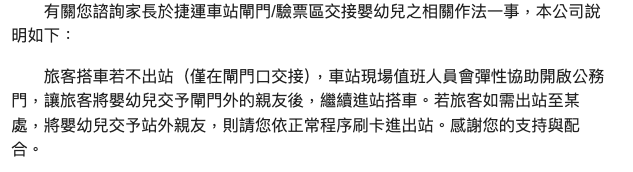
Two metros. Two different answers. Both clear, both on record, both citing either specific regulation or standard procedure.
Singapore's position remains, as of publication: unspecified.
LTA's June 12 Facebook statement described staff applying rules "with kindness," noted the existence of a free child concession card, and mentioned that Chow had declined a private meeting with SMRT.
What it did not contain, at any point, was confirmation of what the rule actually is. The statement managed to discuss the incident at length — including implying that staff behaviour had been appropriate — without once stating whether the behaviour in question (opening the gate without tapping) is permitted under SMRT's own regulations or not.
This matters beyond the specific incident. Tokyo Metro's answer, whatever one thinks of it, gives commuters and staff alike something to rely on: a named regulation, a clear outcome. Taipei Metro's answer does the same from the other direction: a clear yes, a defined procedure, a named mechanism (the service gate), and an explicit statement that it is standard rather than discretionary. In both cases, a parent travelling through those systems on a Saturday morning knows what to expect before they arrive. They are not dependent on which staff member happens to be on duty, what mood they're in, or whether someone filed an unverifiable complaint the week before.
Singapore's current arrangement — in which the answer is apparently "staff will use kindness and discretion," with no underlying rule either permitting or prohibiting the practice — places the entire burden of unpredictability on the commuter and the staff member simultaneously.
The commuter cannot know what to expect. The staff member cannot know what they're authorised to do. And when something goes wrong, as it did on 14 March, neither party has anything to point to — which is precisely why one station manager's decision to finally enforce an unwritten rule became a "showdown" with a screaming toddler, rather than a straightforward application of a stated policy.
We will update this report if SMRT or LTA provides a substantive response to the specific question asked.
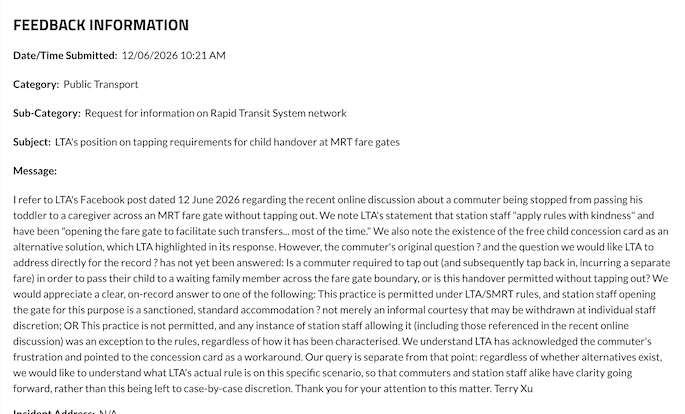
Update, 29 June 2026:
Following publication of this piece, The Online Citizen received a response from an LTA spokesperson regarding our query on whether the passing of a child at MRT fare gates is permitted or not.
The spokesperson's initial message pointed to the child concession card as "a solution for parents travelling with children to aid in such situations."
In a Facebook post published earlier on 12 June 2026, LTA spoke on the existence of MRT regulations.
"There are rules and regulations on the MRT for reasons such as safety, security, passenger comfort, fairness, etc. Our public transport workers apply these rules judiciously and with compassion."
LTA said frontline transport staff routinely exercise discretion when applying such rules.
It cited examples including situations where children, elderly passengers or commuters with medical conditions may need to drink water despite restrictions on eating and drinking aboard trains.
"Similarly, our public transport workers have been assisting families by applying the rules with kindness most of the time and opening the fare gate to facilitate such transfers."