Wong positions Singapore as AI application hub as global order fractures
Singapore Prime Minister Lawrence Wong says Singapore should become an artificial intelligence application hub, not a frontier model developer, as he outlines three strategic adjustments to navigate a fracturing global order and warns that Middle East disruption has yet to fully filter through to prices.
- Singapore's Q1 2026 GDP grew 6 per cent year on year, surpassing the government's initial 4.6 per cent estimate.
- Wong positions Singapore as an AI application hub, not a frontier model developer, citing labour shortages as the core driver.
- Full inflationary impact of the Middle East conflict has yet to filter through to electricity, food and fertiliser prices.

Prime Minister Lawrence Wong has said Singapore's competitive advantage in artificial intelligence lies not in developing the world's largest frontier models but in becoming a hub where AI applications can be tested, refined and scaled in real-life conditions.
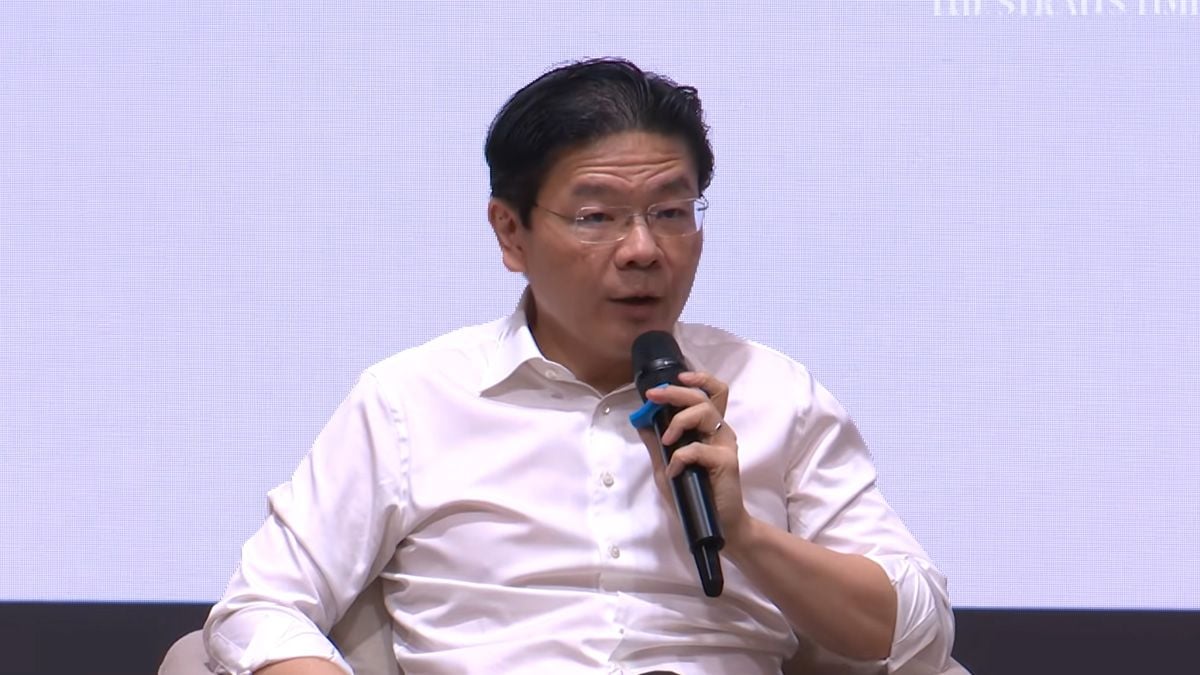
Wong made the remarks on 8 June 2026 at a dialogue organised by the Singapore Press Club, held at the SPH Media auditorium in Toa Payoh. The session, part of the club's Eminent Speaker Series, was moderated by The Straits Times associate editor Zakir Hussain.
His comments came as Singapore reported first-quarter GDP growth of 6 per cent year on year, beating the government's initial estimate of 4.6 per cent — a result Wong said reflected the diversity of Singapore's economic engines but was not grounds for complacency.
Three strategic adjustments
Speaking without a prepared text, Wong outlined three broad areas in which Singapore is making strategic adjustments: sharpening its value proposition to the world, stepping up support for households and workers, and building greater resilience.
On value proposition, he pointed to semiconductors as a model. Singapore currently supplies ten per cent of global chip output and twenty per cent of chip equipment production — an ecosystem built through sustained investment in research and development, talent and infrastructure.
He said Singapore would need to replicate that model in other sectors, developing hard-to-replicate advantages in existing industries such as finance, advanced manufacturing and logistics, as well as in key growth areas including AI and quantum computing.
"Given our size and scale, we of course cannot do everything, but we have to be exceptional in the few things we do that matter to the world," he said.
On resilience, Wong cited Singapore's energy infrastructure as an example of strategic foresight paying off during the current Middle East crisis. Decades-old decisions — including building Jurong Island as an energy and petrochemicals hub and constructing underground oil storage at Jurong Rock Caverns — had allowed companies to quickly source alternative supplies when Persian Gulf flows were disrupted.
He said the next phase would focus on clean energy security, and confirmed that Singapore would embark on an independent International Atomic Energy Agency (IAEA) review of its feasibility to deploy civilian nuclear power, beginning next year.
AI as application hub, not model developer
On artificial intelligence, Wong was direct about where Singapore's advantage lay.
"Our value proposition and the way for us to succeed and do well in AI is not so much to be able to develop the biggest and best frontier models. That's not our competitive advantage," he said.
"But as a small city, to be an AI application hub where AI models and applications can be tested, applied in real-life use cases, and then scaled up further — that's where we can contribute."
He cited logistics as one concrete example, arguing that AI could dramatically enhance throughput at Singapore's airport and seaports as operations are automated further.
"We will still need the manpower, but we can really enhance our throughput. It's not about cutting back jobs," he said.
Wong chairs the National AI Council (NAIC), formed in February 2026, which has begun examining applications in advanced manufacturing, healthcare and finance.
He cautioned, however, against superficial adoption. Running AI chatbots alone would not constitute meaningful transformation.
"The key is really to embed AI and start thinking about how it transforms processes across all organisations. And that will take time," he said.
He drew a parallel with previous technological revolutions — electricity and the internet — noting that the initial excitement invariably precedes the harder work of building new business models.
"Along the way there will be hype, there will be some companies that fail, and then there will be successes," he said. "We are going through that in the AI revolution now."
Uncertainty over jobs remains genuine
Despite his optimism about AI's productive potential, Wong acknowledged that its net impact on employment remained genuinely unknowable.
He invoked the economist John Maynard Keynes, who in 1930 predicted that technological progress would eventually leave his grandchildren working fifteen-hour weeks.
"How many of you are working fifteen hours a week?" Wong said, drawing laughter from the audience.
His point was that humanity consistently underestimates its own capacity to create new value and new roles in response to disruption.
"I really don't know what will happen in the future with AI and jobs. No one knows," he said. "But what we do know is that there will be disruption."
Singapore's response, he said, was to focus on helping companies deploy AI in ways that complement rather than displace workers, drawing on the country's tripartite partnership between government, employers and unions.
"We are not passive bystanders. We have agency," he said.
On global AI governance, Wong described agreement between the United States and China as "a tall order" in the near term, while noting that AI safety had featured in the recent summit between US President Donald Trump and Chinese President Xi Jinping — a signal he said should be encouraged.
Middle East risks not yet priced in
Wong said the government continues to expect inflationary pressures to rise, and that current electricity tariffs do not yet reflect the full increase in oil prices stemming from the Middle East conflict, which began in February 2026.
The Strait of Hormuz closure, he noted, accounts for twenty per cent of global oil supply — yet the global economy had not suffered a commensurate loss, due to rerouting through the Red Sea, alternative supplies from other exporters, and the drawing-down of inventories.
"These buffers have helped to cushion the impact up to now," he said. "But how long will the disruption last, and how long will these buffers last? That's an open question."
If the closure continued and inventories began to dwindle, the downstream effects on growth, demand and prices would become more severe, he warned. Rising costs in food and fertilisers had also not yet been fully accounted for.
A new global order
Wong described the current moment as "perhaps the most important transition to the global order since the end of the Cold War" — one he said would be marked by more distributed centres of power, more willingness by states to use force, and intensifying competition across trade, technology and supply chains.
The US remains the dominant power for the foreseeable future, he said, while China has risen to become its peer competitor, and India is rising rapidly. Middle powers, including ASEAN as a collective, are becoming more consequential.
On US-China relations, Wong said the recent Trump-Xi summit was a positive development, with both leaders acknowledging the need for what he described as "constructive strategic stability." He framed the dynamic using a modified Cold War analogy.
"Perhaps now there is a similar dynamic happening — a different type of MAD, mutually assured disruption. Because any attempt by one side to impose restrictions on another will trigger a response, and in the end, both parties will be worse off," he said.
Wong said Singapore does not want to see Asia divided into competing spheres of influence, and cited ASEAN's Indo-Pacific outlook as the region's collective expression of that preference — an open, inclusive architecture engaging all major players rather than aligning exclusively with any one.
North Korea engagement
Asked about Singapore's Foreign Minister Vivian Balakrishnan's recent visit to North Korea, Wong said it arose from a standing invitation linked to a bilateral anniversary milestone.
Singapore's approach, he said, was simple: "We want to be friends with everyone. We don't need to have enemies."
He noted that North Korea views Singapore as a trusted interlocutor — one reason, he said, the DPRK agreed to host the 2018 Trump-Kim summit here.
"We have a position, we articulate our national interests, but we continue to be friends with as many countries as possible. It's always better to have more friends than fewer — for individuals and for countries alike."
Cohesion as the core asset
Running through Wong's remarks was a consistent argument: that Singapore's most durable strategic asset is not its quarterly growth rate but its social cohesion.
"Our greatest strength remains the same — and that's our ability to stay united and move forward together as one people," he said. "The world may become more fractured, but Singapore must become more cohesive."
When asked about jobs going to non-residents and what this means for the government's record, Wong urged against reading too much into quarterly labour data.
"Look across the entire society and see, at the end of the day, whether or not Singaporeans are indeed having a better life," he said.
He closed with a broader defence of Singapore's democratic model.
"In our system of democracy, we have a strong and decisive government, but it is always held to account. We, at the end of the day, show Singaporeans what we have achieved, and Singaporeans decide which government they want to serve them. That's how Singapore works, and that's how Singapore has continued to succeed all these years."