Harvard PhD graduate Joel Tan urges peers to 'open doors' for future scientists
Dr Joel Tan, a Harvard PhD graduate originally from Singapore, used his student address at a hooding ceremony to trace his path into science and call on fellow graduates to widen access for others.
- Tan said Singapore schooling told him studying biology was not realistic for him.
- He credited mentors and community, including support during Harvard's international student crisis.
- Tan urged graduates to become mentors and "open doors" for others in science.

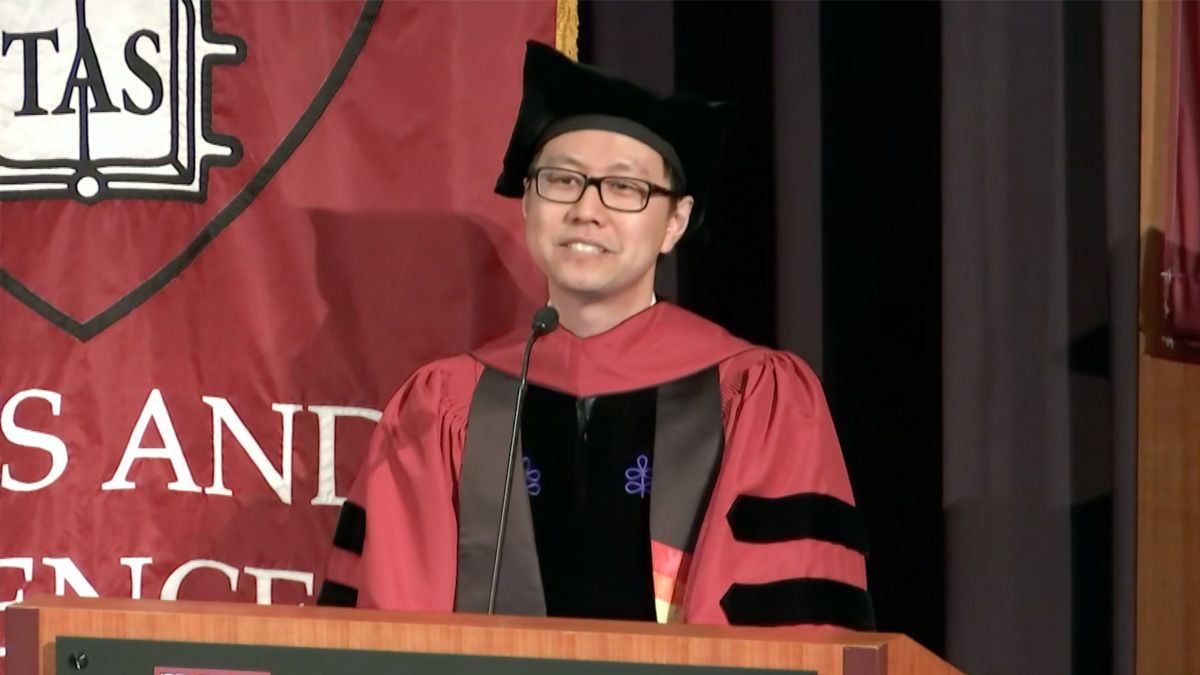
Dr Joel Tan, who is graduating with a PhD in Biological and Biomedical Sciences from Harvard, delivered the student address at the HMS-Affiliated PhD Programs Hooding Ceremony on 28 May 2026.
In his speech, Tan traced his path from Singapore to Harvard, framing his story around the idea that "talent is everywhere, opportunity is not".
Early setbacks in Singapore
Tan said that as a teenager in Singapore, he wanted to study biology but was repeatedly told it was not a realistic path for him.
He said his middle school grades were considered too low for biology classes, so he was placed into physics and chemistry instead, subjects he described as no easier despite that reputation.
Tan said his academic performance suffered because he was never given the chance to study the subject he was actually interested in, and he left high school with grades of C and D.
He recalled failing twice to gain admission to a university in Singapore, before deciding, on his third attempt, to leave the country to look for opportunities overseas.
Tan said the University of Toronto then "took a chance" on him, giving him his first biology class, access to mentors and laboratories, and a community in which to discover what science was.
He reflected that much of his life had depended on someone deciding that his past performance "did not have to define" his future potential, adding that "someone opened a door that had been closed to me".
From Toronto to Harvard
Tan went on to Harvard for the Biological and Biomedical Sciences (BBS) programme, joining the laboratory of Professor Philip Cranston.
His research led to the discovery of a new anti-phage defence system in bacteria, which he named "Hai Long", after a Chinese ocean dragon associated with protection.
After graduation, Tan said he will continue as a postdoctoral researcher, using computational biology and machine learning to study protein structure prediction and design, with applications to neurodegeneration.
Beyond his research, Tan said he was involved in Harvard's rotation club and data club, and served as a peer mentor supporting other graduate students through the challenges of graduate school.
The shared experience of graduate school
Tan spoke at length about graduate school as a collective experience rather than an individual one, recalling "G1 classes", rotations he likened to "an awkward three-month-long hinge date", and preliminary qualifying exams (PQEs) that turned a research proposal into "a full-body stress response".
He also recalled late-night messages, committee meetings, conference posters and fellowship deadlines, alongside what he called the moments that made it worthwhile: the first clean result, the first time a hypothesis made sense, and the first time graduates realised "we had become scientists".
Tan said that transformation did not happen in isolation, describing science as "a community project" built by lab mates, mentors, friends, families and partners.
The international student enrolment crisis
Tan said that almost a year before the ceremony, he was still on a flight when Harvard lost its ability to enrol international students.
He said he landed in Boston to more than 100 messages from friends, lab mates and his advisor, all asking if he was alright and how they could help.
Tan described what followed as "truly inspiring", with administrators fielding back-to-back video calls with affected students, and faculty, staff and peers reassuring international students that they belonged at Harvard.
He said that "at no point at all" did international students feel they were facing the situation alone, describing the experience as evidence that science depends on people being able to move between countries to learn from one another.
Tan added that international students had to contend not only with the uncertainty of their research, but with whether "the systems" would allow them to stay, work and contribute.
A call to open doors for others
Tan told graduates that research depends on the "collision of ideas, of method, of history, and of people", and that this was especially true in fields such as cancer and neurodegeneration, which he said "do not respect borders".
He argued that for science to meet its responsibilities, "access matters, inclusion matters, and community matters", and that the people doing science must reflect the world if science is to serve it.
Tan said the cohort needed students from small towns and big cities, from public and private schools, and from Singapore and elsewhere, including those who "needed that third chance".
He urged his fellow graduates to become mentors and to build labs, institutions and classrooms in which people from many backgrounds could thrive.
Tan closed by saying that while the graduates were celebrating, "tomorrow we go back to work" — not only the work of science, but the work of building a society in which talented people from everywhere can solve problems that belong to everyone.
The Hooding Ceremony marked the conclusion of doctoral studies for 168 students across nine HMS-based PhD programmes, six of which are jointly administered by the HMS Office for Graduate Education.