Indonesian student groups plan new Jakarta protest after HI Roundabout standoff
Indonesian student organisations are preparing a new demonstration in central Jakarta after authorities blocked protesters from reaching the HI Roundabout, fuelling criticism over assembly restrictions and military involvement in civilian affairs.
- Student groups are planning a larger follow-up protest in central Jakarta.
- Police and organisers continue to dispute the handling of the 12 June demonstration.
- Military involvement in protest security remains a major source of criticism.

Student groups in Indonesia are preparing for a new demonstration in central Jakarta after hundreds of protesters were prevented from reaching the Hotel Indonesia (HI) Roundabout during a rally last week, prompting criticism of police restrictions and the deployment of military personnel.
The follow-up protest is expected to take place after organisers from the University of Indonesia Student Executive Council (BEM UI) vowed to continue their Towards Indonesia's Bankruptcy (Menuju Indonesia Bangkrut) campaign.
BEM UI chair Yatalathof Ma'shum Imawan, known as Athof, said the new demonstration would fulfil a commitment made at the conclusion of the previous protest on 12 June.
According to organisers, additional universities and student organisations are being invited to join the action in an effort to mobilise a larger crowd than the one that participated in last week's demonstration.
The planned rally comes amid an unresolved dispute between student groups and security authorities over access to the HI Roundabout, one of Jakarta's most prominent public spaces.
Previous protest blocked from reaching HI Roundabout
Hundreds of student protesters from universities and student organisations across Indonesia were prevented from reaching Jakarta's Hotel Indonesia (HI) Roundabout during a demonstration on 12 June, prompting confrontations with security personnel and renewed debate over restrictions on public assemblies in the capital.
The protest was originally scheduled to take place at the HI Roundabout in Central Jakarta. However, demonstrators travelling towards the location were stopped by police barricades in the Semanggi area of South Jakarta and later near Jalan Jenderal Sudirman.
“We wanted to go to HI, but we were blocked in Semanggi,” said Divar Akbar, a member of the National Student Front (FMN).
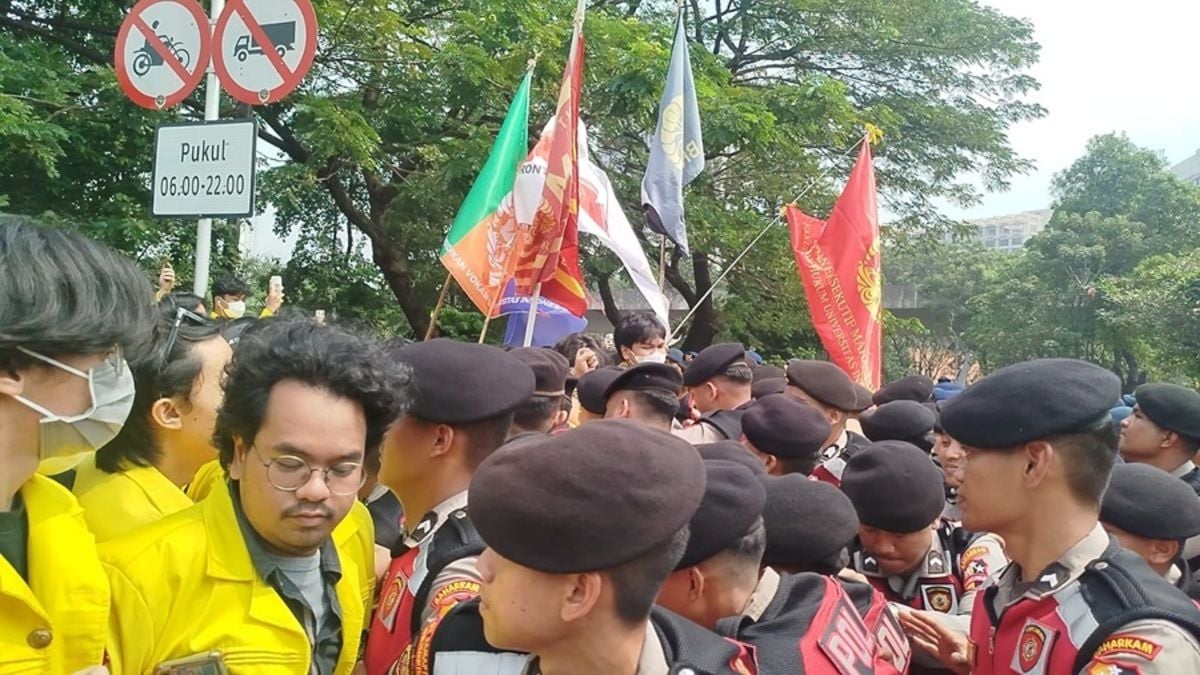
According to participants, students attempted to push through police lines after being prevented from continuing towards the designated gathering point. Several vehicles carrying demonstrators were also reportedly stopped, forcing many students to continue their journey on foot.
When protesters reached the area near BCA Tower on Jalan Jenderal Sudirman, they encountered another security cordon that blocked access to the HI Roundabout.
Dozens of military personnel were seen standing behind police lines. Negotiations later took place between student representatives and security officials, but demonstrators were ultimately not allowed to continue to the landmark traffic circle.
Police defend restrictions
The Jakarta Metropolitan Police said the demonstration had been redirected away from the HI Roundabout because of concerns over public activity and traffic disruption in one of the city's busiest commercial districts.
Senior Commissioner Budi Hermanto, Head of Public Relations at the Jakarta Metropolitan Police, said authorities had communicated with organisers to relocate the protest either to the Arjuna Wijaya Horse Statue area or to the grounds in front of Indonesia's House of Representatives (DPR) and People's Consultative Assembly (MPR) complex.
“We have also communicated through the Intelligence Directorate to redirect the gathering point from the HI Roundabout to either the Horse Statue area or in front of the DPR/MPR complex,” Budi said during a security briefing.
Police later stated that the restriction was based on Jakarta Gubernatorial Decree No. 232 of 2015, arguing that the HI Roundabout serves as a major centre for business activity and public transportation.
According to Budi, a large-scale demonstration at the location could significantly affect traffic conditions in Central Jakarta.
Jakarta administration denies protest ban
Following the incident, Jakarta Governor spokesperson Cyril Raoul Hakim, commonly known as Chico Hakim, rejected suggestions that the Jakarta Provincial Government had prohibited demonstrations at the HI Roundabout.
“The Jakarta Provincial Government fully supports the public's right to voice their opinions,” Chico said on 13 June.
His statement came after reports that students had been prevented from gathering at the landmark location by a joint deployment of police and military personnel.
While denying the existence of a ban, authorities continued to defend restrictions imposed on the specific protest location, citing public order and traffic management considerations.
Military presence becomes focal point of criticism
The presence of personnel from the Indonesian National Armed Forces (TNI) alongside police officers attracted particular attention among demonstrators.
Several students questioned why soldiers had been deployed to secure a civilian protest, arguing that demonstrations are typically monitored by police.
One participant, identified as Gifar, said he was surprised by the number of military personnel present.
“Usually when I take part in demonstrations, it's only the police. Here there are so many military personnel — it even seems as though there are more soldiers than police officers,” he said.
Another protester, Dugi, described the deployment as intimidating.
“I see it as intimidation. It feels as though we are being warned that today it is not only the police but also the military that has been deployed directly,” he said.
Students repeatedly criticised what they described as increasing militarisation of civilian affairs, one of the key issues highlighted in their protest demands.
Social media debate intensifies
Footage from the demonstration circulated widely on social media after being shared by WatchDoc, an Indonesian documentary media platform. The video showed students attempting to reach the HI Roundabout while police and military personnel stood behind security barricades blocking access to the area.
View this post on Instagram
The footage generated extensive public discussion online.
One widely shared comment stated, “Instead of confronting foreign interests, they confront their own people.”

Another commenter wrote, “Facing debt collectors is difficult, but facing ordinary citizens is easy.”

Others questioned the military's role in the operation, including one user who asked, “Is the TNI now fighting civilians?” and another who commented, “Why are soldiers dealing with student demonstrators? I thought they were busy handling the food security programme.”

The comments reflected concerns similar to those expressed by demonstrators at the protest site regarding the deployment of military personnel during a civilian protest.
Protesters and police disagree over procedures
A separate dispute emerged over whether organisers had properly notified police of the planned demonstration.
Student leaders from the Student Executive Council of the University of Indonesia (BEM UI) rejected police claims that no official notification had been submitted.
Athof said organisers had sent a notification letter to police through WhatsApp and received an initial response.
“The right to demonstrate is protected by the Constitution,” he said, arguing that notification requirements are administrative procedures rather than conditions determining the legality of a demonstration.
Athof also criticised the authorities' decision to redirect demonstrators away from the HI Roundabout.
Police, however, said they had only received a PDF copy of a notification letter and had not received the formal submission required under Indonesian law.
Central Jakarta Metro Police Chief Senior Commissioner Reynold E.P. Hutagalung said Law No. 9 of 1998 requires organisers to personally deliver notification documents to police no later than 72 hours before a public demonstration.
“According to the regulations, the individual in charge of the activity is obligated to directly deliver the notification letter to the police. Right up until the demonstration took place, we never received an official notification letter,” Reynold said.
Five demands at centre of campaign
The alliance behind the protest includes BEM UI, 15 faculty-level student executive bodies at the University of Indonesia, BEM KM IPB, BEM PNJ, BEM Pancasila University, the BEM Gunadarma Alliance, FMN Pusat, FMN UI, Pembebasan and Semar UI.
The coalition has outlined five principal demands:
- An end to what it describes as misuse and waste of state budget funds.
- Reductions in the prices of basic necessities and fuel.
- Cancellation of the government's Free Nutritious Meals (Makan Bergizi Gratis or MBG) programme.
- Cancellation of the planned expansion of the Red and White Village Cooperative programme.
- An end to military involvement in civilian affairs.
The protesters have also called on President Prabowo Subianto to acknowledge what they describe as government failures and respond to public concerns over economic conditions.
During speeches delivered after the demonstration was relocated, organisers argued that official economic growth figures did not reflect the realities faced by many Indonesians.
“Rice prices rise. Job opportunities are scarce,” a representative of the alliance said.