HR practitioner questions hawker push as young Singaporeans face mounting business and employment pressures
An HR practitioner has questioned whether efforts to encourage young Singaporeans into hawking addressed the sector’s deeper structural challenges, warning that financial pressures, business closures and limited graduate employment opportunities could threaten both livelihoods and hawker culture.

- Martin Gabriel questioned whether structural problems in hawking were addressed before recruiting younger entrants.
- Commenters linked hawker challenges to graduate employment concerns and broader economic pressures.
- Several contributors called for policy reforms to improve hawker sustainability and business viability.

SINGAPORE: An HR practitioner has questioned whether efforts to attract younger Singaporeans into hawking have adequately addressed the underlying economic challenges facing the industry, arguing that preserving hawker culture requires more than simply encouraging new entrants into the trade.
In a Facebook post published on 11 June 2026, Martin Gabriel reflected on a 2019 initiative in which Minister for Sustainability and the Environment Grace Fu encouraged more young Singaporeans to consider careers as hawkers as part of efforts to preserve the nation’s hawker heritage.
According to Gabriel, the objective at the time was understandable.
Many veteran hawkers were approaching retirement, and there were concerns that Singapore’s distinctive hawker culture could gradually disappear without a new generation stepping forward.
However, Gabriel said developments in recent years have led him to question whether the root causes behind the decline in hawker numbers were sufficiently addressed.
Examining the causes of hawker exits
Gabriel argued that the departure of older hawkers may not have been solely due to retirement age.
“Were older hawkers retiring simply because they had reached retirement age? Or were many of them leaving because the economics of the trade had become increasingly unsustainable?” he wrote.
He pointed to rising rental costs, increasing operating expenses, manpower shortages and the physically demanding nature of hawker work as factors that may have contributed to veteran hawkers leaving the industry.
“If those were the underlying reasons, then encouraging young people to enter the trade without first addressing these structural challenges may not have solved the problem,” Gabriel said.
“Instead, it may have transferred the same struggles to a new generation.”
The comments highlighted broader concerns about whether attracting younger hawkers alone is sufficient to secure the future of Singapore’s hawker ecosystem.
Questions over graduate employment
Beyond the hawker sector itself, Gabriel suggested that the initiative may also have intersected with wider labour market concerns.
“I also wonder whether the hawker initiative served another purpose — providing an alternative career path at a time when there were concerns about the availability of quality white-collar jobs for graduates and young Singaporeans,” he wrote.
He questioned whether sufficient measures had been implemented to ensure that younger hawkers could build sustainable and rewarding careers after entering the trade.
Gabriel argued that many younger operators had committed significant financial resources, time and personal effort to establishing their businesses.
Yet some now face shrinking profit margins, uncertain customer traffic and a challenging operating environment.
“The concern is no longer just about preserving hawker culture. It is also about protecting livelihoods,” he wrote.
He warned that if more stalls continue to close and increasing numbers of younger hawkers leave the industry, Singapore could face wider issues involving underemployment and lost entrepreneurial investment.
Gabriel further argued that graduate employment challenges may have influenced policy thinking.
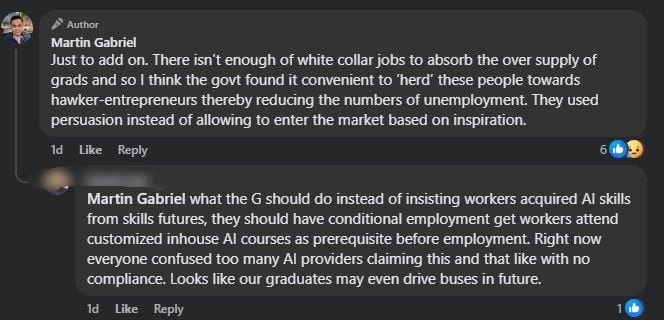
“There isn’t enough of white collar jobs to absorb the over supply of grads and so I think the govt found it convenient to ‘herd’ these people towards hawker-entrepreneurs thereby reducing the numbers of unemployment,” he wrote.
“They used persuasion instead of allowing to enter the market based on inspiration.”
Rental pressures and market access among key hawker concerns
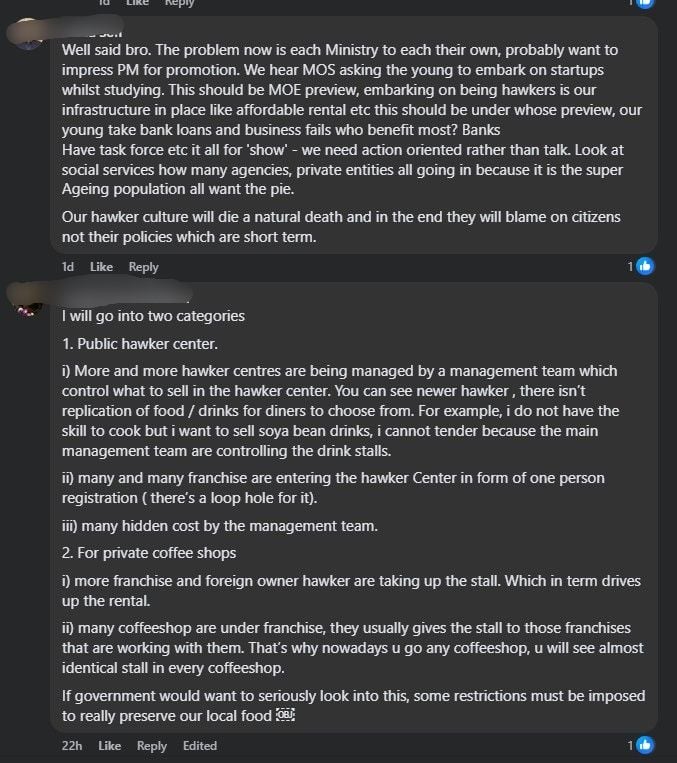
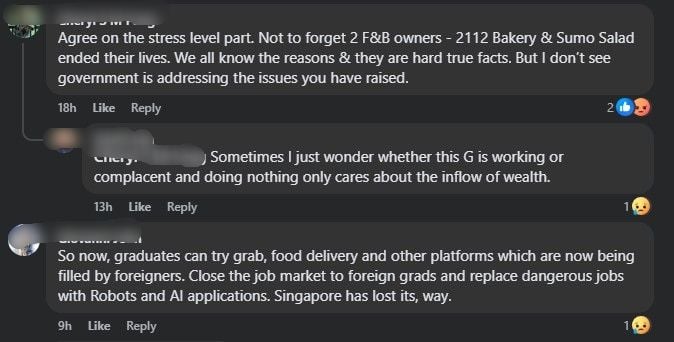
The post sparked broader discussion, with some comments on Gabriel's FB page linking challenges in the hawker sector to wider concerns about employment, entrepreneurship and economic policy.
Several contributors argued that workers seeking to acquire artificial intelligence-related skills face a fragmented training landscape, with numerous providers offering programmes of varying quality and relevance.
Some suggested that employers should play a larger role by providing structured, job-linked AI training tailored to workplace requirements, rather than expecting individuals to navigate the market independently.
Others questioned whether young Singaporeans are being encouraged into entrepreneurship, including hawking, without sufficient supporting infrastructure.
Concerns were raised over issues such as affordable rentals, access to financing and the long-term sustainability of small businesses. Some commenters argued that policy initiatives should place greater emphasis on practical implementation and measurable outcomes.
Discussion also focused on the structure of hawker centres and coffee shops.
Commenters pointed to concerns over rising operating costs, franchise expansion, rental pressures and barriers faced by independent operators seeking to enter the industry.
Some called for stronger measures to preserve opportunities for local hawkers and maintain the diversity of Singapore’s food culture.
Calls grow for action on hawker costs as Grace Fu says food price pressures are being monitored
Earlier on 6 June, Minister for Sustainability and the Environment Grace Fu said the Government is closely monitoring cost pressures affecting food prices and hawkers, while stressing that supporting hawkers' livelihoods remained a priority.
Speaking during a community visit to Sembawang GRC, she said authorities had been engaging hawkers and food distributors to better understand industry challenges. While wholesale food prices had remained relatively stable, rising logistics costs continued to place pressure on businesses, and the Government stood ready to provide assistance if necessary.
Her remarks came amid broader concerns over global energy market volatility following conflict involving Iran, the United States and Israel, which has heightened uncertainty over fuel, transportation and supply chain costs.
However, online reactions indicated that many people wanted more immediate action rather than continued monitoring, arguing that hawkers and consumers are already facing significant financial strain.
Rising rental costs, subletting practices and higher operating expenses were widely cited as key reasons for increasing food prices, beyond ingredient costs alone.
Commenters called for stronger government intervention, including tighter regulation of hawker centre rents, measures to reduce business costs and broader reforms to keep hawker food affordable.
Hawker concerns remain in focus
Fu’s remarks come amid continuing concerns over the sustainability of Singapore’s hawker trade.
Many hawkers have cited rising operating expenses, manpower shortages and rental costs as key challenges affecting the viability of their businesses.
The issue has attracted growing public attention as policymakers and industry stakeholders seek ways to preserve Singapore’s hawker culture while ensuring businesses remain financially sustainable.
In May, Prime Minister Lawrence Wong highlighted the importance of preserving the nation’s hawker culture during a visit to veteran hawker Roger Wong Hien Lai at Marsiling Lane Food Centre.
During the visit, Wong acknowledged the long hours and commitment required of hawkers and encouraged Singaporeans to continue supporting local food businesses to ensure the culture endures for future generations.
Calls for longer-term solutions
Despite public recognition of hawkers' contributions, some industry observers have argued that more structural reforms are needed.
Hawker advocate KF Seetoh welcomed efforts to highlight the role of hawkers in Singapore society but said policy measures should go beyond symbolic support.
He argued that issues such as rental frameworks, operating costs and management practices require closer attention to strengthen the long-term sustainability of the sector.
Seetoh described Singapore’s hawker culture as a national heritage facing increasing pressures and said addressing structural challenges would be important to securing its future.