Executive Yuan approves NT$210 billion special bill to procure domestic drones over six years
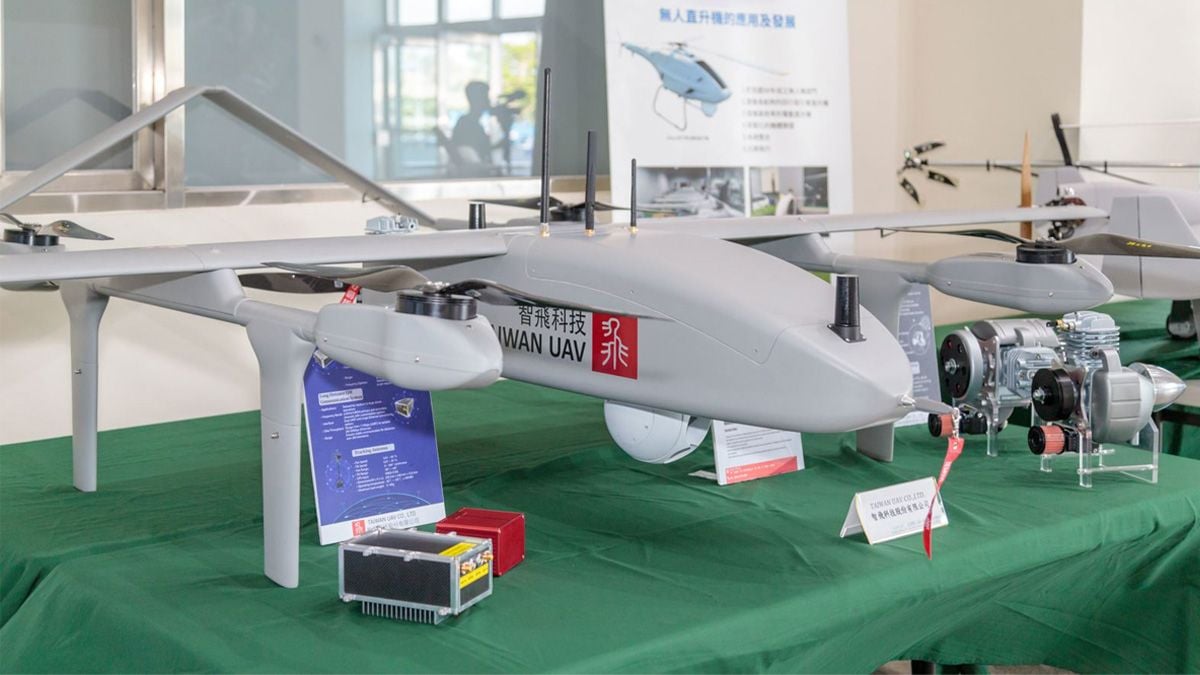
Taiwan's Cabinet has approved a NT$210 billion (US$6.65 billion) special budget bill to procure more than 210,000 domestically produced drones and uncrewed vessels through 2031, restoring funding the legislature stripped from an earlier defence package.
- Cabinet approves NT$210 billion special budget for domestic uncrewed systems running August 2026 to end-2031.
- Package covers 1,446 reconnaissance drones, 208,200 attack drones and 1,320 suicide uncrewed vessels.
- Bill restores funding the legislature removed from an earlier NT$1.25 trillion defence package.

Taiwan's Executive Yuan yesterday, 18 June 2026, approved a draft special bill to procure domestically produced uncrewed systems, with funding capped at NT$210 billion (US$6.65 billion) over a six-year period.
The draft Special Act on the Procurement of Indigenous Defence Uncrewed Vehicles would run from 1 August 2026 until 31 December 2031, providing for the year-by-year acquisition of coastal reconnaissance and attack drones as well as small suicide uncrewed surface vessels.
The bill, which now proceeds to the Legislative Yuan for review, uses a special budget mechanism under Article 83 of the Budget Act to bypass normal budget planning procedures and ensure timely, sustained implementation.
The package would cover the procurement of 1,446 coastal reconnaissance drones, 208,200 coastal attack drones and 1,320 small suicide uncrewed surface vessels, according to Department of Strategic Planning head Huang Wen-chi.
Premier Cho Jung-tai said the aim was to achieve the goals of local supply, autonomous production and self-sufficient maintenance for uncrewed systems. He described uncrewed vehicles as critical to a new form of asymmetric warfare.
The proposal follows the Legislative Yuan's decision last month to remove funding for domestic drone procurement from a larger defence package. In May 2026, legislators passed their version capping spending at NT$780 billion.
That version, passed by a legislative majority, excluded commercial purchases, contract production and codevelopment items, including drones, uncrewed vessels, the Taiwan Tactical Network, troop awareness kits and missile systems.
Cho said the original NT$1.25 trillion defence package had comprised three pillars he called indispensable to national security: constructing a "shield" for Taiwan, introducing a high-technology kill chain, and advancing defence self-sufficiency.
He said it was regrettable that the legislature passed only NT$780 billion and excluded the commercial and contract-production items, harming the integrity of the nation's defence capabilities.
Huang explained that the small drones and uncrewed vessels would be entirely domestically produced, acquired through open tender and multiple-award contracting. Any qualified manufacturer meeting the technical standard could participate.
The Ministry of National Defence said it hoped to draw on the features of "concentrated resources and stable scale", using long-term orders and an iterative-update principle to build up uncrewed combat capacity and forge a non-red supply chain.
On procurement volumes, Huang said the quantities matched those originally planned under the earlier asymmetric capabilities bill. The drones acquired would all be small models classified as Category Two or below.
These include four types of coastal attack drone — immersive, bomb-dropping, and short-range and long-range suicide variants. The Navy and Army have each established dedicated drone units, he said.
Huang said that beyond the special budget, from the third year onward, additional procurement would be funded through operational maintenance expenses according to consumption rates, satisfying overall combat requirements.
He added that the current special act was intended to meet the basic operational needs of these specialist units, with the same planning approach applied to the suicide uncrewed vessels.
On the exclusion of counter-uncrewed systems from the special act, Huang said the earlier NT$1.25 trillion draft had divided their acquisition into two parts. Counter-systems for large uncrewed vehicles, a mixed soft-and-hard-kill system, would still proceed through planned arms procurement cases.
He said the second part, several hundred portable uncrewed jamming systems, was closely linked to the small uncrewed systems being acquired under the special act. Drawing on the Russia-Ukraine war, he said Ukraine's rapid progress came from combining counter-uncrewed and uncrewed systems and iterating through experience.
For that reason, Huang said, the portable counter-uncrewed systems would be funded through a supplementary budget or included in the ministry's annual budget for 2027.
Cho also pointed to economic benefits beyond defence, noting that the uncrewed-vehicle industry spanned vehicle manufacturing, battery systems, optoelectronic sensors, artificial intelligence, communications equipment, software development and maintenance.
He said this would drive the uncrewed-vehicle supply chain, stimulate domestic economic growth and establish an emerging strategic industry, creating what he described as a win-win outcome for both defence and civilian life.
Su Tzu-yun, director of the Defence Strategy and Resources Division at the Institute for National Defence and Security Research, said the Cabinet's proposal aligned with the constitutional spirit and respected the Legislative Yuan's resolutions while reflecting the government's responsibility to safeguard national interests.
Su described the military's proposal as highly urgent and necessary. He said uncrewed capabilities and computing power could help offset troop shortages and enhance deterrence against potential aggression from China.
He added that advancing the proposal would facilitate direct engagement with the US Congress and aligned with the US Blue Skies for Taiwan Act, which authorises Taiwan-US cooperation on uncrewed systems technology and procurement.