'MBG is a political project': Indonesian women march with pots and pans on Presidential Palace over food prices and jobs
Hundreds of women demonstrators marched towards Indonesia's Presidential Palace on Thursday, beating kitchen utensils and defying police cordons, as the Indonesian Women's Alliance demanded lower commodity prices, expanded employment, and the scrapping of President Prabowo Subianto's flagship Free Nutritious Meals programme.
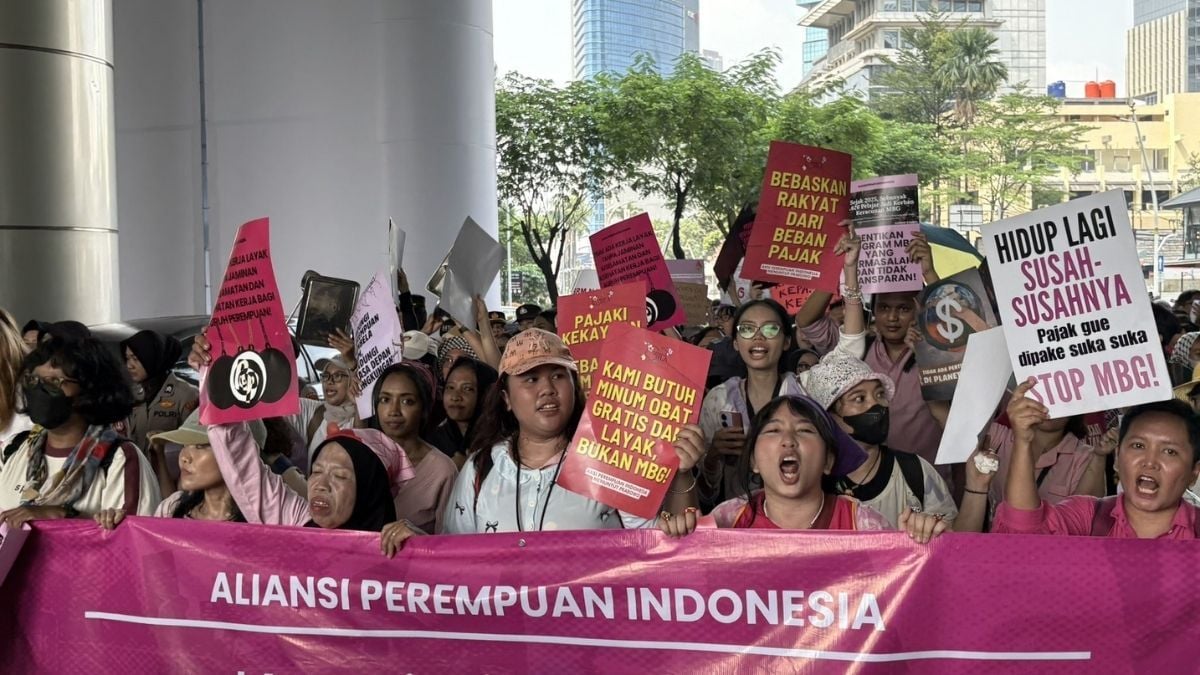
- Hundreds of women marched to demand lower prices, more employment opportunities and an end to the MBG programme.
- Protesters briefly broke through police cordons after rejecting a police-ordered diversion from their planned route.
- Organisers argued women are bearing the brunt of rising living costs, unemployment and economic insecurity.

Hundreds of women activists, workers, and civil society members rallied in Central Jakarta on Thursday, 18 June 2026, marching from Dukuh Atas towards the Presidential Palace to press the government over rising living costs, limited employment, and the controversial Free Nutritious Meals (MBG) programme championed by President Prabowo Subianto.
The demonstration, organised by the Indonesian Women's Alliance (Aliansi Perempuan Indonesia, API), drew participants dressed in pink clothing and house dresses as a symbol of solidarity. Many carried kitchen utensils — pots and frying pans — alongside banners and posters decrying soaring food prices and government policy.
One demonstrator, identified as Fanda, told Tempo she had taken leave from work specifically to join the march.
"I deliberately took time off because I felt the need to take these concerns to the streets," she said.
She added that the rise in the cost of living was being felt across the informal economy. "Even taking a motorcycle taxi ride feels more expensive. Drivers feel it, passengers feel it. These are issues that affect our daily lives," Fanda said.
Protesters break through police lines
The march was not without friction. API representative Afifah told reporters that demonstrators had notified police in advance of their planned route — from Jalan Jenderal Sudirman to the Hotel Indonesia (HI) Roundabout, then on to the National Monument (Monas), the Arjuna Wijaya Monument, and the State Palace.
Authorities, however, rerouted the crowd through Jalan Kota Bumi and a series of narrow residential streets before erecting a fresh cordon near the Grand Indonesia intersection.
According to Afifah, protesters refused to comply with instructions that would have diverted them away from the HI Roundabout.
"We had already passed through the small streets and were then instructed to turn left, which would have taken us away from the HI Roundabout. We refused and pushed forward to the right until we finally reached HI," she said.
Demonstrators said they intended to continue to Monas and the Presidential Palace. "We will keep marching to Monas, to the Palace, because we know the primary accountability lies with the state, with the Palace," Afifah said.
Three demands: prices, jobs, and MBG
Speaking from the HI Roundabout, Afifah outlined the alliance's three core demands. "First, lower prices. Second, create jobs. Third, stop MBG," she said.
Mutiara Ika Pratiwi, another API representative, said the protest reflected deepening frustration among women over economic pressures on households. She argued that fuel price increases had pushed up the cost of food and essential goods, disproportionately affecting low-income women and workers.
"The increase in fuel prices has pushed up the cost of living and made life harder for women, especially labourers who work long hours for low wages," Mutiara said.
She also said that middle-class households, squeezed by financial pressures, had cut back on domestic help, resulting in job losses for women employed in the sector. "Many domestic workers have lost their jobs because households are facing greater financial burdens and can no longer afford to employ them," she said.
Afifah added that young female graduates were among those most affected by unemployment. "Our young women friends cannot find work even though they hold university degrees. They are left to remain jobless," she said.
MBG: 'A political project, not a nutrition project'
The protesters reserved particular criticism for the MBG programme, one of President Prabowo's most prominent social initiatives, which provides free meals to schoolchildren nationwide.
Afifah dismissed the scheme as politically driven rather than nutritionally sound. "MBG is a political project, not a project to provide nutritious food," she told Tempo.
She questioned the credentials of the National Nutrition Agency (Badan Gizi Nasional, BGN), which oversees the programme. "We know that the BGN, from its representatives to its leadership, is not composed of nutrition experts. They come from different professional backgrounds," she said.
Afifah also cited reports of food poisoning incidents linked to the school meals rollout, saying such cases had compounded public scepticism. She argued that a change in BGN leadership would not resolve the programme's structural problems, calling instead for it to be halted entirely.
Some mothers attending the rally echoed concerns about both the implementation of the programme and the nutritional quality of meals being served to students.
As the afternoon progressed, demonstrators said they would press on towards Monas and the Presidential Palace to deliver their demands directly to the government.