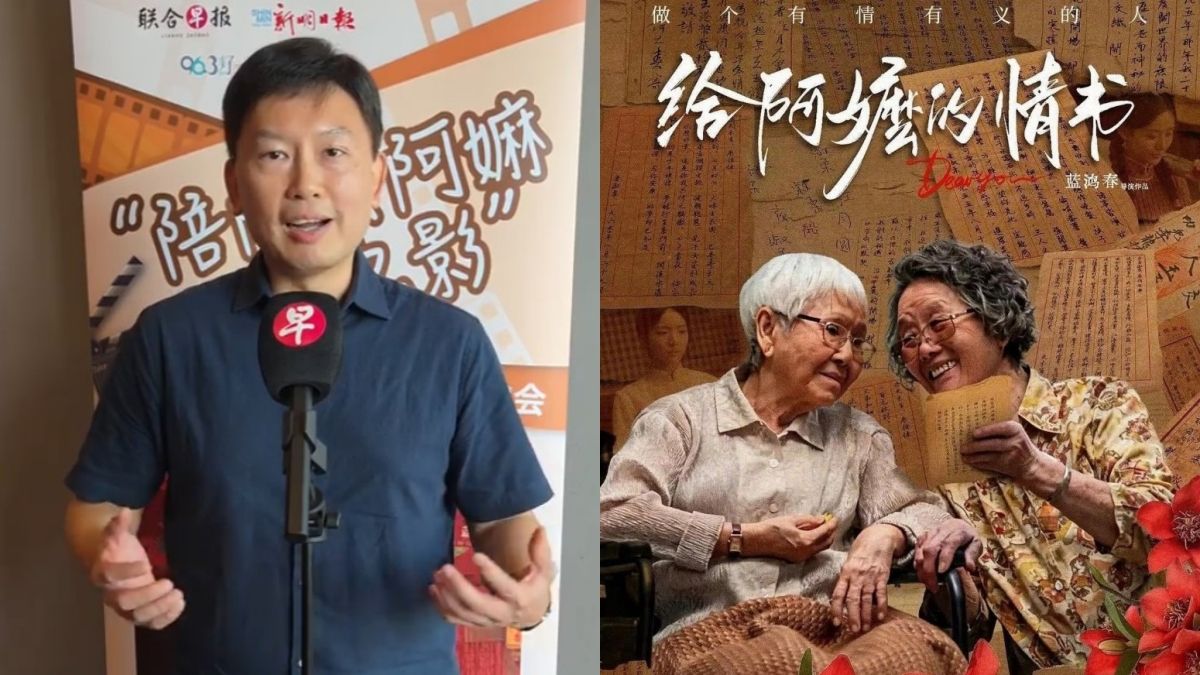
Dennis Tan renews call to preserve Chinese dialects amid controversy over Dear You Teochew film screenings
Workers’ Party MP Dennis Tan has renewed calls to preserve Chinese dialects following public reaction to the screening arrangements for Dear You, a Teochew-language film whose commercial release in Singapore will be largely in Mandarin, reigniting discussion over dialect heritage and language policy.
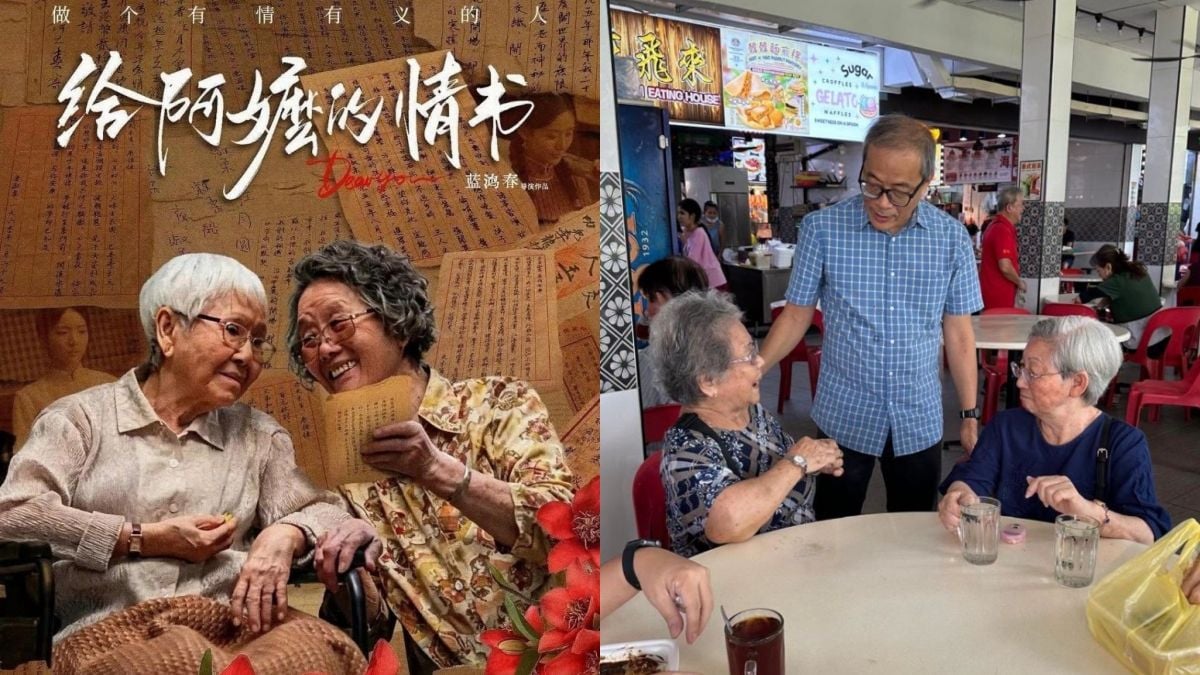
- Dennis Tan renewed calls to preserve Chinese dialects following controversy over Dear You screenings.
- Many Singaporeans urged a review of longstanding restrictions on Chinese dialect use.
- Demand for Teochew-language screenings highlighted growing interest in dialect heritage preservation.

SINGAPORE: Workers’ Party Member of Parliament Dennis Tan has renewed calls for stronger efforts to preserve Chinese dialects in Singapore, as public reaction to the screening arrangements for the Teochew-language film Dear You (给阿嬷的情书) reignites discussion about dialect heritage and cultural identity.
The controversy emerged after the Infocomm Media Development Authority (IMDA) confirmed that the film's Mandarin-dubbed version would receive a commercial cinema release, while the original Teochew version would be limited to its premiere and subsequent festival or niche screenings.
The decision prompted widespread discussion among Singaporeans, many of whom argued that the issue extends beyond a single film and reflects broader concerns about the future of Chinese dialects in Singapore.
Tan, who represents Hougang Single Member Constituency (SMC), said the response to Dear You had sparked an important national conversation about preserving dialect heritage.
In a social media post, Tan expressed support for efforts to preserve and promote Chinese dialects, describing them as an integral part of Singaporean Chinese cultural identity.
“In Hougang SMC, dialect has often been the language many residents use,” Tan said.
He noted that Teochew and Hokkien greetings remain common in coffee shops and that some Meet-the-People Session cases are handled entirely in dialect.
Tan said he had become increasingly concerned about the declining use of dialects among younger Singaporeans.
“Unfortunately, fewer younger Chinese Singaporeans know or use dialects,” he wrote.
He added that dialect group heritage was as much a part of Singaporean Chinese cultural heritage as customs and traditions that are more commonly celebrated.
“To lose it would mean losing not just a way of speaking, but a way of remembering, the culture, customs and food that come bundled together with the dialect itself.”
Calls for stronger preservation efforts
Tan questioned whether more could be done to safeguard dialects as Singapore's population ages and younger generations have less exposure to them.
“With an aging population and a younger generation who have limited exposure to dialect, transferring culture and heritage does not happen overnight. How can we do more to preserve this intangible heritage?” he asked.
He described Chinese dialects as living repositories of migration history, traditions and identity.
“Our Chinese dialects—whether Teochew, Hokkien, Cantonese, Hakka, or Hainanese—are the living, breathing repositories of our forefathers’ journeys, customs, and identity,” Tan said.
The Hougang MP also highlighted his involvement with Teochew Poit Ip Huay Kuan (潮州八邑会馆), where he serves as an Honorary Advisor.
Tan said his work with the clan association reinforced the importance of preserving language, customs and ancestral roots.
“As a Teochew, I also find my support and involvement as an Honorary Advisor with the Teochew Poit Ip Huay Kuan to be really meaningful,” he said.
He added that clan associations continue to play an important role in keeping dialect traditions alive through community-based activities and cultural programmes.
The comments echoed arguments Tan previously raised during the 2023 Budget Debate, when he called for greater support for dialect learning and for initiatives promoting knowledge of the customs, practices and cultures associated with various dialect groups.
Background to the Dear You controversy
The renewed discussion comes amid heightened public interest in Dear You, a low-budget independent Chinese film that has become an unexpected commercial success.
The migration-themed drama follows a man who travels to Thailand in search of his estranged grandfather, only to uncover a long-hidden family secret.
Despite being produced on a modest budget and featuring a largely non-professional cast, the film has grossed more than 1.6 billion yuan (S$303.5 million) in China.
A distinctive feature of the production is its extensive use of the Teochew dialect, with most dialogue delivered in Teochew rather than Mandarin.
The film is scheduled for release in Singapore cinemas on 18 June 2026 in a Mandarin-dubbed version.
However, the original Teochew-language version was screened during its premiere and will remain available only for festival and niche screenings.
Responding to media queries on 16 June 2026, IMDA said the arrangement was consistent with existing policy.
The authority said full dialect films may be screened at special events while Singapore continues to support its bilingual policy, under which Mandarin remains the primary language promoted among Chinese Singaporeans.
Growing calls to review restrictions
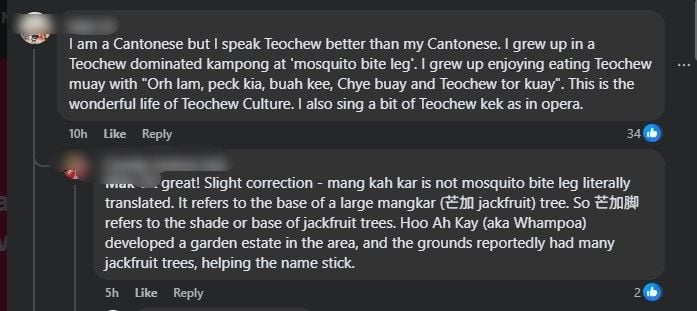
The issue has generated extensive public discussion, including on Tan’s Facebook page, where many commenters supported calls for a review of restrictions on Chinese dialects.
Several argued that the original objectives of the 1979 Speak Mandarin Campaign had largely been achieved.
Commenters noted that Mandarin is now firmly established among Chinese Singaporeans, while dialects have become increasingly endangered as younger generations grow up speaking mainly English and Mandarin.
Many viewed dialects as an important connection to family history, community identity and cultural memory.
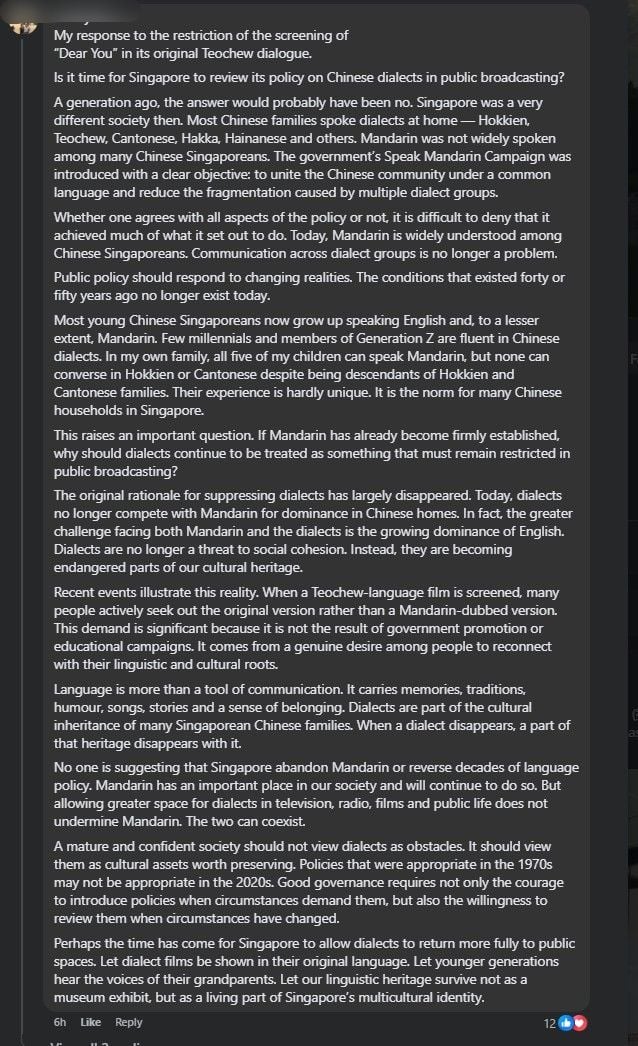
One commenter, identifying as Cantonese, said he grew up in a predominantly Teochew kampong and developed a deep appreciation for Teochew culture, food and opera.
He described those experiences as “the wonderful life of Teochew culture”.
Another commenter recalled learning fluent Hokkien through Rediffusion broadcasts and conversations with neighbours.
“It’s a pity for us to lose our mother tongues and heritage,” the commenter wrote.
Discussions also focused on whether audiences should be given greater freedom to choose between different versions of the film.
Some argued that dubbing Dear You into Mandarin would diminish the authenticity of the story.
One commenter said that “all its nuances and unique cultural flavours will be lost” through dubbing.
Supporters of additional Teochew screenings argued that subtitles could overcome language barriers while preserving the original dialogue.
Others maintained that Mandarin versions remained important for accessibility, particularly for viewers who may not understand Teochew or who find subtitles difficult to follow.
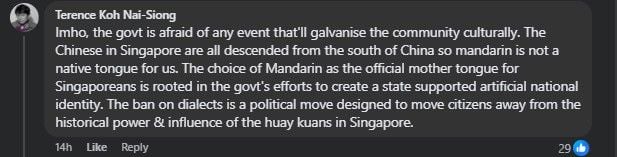
Singaporean writer and director Terence Koh also weighed in on the issue, arguing that restrictions on dialect use were historically linked to nation-building policies and efforts to reduce the influence of clan associations.
Demand for original-language screenings
Public interest in the original Teochew version has been particularly strong.
Film distributors Clover Films and Golden Village had sought approval for additional Teochew-language screenings.
According to the Straits Times, all 4,800 tickets allocated for eight special screenings sold out within an hour.
The rapid sell-out has been cited by supporters as evidence of growing public interest in dialect-language content.
Many commenters said the demand reflected a broader desire among Singaporeans to reconnect with their linguistic roots and preserve dialects as a living component of Singapore’s multicultural identity.
The wider discussion has also revived attention on the historical impact of language policies.
Restrictions on Chinese dialects were introduced as part of the Speak Mandarin Campaign launched in 1979.
The campaign sought to encourage Mandarin use among Chinese Singaporeans and reduce reliance on dialects.
According to official data, households using dialects as their main language declined from 76 per cent in 1980 to 8.7 per cent in 2020.
Although dialect use has diminished significantly, dialects have reappeared in selected public campaigns and transport announcements in recent years.
The Government reaffirmed its position in Parliament in January 2023.
Then-Minister for Communications and Information Josephine Teo said restrictions on dialect content in free-to-air radio and television remained necessary to support Mandarin as one of Singapore’s official languages.
At the same time, she acknowledged the role dialect programmes can play in communicating with elderly residents.
During the 2023 Budget Debate, Tan warned that Chinese dialects were approaching a “tipping point”.
He argued that many younger Singaporeans no longer understood their ancestral dialects and cautioned that “there may hardly be any Singaporeans below 50” who remain conversant in them within a few decades.
Tan urged stronger measures to preserve what he described as an important form of intangible heritage encompassing language, culture, customs and food traditions.